Skip to content
You can now search across every topic, entity and event.What's new
European Energy Markets
31JUL

454,000 displaced in Lebanon in six days

3 min read
09:44UTC

Lebanon is losing 75,000 people a day to displacement — 2.5 times the rate of the 2006 war — and nine in ten of its shelters are already full.

EconomicDeveloping
Key takeaway

Lebanon's shelter system collapsed not because the current displacement is uniquely large, but because the state entered this crisis with every buffer already consumed — economic collapse, pre-existing refugee loads, and a devalued currency had eliminated all contingency capacity before the first strike.

Lebanon's social affairs minister Haneen Sayed reported 454,000 people registered as displaced since Israeli strikes began on Monday 2 March — nearly five times Saturday morning's figure of 95,000. Of the 399 shelters opened nationwide, 357 are already full.

The rate — approximately 75,000 people per day — outpaces the 2006 Israel-Lebanon war by a factor of 2.5. That conflict displaced roughly one million over 34 days, approximately 29,000 per day. At the current pace, this war will match the 2006 total in under two weeks. Lebanon alone has already surpassed the UN Secretary-General's region-wide displacement figure of 330,000, published one day earlier .

The country absorbing these people is not the Lebanon of 2006. Between 2019 and 2023, Lebanon's GDP contracted by more than 60% — the World Bank classified it among the worst economic collapses recorded since the mid-nineteenth century. The banking system froze household deposits. The Beirut port explosion of August 2020 destroyed 300,000 homes. An estimated 1.5 million Syrian refugees remain in the country, straining housing, water, and medical infrastructure built for a pre-crisis population of 5.5 million. The shelters filling at 89% capacity in six days are absorbing people into a system that was already past its limits.

The toll so far: 294 killed and 1,023 wounded , driven in part by the Nabi Chit commando operation that killed 41 people and by continuing strikes across southern Lebanon and the Bekaa Valley. Lebanon's hospitals, many running on backup generators and haemorrhaging staff to emigration since 2020, face the prospect of treating a growing casualty count with a medical system that has been contracting for years. The displacement and the casualties are not separate crises — they are the same crisis, and the infrastructure meant to absorb both was failing before the first strike landed.


Deep Analysis

In plain English

Lebanon was already one of the poorest and most indebted countries in the world before this war, and was already housing more refugees per citizen than any other nation. When Israeli strikes began forcing people from their homes, the country had virtually no spare capacity in shelters, hospitals, or public finances to absorb the surge. The speed at which shelters filled — 357 of 399 in six days — reflects a system that had nothing in reserve, not one that was unprepared for the specific scale of this event.

Deep Analysis
Root Causes

Lebanon's 2019 financial collapse (GDP fell ~58% in real terms by 2021; the World Bank characterised it as one of the worst globally since the mid-19th century) destroyed the state's fiscal capacity for emergency response. The Lebanese pound's ~98% devaluation means dollar-denominated humanitarian supplies cost multiples of 2006 prices — the state cannot self-fund even basic shelter provisioning, making the entire response burden fall on international agencies from Day 1.

Escalation

At 75,000 displaced per day, Lebanon's total could exceed one million within approximately one week. UNHCR and OCHA typically escalate to a Level 3 emergency — the highest classification, triggering mandatory agency-wide resource mobilisation — at that threshold. The figures suggest this escalation is imminent rather than contingent.

What could happen next?
  • Risk

    Lebanon's shelter system will reach complete saturation within 48–72 hours at current displacement rates, forcing populations into informal settlements or secondary displacement into Syria — itself a failing state — or via sea.

    Immediate · Assessed
  • Consequence

    With no functioning Lebanese state fiscal capacity and Gulf donors under attack, international humanitarian agencies will carry the entire response burden without a sovereign counterpart to coordinate through — a structurally unprecedented arrangement for a conflict of this scale.

    Short term · Assessed
  • Risk

    Post-conflict reconstruction has no credible financing pathway: Gulf donors are engaged belligerents or under attack, IFI instruments require IMF programme conditionality Lebanon has not met since 2019, and EU macro-financial instruments are already committed elsewhere.

    Long term · Suggested
First Reported In

Update #28 · Iran and Israel swap refinery strikes

Times of Israel· 8 Mar 2026
Read original
Different Perspectives
Spain's LNG terminal operators
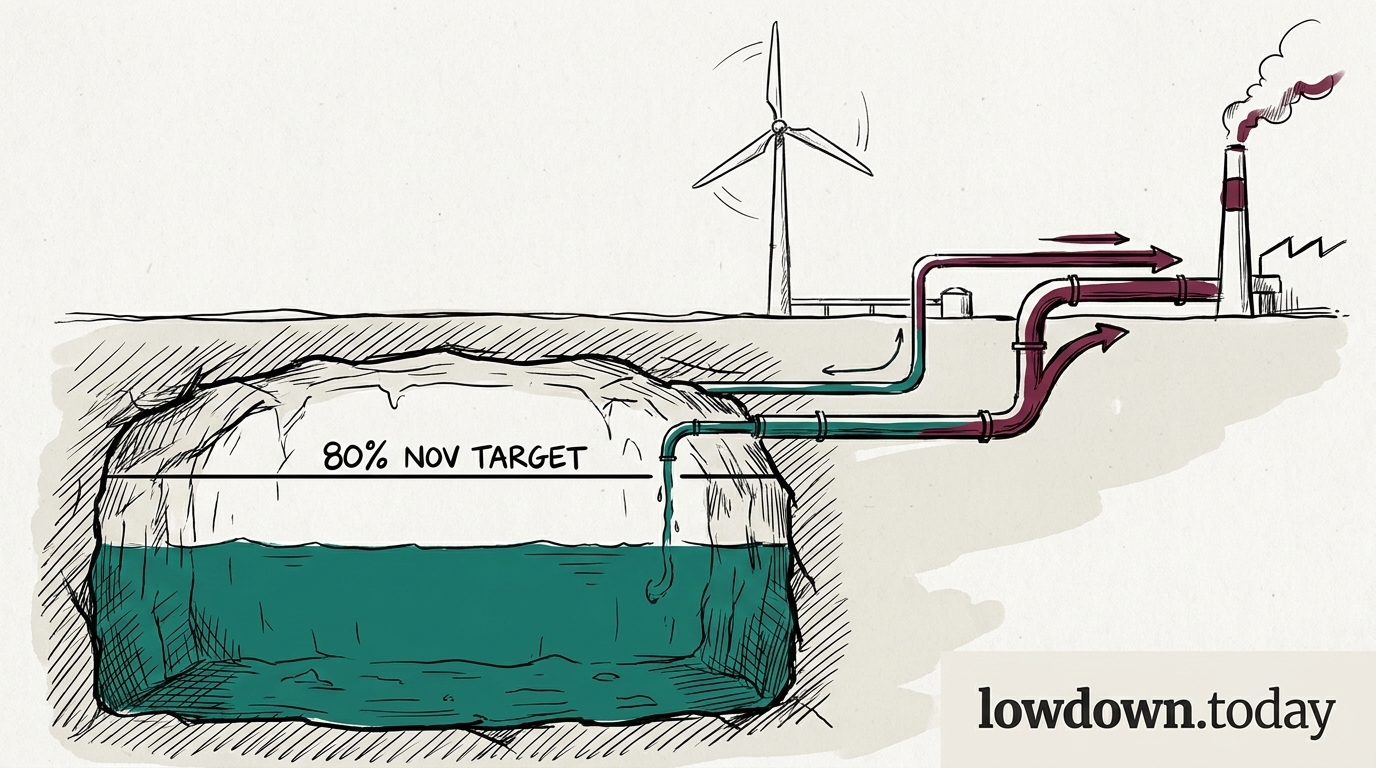
Spain's 9,145 GWh terminal inventory is the largest single stock in the EU LNG network, an option value that can reroute cargoes wherever the winter strip pays best rather than a cavern gas obligation tied to a fixed date. That flexibility matters more as Germany's cavern shortfall pushes more of the winter security question onto import infrastructure.
European Commission
European Commission
Brussels holds the bloc to 90% on a flexible window while Germany, holding roughly a quarter of EU storage capacity, tracks toward missing its own lower 80% figure by 21 points. A national shortfall this size in the anchor market matters more to bloc security than the flexible timetable alone can absorb.
French power exporters and CRE
French day-ahead rose in step with Germany but by less, reopening a EUR 7-17 premium that makes northward export flows commercially attractive again after the EUR 43.09 discount evaporated in days. CRE separately authorised RTE and Enedis to buy flexibility locally, betting the coming winter's binding constraint is grid congestion rather than a shortage of firm capacity.
TTF trading desk
TTF trading desk
A visible national shortfall like Germany's 21-point gap is a directional signal, not noise, for a desk holding the summer-winter spread. TTF's flat EUR 58-60 range through this week's German price swings says the market has not yet chosen to reprice refill risk into the front of the curve.
German cavern and CCGT operators
German caverns kept buying prompt gas at TTF near EUR 58-60 through the inversion; the wind collapse to 2.4 GW then flipped the spark spread to plus EUR 29 and put turbines back in the same queue. Every day turbines win that bid, injection at a third of the 877 GWh/day pace needed falls further behind.
Slovakia
Slovakia
Slovakia says it dropped its hold-out on the 21st sanctions package only after Ursula von der Leyen personally signed written gas-price and supply guarantees. The Council of the European Union's own 17,238-character release on the package names neither Slovakia nor any guarantee, leaving Bratislava's account unconfirmed by the institutional record.



