Skip to content
You can now search across every topic, entity and event.What's new
European Energy Markets
31JUL

Iran's deal-signer cannot be reached at speed

3 min read
09:44UTC

Trump's team says the framework was approved at the highest level of Iranian leadership. That level is a Supreme Leader unseen since March who answers only by courier.

EconomicAssessed
Key takeaway

Iran's command was rebuilt to fight without a single signer, which is exactly what a deal needs.

Trump's team said the MoU (memorandum of understanding) framework was "approved at the highest level of Iranian leadership". That level is Supreme Leader Mojtaba Khamenei, who has not appeared in public since 8 March and is reachable only by handwritten message in a sealed envelope, carried by courier with a three-to-five-day lag 1.

The day before, analysts assessed that the IRGC (Islamic Revolutionary Guard Corps), not Khamenei, holds day-to-day war authority, with no memorandum response recorded from the top . So the approval claim collides with the command structure. A framework cleared "at the highest level" inside the signing window Trump describes would have to pass a decision node that needs days to deliver a single letter, while the corps runs the kinetic war in the meantime.

Iran's wartime command was deliberately decentralised after the February decapitation, devolving launch authority to provincial units and leaving the state with no single ratifying voice the war machine was redesigned to do without. Either someone other than Mojtaba approved the text, or the word "approved" is doing lighter work than it implies. Until the IRGC itself comments, the claim cannot be verified at deal speed.


Deep Analysis

In plain English

Iran's supreme leader is a man named Mojtaba Khamenei, who has not been seen in public since early March 2026. He only receives messages by handwritten letter, and replies take three to five days to arrive. Trump's team said Khamenei approved the deal, but getting his actual signature within a few days is physically very difficult given that constraint. Iran's military force, the IRGC, has been running the war day-to-day and making its own decisions independently of the supreme leader. Think of it as a situation where the president has gone quiet and the army has taken over the daily running of the war. A deal needs the president's signature, but the army is not the president.

Deep Analysis
Root Causes

Mojtaba Khamenei's installation as supreme leader on 7 March 2026 came under IRGC pressure, with at least eight Assembly of Experts members boycotting the vote citing his lack of the marja theological credentials required under Article 109 of Iran's constitution. His authority is therefore contested at its constitutional source, making it structurally difficult for him to issue binding commands over a corps that effectively installed him.

The Decentralised Mosaic Defence doctrine, activated on 28 February 2026, deliberately distributed launch authority to provincial IRGC units to prevent command decapitation from halting operations. That architecture is operationally correct for surviving a US-Israeli strike campaign. It is functionally incompatible with a single ratifying authority confirming a negotiated text at the speed of a weekend signing window.

Escalation

The command-split dynamic introduced by Khamenei's inaccessibility and the IRGC's autonomous authority is the single most likely mechanism by which a genuine deal collapses without either side formally rejecting it. No escalation signal is present on 12 June specifically, but the structural gap remains unchanged.

What could happen next?
  • Risk

    If the IRGC publicly disowns the MoU framework, Trump's 'approved at the highest level' claim collapses, and any signed text becomes politically unenforceable on the Iranian side regardless of civilian signature.

    Immediate · Assessed
  • Consequence

    A weekend signing would require either a pre-cleared mandate from Khamenei communicated days before Trump's announcement, or a proxy signer whose authority the IRGC would need to publicly accept. Neither scenario has been publicly confirmed.

    Immediate · Assessed
  • Risk

    The constitutional illegitimacy of Khamenei's appointment means any deal he signs may face future repudiation by hardline IRGC factions that contested the succession, a structural fragility that outlasts the immediate signing window.

    Long term · Suggested
First Reported In

Update #125 · Trump halts strikes, touts deal Iran denies

CBS News· 12 Jun 2026
Read original
Different Perspectives
Spain's LNG terminal operators
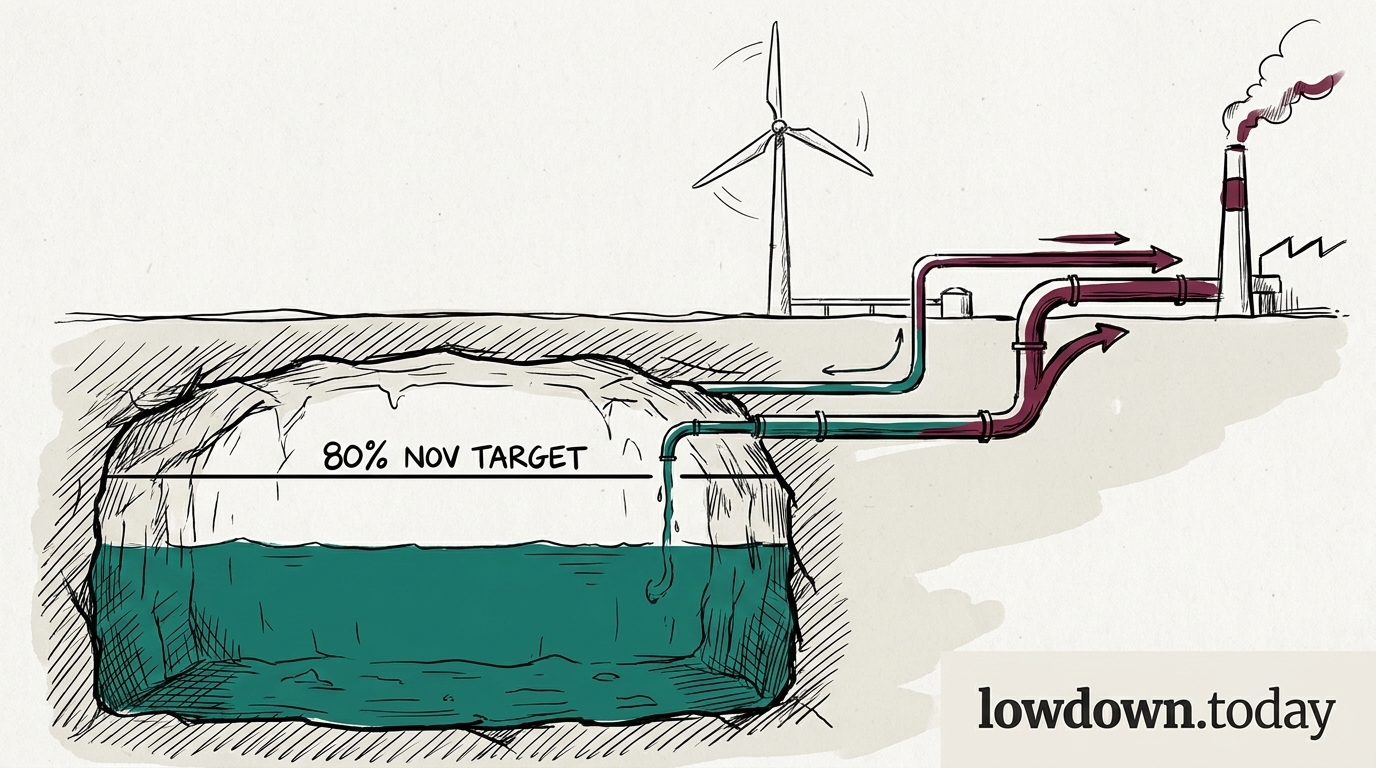
Spain's 9,145 GWh terminal inventory is the largest single stock in the EU LNG network, an option value that can reroute cargoes wherever the winter strip pays best rather than a cavern gas obligation tied to a fixed date. That flexibility matters more as Germany's cavern shortfall pushes more of the winter security question onto import infrastructure.
European Commission
European Commission
Brussels holds the bloc to 90% on a flexible window while Germany, holding roughly a quarter of EU storage capacity, tracks toward missing its own lower 80% figure by 21 points. A national shortfall this size in the anchor market matters more to bloc security than the flexible timetable alone can absorb.
French power exporters and CRE
French day-ahead rose in step with Germany but by less, reopening a EUR 7-17 premium that makes northward export flows commercially attractive again after the EUR 43.09 discount evaporated in days. CRE separately authorised RTE and Enedis to buy flexibility locally, betting the coming winter's binding constraint is grid congestion rather than a shortage of firm capacity.
TTF trading desk
TTF trading desk
A visible national shortfall like Germany's 21-point gap is a directional signal, not noise, for a desk holding the summer-winter spread. TTF's flat EUR 58-60 range through this week's German price swings says the market has not yet chosen to reprice refill risk into the front of the curve.
German cavern and CCGT operators
German caverns kept buying prompt gas at TTF near EUR 58-60 through the inversion; the wind collapse to 2.4 GW then flipped the spark spread to plus EUR 29 and put turbines back in the same queue. Every day turbines win that bid, injection at a third of the 877 GWh/day pace needed falls further behind.
Slovakia
Slovakia
Slovakia says it dropped its hold-out on the 21st sanctions package only after Ursula von der Leyen personally signed written gas-price and supply guarantees. The Council of the European Union's own 17,238-character release on the package names neither Slovakia nor any guarantee, leaving Bratislava's account unconfirmed by the institutional record.



