Skip to content
You can now search across every topic, entity and event.What's new
European Energy Markets
31JUL

IDF destroys Litani bridge; a first

3 min read
09:44UTC

The first acknowledged Israeli strike on Lebanese civilian infrastructure cuts a key river crossing, isolating the south ahead of the planned ground offensive.

EconomicDeveloping
Key takeaway

The Zrarieh strike activates the Dahiya doctrine's infrastructure-coercion phase for the first time in this conflict.

The IDF destroyed the Zrarieh Bridge over the Litani River on Friday — the first acknowledged Israeli strike on Lebanese civilian infrastructure in this conflict 1. Defence Minister Israel Katz framed the destruction as policy: Israel would impose "increasing costs through damage to infrastructure and loss of territory" 2.

The tactical purpose requires no interpretation. A ground force planning to seize everything south of the Litani needs to control movement across it. Destroying the bridge severs a supply and evacuation route, isolating the southern theatre before troops advance. Israel destroyed every major crossing over the Litani during the 2006 war for the same reason — but those strikes came after the ground invasion began. This one comes before, as preparation.

Until Friday, Israel's Lebanon campaign had struck what it described as Hezbollah military infrastructure: weapons depots, command centres, launch sites. The Zrarieh Bridge is a civilian road crossing. Katz's language — "loss of territory" — frames the destruction not as collateral damage but as a cost imposed on the Lebanese state, consistent with his earlier warning that Israel would take Lebanese territory if the government could not prevent Hezbollah attacks . For the 830,000 people displaced within Lebanon and the nearly 100,000 who have crossed into Syria, each destroyed crossing compresses the remaining evacuation corridors.


Deep Analysis

In plain English

The Litani River is a natural east-west barrier across southern Lebanon. Destroying the bridge serves two immediate purposes: cutting Hezbollah's ability to move fighters and equipment across the river, and creating a physical boundary that matches Israel's intended buffer zone. More significantly, this is the first time Israel has acknowledged targeting Lebanese civilian infrastructure in this conflict — a deliberate signal, backed by an explicit ministerial warning of more to come. The Dahiya doctrine, developed by the IDF after 2006, envisages destroying civilian infrastructure to raise costs on the Lebanese state for tolerating Hezbollah. That doctrine is now operationally active.

Deep Analysis
Synthesis

The strike is addressed to the Lebanese state, not to Hezbollah. Hezbollah operates multiple crossing points and maintains pre-positioned supplies. The Zrarieh Bridge's primary users are civilians and the Lebanese Army — precisely the entities Israel is signalling it holds responsible. Katz's language about 'loss of territory' is an ultimatum to Beirut: it demands action from a government that structurally cannot deliver it.

Escalation

Katz's explicit warning of 'increasing costs through damage to infrastructure' follows the Dahiya doctrine's graduated escalation logic. Based on 2006 precedent and doctrine, the next likely targets are power generation infrastructure and the road network linking Sidon to Tyre. The body notes Katz's warning but does not identify the probable sequence.

What could happen next?
  • Precedent

    The first acknowledged civilian infrastructure strike establishes a permissive precedent — each subsequent strike requires less political justification than the first.

    Immediate · Assessed
  • Consequence

    Civilian evacuation from villages south of the Litani is now physically more difficult, compounding the displacement crisis already at 830,000 people.

    Immediate · Assessed
  • Risk

    If power infrastructure follows bridges as the next Dahiya target, Lebanon's already-degraded electrical grid — running two to four hours daily in most areas — could fail entirely, with cascading effects on hospitals and water pumps.

    Short term · Suggested
  • Meaning

    Israel's acknowledgement that this is a civilian infrastructure strike — unlike earlier strikes framed as targeting Hezbollah positions — shifts the legal and political framing of the Lebanon operation internationally.

    Immediate · Assessed
First Reported In

Update #36 · Israel plans full Litani seizure

Axios· 15 Mar 2026
Read original
Causes and effects
This Event
IDF destroys Litani bridge; a first
The bridge destruction shifts Israel's Lebanon campaign from targeting Hezbollah military assets to destroying civilian infrastructure, physically isolating the southern theatre before a ground advance. Defence Minister Katz framed it as deliberate policy — territorial loss imposed as punishment on the Lebanese state.
Different Perspectives
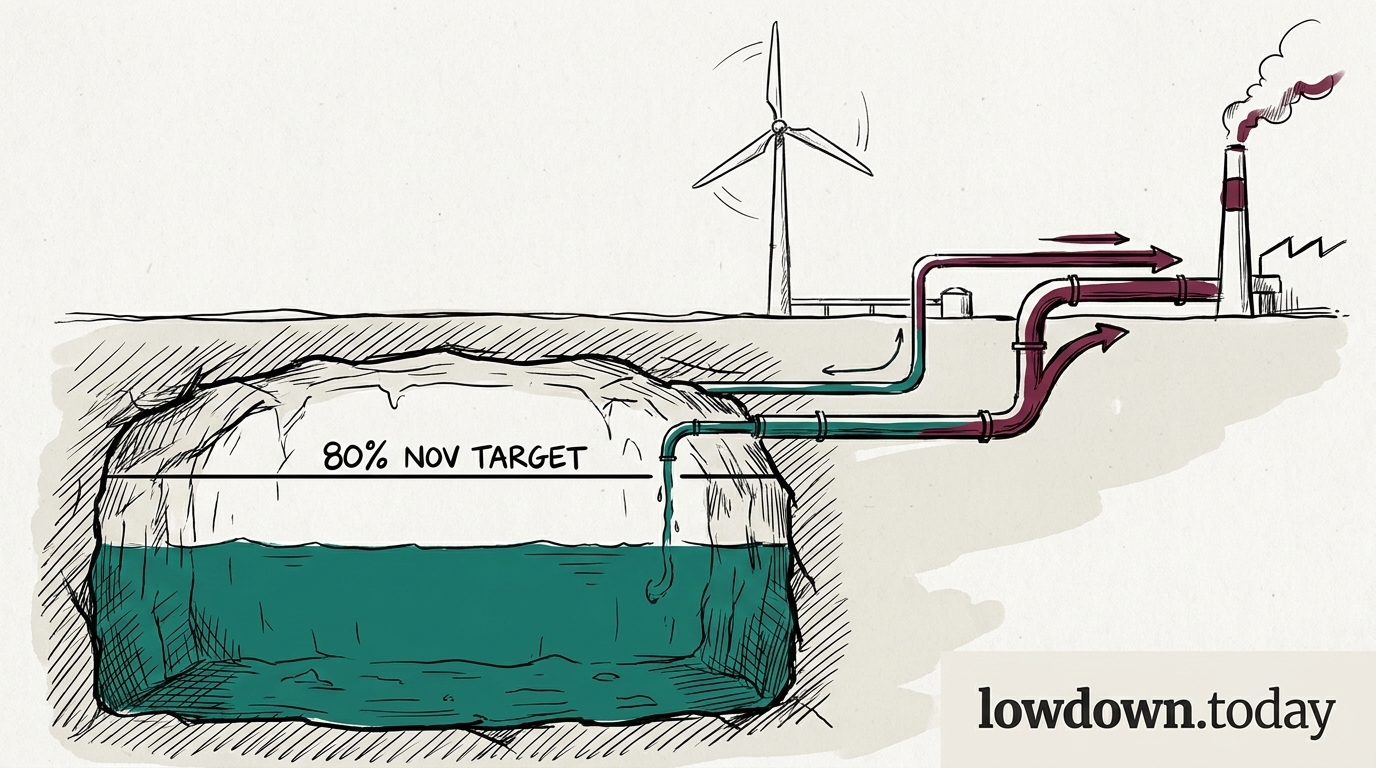
Spain's LNG terminal operators
Spain's 9,145 GWh terminal inventory is the largest single stock in the EU LNG network, an option value that can reroute cargoes wherever the winter strip pays best rather than a cavern gas obligation tied to a fixed date. That flexibility matters more as Germany's cavern shortfall pushes more of the winter security question onto import infrastructure.
European Commission
European Commission
Brussels holds the bloc to 90% on a flexible window while Germany, holding roughly a quarter of EU storage capacity, tracks toward missing its own lower 80% figure by 21 points. A national shortfall this size in the anchor market matters more to bloc security than the flexible timetable alone can absorb.
French power exporters and CRE
French day-ahead rose in step with Germany but by less, reopening a EUR 7-17 premium that makes northward export flows commercially attractive again after the EUR 43.09 discount evaporated in days. CRE separately authorised RTE and Enedis to buy flexibility locally, betting the coming winter's binding constraint is grid congestion rather than a shortage of firm capacity.
TTF trading desk
TTF trading desk
A visible national shortfall like Germany's 21-point gap is a directional signal, not noise, for a desk holding the summer-winter spread. TTF's flat EUR 58-60 range through this week's German price swings says the market has not yet chosen to reprice refill risk into the front of the curve.
German cavern and CCGT operators
German caverns kept buying prompt gas at TTF near EUR 58-60 through the inversion; the wind collapse to 2.4 GW then flipped the spark spread to plus EUR 29 and put turbines back in the same queue. Every day turbines win that bid, injection at a third of the 877 GWh/day pace needed falls further behind.
Slovakia
Slovakia
Slovakia says it dropped its hold-out on the 21st sanctions package only after Ursula von der Leyen personally signed written gas-price and supply guarantees. The Council of the European Union's own 17,238-character release on the package names neither Slovakia nor any guarantee, leaving Bratislava's account unconfirmed by the institutional record.



