Skip to content
You can now search across every topic, entity and event.What's new
European Energy Markets
31JUL

House votes 215-208 to curb Iran war

3 min read
09:44UTC

The House passed a war-powers resolution 215-208 on Wednesday 3 June, the first time either chamber carried such a measure since the war began, after four Republicans crossed the floor.

EconomicDeveloping
Key takeaway

A full chamber voted to curb the Iran war for the first time; it cannot force Trump.

The House of Representatives passed a war-powers resolution 215-208 on Wednesday 3 June, directing Donald Trump to wind down US involvement in hostilities with Iran absent a declaration of war or an authorisation for the use of military force 1. The War Powers Resolution is a 1973 law meant to stop presidents fighting undeclared wars indefinitely.

The House had voted on Iran war powers before; on 3 June the count changed. The same chamber had deadlocked 212-212 on 14 May , and the resolution's 30-day wind-down clock had lapsed unvoted a third time on Day 93 . On 3 June the tied, dead measure became a carried one, supplied by four Republicans who crossed the floor: Thomas Massie, Brian Fitzpatrick, Tom Barrett and Warren Davidson. 'You either follow the law or you change the law. You can't violate the law,' Fitzpatrick said 2.

The resolution is non-binding and cannot compel Trump to stop, and The White House had issued no veto threat by 4 June. The resolution carries precedential weight rather than physical force. For 96 days the executive has run this war without a single signed instrument, and the vote converts the war-powers question from a lapsing-clock procedural gap into an affirmative on-record chamber position the executive must now argue against in any later court challenge or appropriations fight over funding the deployment.


Deep Analysis

In plain English

The War Powers Resolution is a 1973 US law that says if an American president sends troops into combat without Congress declaring war, Congress can vote to order a withdrawal within 60 days. The Iran conflict has been running since 28 February 2026 without Congress ever formally authorising it or voting on it. Various attempts had either failed or the clock had run out without a vote. On 3 June 2026, the House of Representatives voted 215 to 208 to instruct President Trump to wind down US involvement in the conflict unless Congress formally declares war or passes an authorisation. Four Republicans crossed party lines to give the measure its margin. The vote does not legally compel Trump to do anything: it is a non-binding directive. But it is the first time a chamber of Congress has on record said the war should end, and that record matters if courts or future budget fights ever revisit the question.

What could happen next?
  • Precedent

    The 215-208 passage converts a lapsing-clock procedural gap into an affirmative on-record chamber position that courts and future appropriations fights can reference, qualitatively changing the legal terrain.

  • Risk

    Without a Senate companion vote and matching text, the House resolution cannot become the bicameral instrument needed to legally compel compliance, leaving the executive with a political liability but no legal constraint.

First Reported In

Update #117 · Iran's drone finds Kuwait's arrivals hall

CBS News· 4 Jun 2026
Read original
Different Perspectives
Spain's LNG terminal operators
Spain's 9,145 GWh terminal inventory is the largest single stock in the EU LNG network, an option value that can reroute cargoes wherever the winter strip pays best rather than a cavern gas obligation tied to a fixed date. That flexibility matters more as Germany's cavern shortfall pushes more of the winter security question onto import infrastructure.
European Commission
European Commission
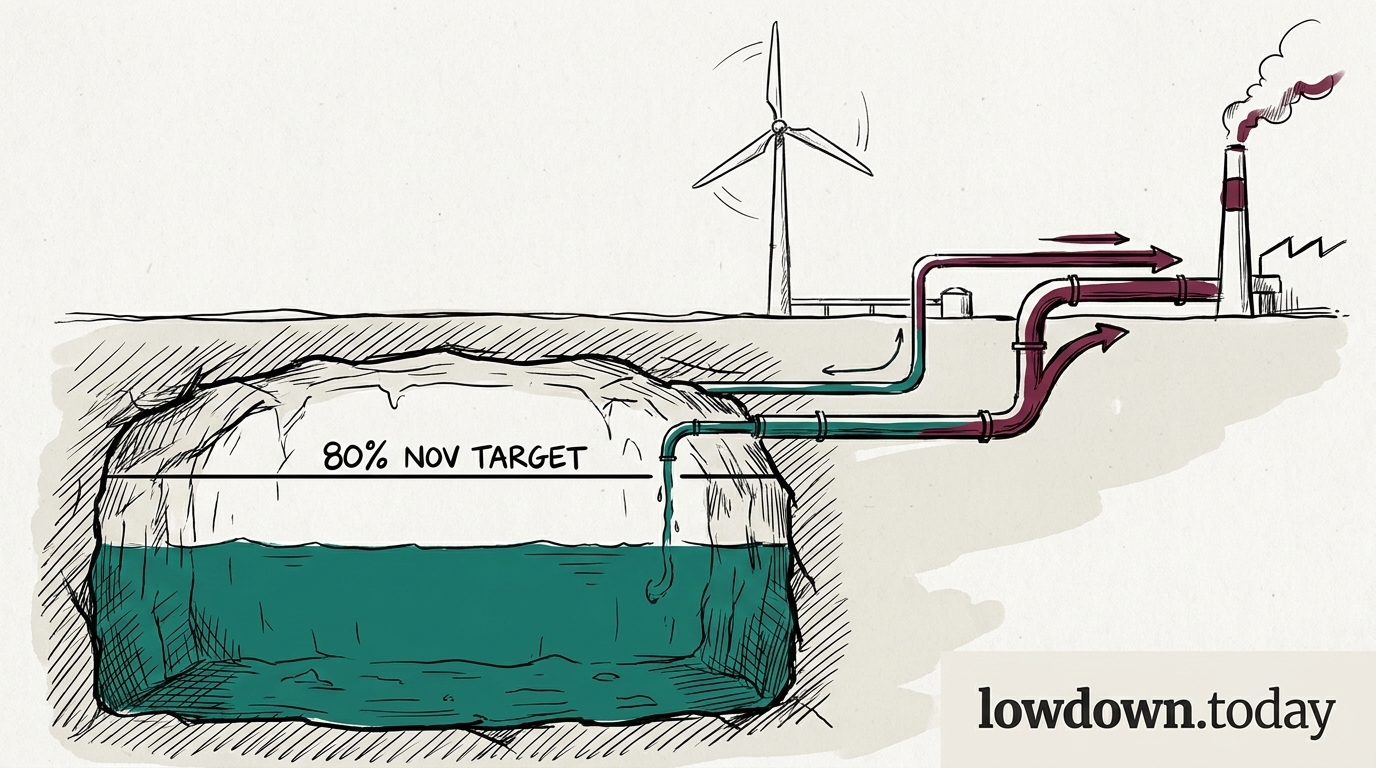
Brussels holds the bloc to 90% on a flexible window while Germany, holding roughly a quarter of EU storage capacity, tracks toward missing its own lower 80% figure by 21 points. A national shortfall this size in the anchor market matters more to bloc security than the flexible timetable alone can absorb.
French power exporters and CRE
French day-ahead rose in step with Germany but by less, reopening a EUR 7-17 premium that makes northward export flows commercially attractive again after the EUR 43.09 discount evaporated in days. CRE separately authorised RTE and Enedis to buy flexibility locally, betting the coming winter's binding constraint is grid congestion rather than a shortage of firm capacity.
TTF trading desk
TTF trading desk
A visible national shortfall like Germany's 21-point gap is a directional signal, not noise, for a desk holding the summer-winter spread. TTF's flat EUR 58-60 range through this week's German price swings says the market has not yet chosen to reprice refill risk into the front of the curve.
German cavern and CCGT operators
German caverns kept buying prompt gas at TTF near EUR 58-60 through the inversion; the wind collapse to 2.4 GW then flipped the spark spread to plus EUR 29 and put turbines back in the same queue. Every day turbines win that bid, injection at a third of the 877 GWh/day pace needed falls further behind.
Slovakia
Slovakia
Slovakia says it dropped its hold-out on the 21st sanctions package only after Ursula von der Leyen personally signed written gas-price and supply guarantees. The Council of the European Union's own 17,238-character release on the package names neither Slovakia nor any guarantee, leaving Bratislava's account unconfirmed by the institutional record.



