Skip to content
Briefings are running a touch slower this week while we rebuild the foundations.See roadmap
Iran Conflict 2026
15MAY

House ties 212-212 on third Iran vote

3 min read
13:51UTC

Three House Republicans crossed and one Maine Democrat held against his own caucus; the 212-212 tie is the closest margin the lower chamber has produced on Iran and still fails on the rules.

ConflictDeveloping
Key takeaway

The House has now failed three Iran war powers votes at single-digit margins; the third was the closest yet.

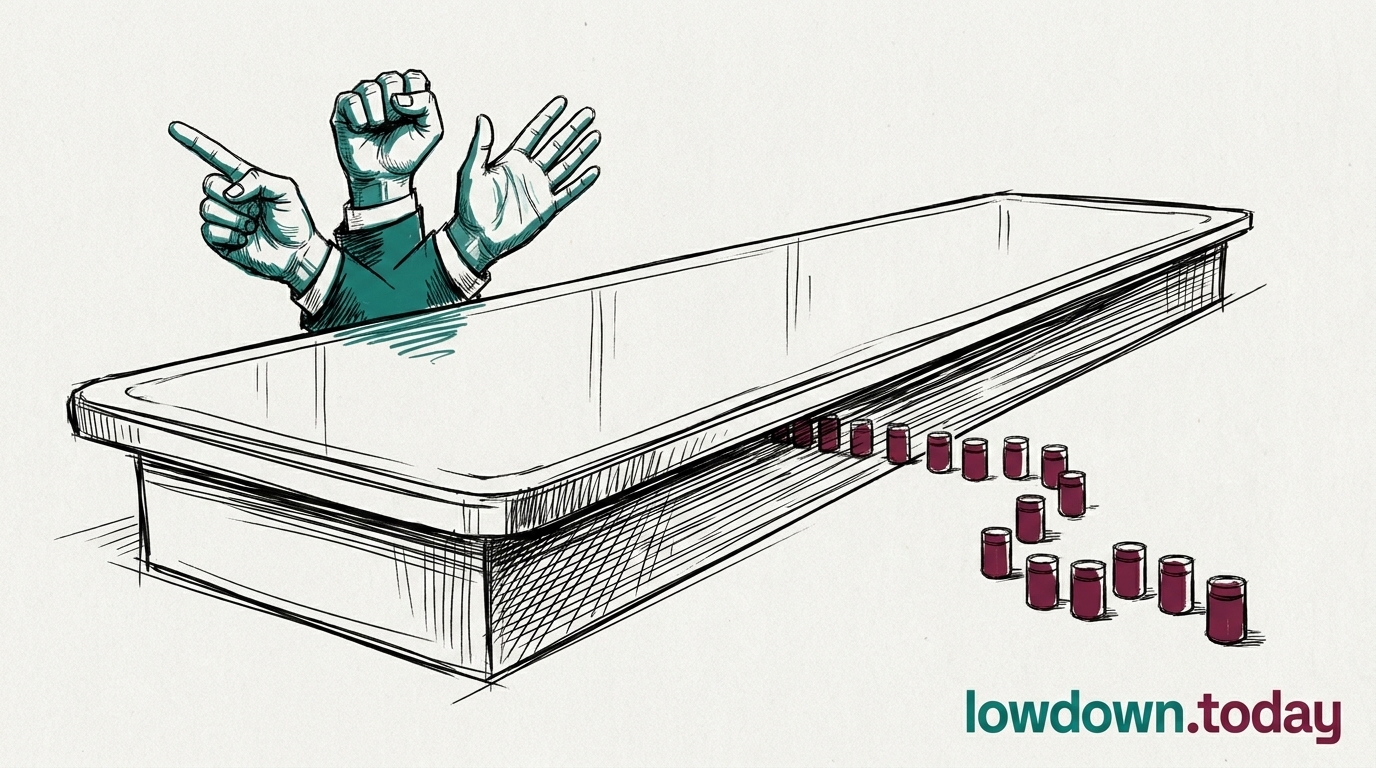
The House of Representatives voted 212-212 on Thursday 14 May on the parallel Iran War Powers Resolution 1. A tie fails under House rules. Three Republicans crossed: Thomas Massie of Kentucky, Brian Fitzpatrick of Pennsylvania, and Tom Barrett of Michigan. One Democrat held against his own caucus: Jared Golden of Maine. The result is the closest margin the Lower Chamber has produced on Iran across three attempts; the prior pair of votes had been 219-212 and an earlier defeat in the same pattern.

The Senate had voted 50-49 on the seventh War Powers Resolution one day earlier on Wednesday 13 May , with Alaska's Lisa Murkowski crossing for the first time among Republicans; the House tie came less than 24 hours later. Thursday's vote sits one day after the War Powers Act 60-day window formally lapsed, removing privileged floor consideration from any future resolution. With the clock run out, any future War Powers Resolution loses automatic floor privilege and is subject to leadership scheduling.

Three Republican defectors and one Democratic holdout is the same arithmetic that produced the prior tied vote, repeated this week by three different Republicans and a different Democrat. Each weekly attempt has found enough crossers to close the gap without producing the additional vote that breaks it. Massie, Fitzpatrick, and Barrett are the same fragile coalition shape Speaker Johnson's whip operation has held against across three House attempts.

Deep Analysis

In plain English

The US House of Representatives has 435 members. On 14 May, exactly half voted for a measure to force the president to seek congressional approval for the Iran war, and exactly half voted against it. Under House rules, a tie counts as a defeat for the measure that was proposed. Three Republicans voted against their own party leadership. One Democrat voted against his. Those defections cancelled each other out perfectly. This was the third time the House has produced this same tied result. Each time, the vote gets closer to passing. But because the 60-day legal deadline also passed the day before this vote, the House leadership now controls whether any future vote even gets to the floor.

Deep Analysis
Root Causes

House War Powers procedure under the original 1973 legislation granted privilege to resolutions filed within the 60-day clock. With the clock expired on 13 May, the Speaker now controls whether any Iran resolution reaches the floor.

The three consecutive 212-212 outcomes reflect not a genuine whip failure but a deliberate margin management by leadership: enough members are allowed to vote their conscience to signal responsiveness to constituents, while the final outcome is managed to fall one Democratic holdout short of passage.

Golden's continued defection is electorally rational for Maine's second congressional district, a Trump-won seat where opposition to executive war powers reads as soft on defence rather than constitutionalist. His defection has been consistent across all three House votes, suggesting it reflects a durable strategic position rather than pressure from Democratic leadership.

What could happen next?
  • Consequence

    With the WPA clock expired and the Speaker controlling floor scheduling, the three-Republican crossover coalition has no automatic vehicle for forcing a fourth vote; it requires either a discharge petition (218 signatures) or leadership consent.

    Immediate · 0.85
  • Risk

    The repeated 212-212 pattern normalises congressional impotence on war powers oversight; future administrations will cite 2026 House vote cycles as precedent for treating WPA resolutions as advisory.

    Long term · 0.68
  • Opportunity

    The three-Republican crossover bloc (Massie, Fitzpatrick, Barrett) has distinct electoral profiles, meaning each represents a different congressional constituency that could be mobilised for a discharge petition to force a floor vote without leadership consent.

    Medium term · 0.45
First Reported In

Update #98 · Three pledges, no paper, twelve sanctions

The Hill· 15 May 2026
Read original
Different Perspectives
India (BRICS chair / S. Jaishankar)
India's BRICS chair draft communique frames the Iran conflict as a matter of 'safe, unimpeded maritime flows', a formula explicitly neutral on Iran's 'no obstacles' claim and short of endorsing IRGC maritime doctrine. Delhi has maintained separate tracks: a demarche on Iranian tanker firings at Indian-crewed vessels, silence on OFAC designations naming Indian firms.
International Energy Agency
The IEA's May 2026 Oil Market Report quantified the closure at 14.4 million barrels per day shut in, more than one billion barrels of cumulative supply loss, and a 246-million-barrel inventory draw in eight weeks, five times the monthly rate of the 2022 SPR release. The IEA projects a deficit through Q4 2026 even if Hormuz reopens in June.
Pakistan (mediating channel)
Pakistan's intermediary channel between Washington and Tehran remains active despite Trump's 'totally unacceptable' rebuff of Iran's 10-point MOU reply on 11 May. Islamabad carries the only direct US-Iran track and the only channel with both civilian and military buy-in on the Iranian side, but has not convened a second Islamabad round.
Mojtaba Khamenei / IRIB
Iran's state broadcaster reported on 14 May that the Supreme Leader has issued 'new and decisive directives' for military operations, the first such signal since the war began. Mojtaba has not appeared publicly since 28 February; the directives are paper instruments, not verbal statements.
Chinese Ministry of Foreign Affairs
Beijing's official summit readout mentioned 'the Middle East situation' alongside the Ukraine crisis and the Korean Peninsula, without naming Iran or specifying any Iranian commitment. Chinese state media has not published the three red lines Trump described.
White House / Trump administration
Trump told Fox News from Beijing that Xi had committed to three Iran red lines: no nuclear weapon, an open Hormuz, no military equipment supplied to Tehran. He described the summit as 'a big statement'. The White House issued its own readout confirming those commitments; the Chinese Ministry of Foreign Affairs readout did not.