Skip to content
You can now search across every topic, entity and event.What's new
European Energy Markets
31JUL

German gas plants priced out of merit

3 min read
09:44UTC

German day-ahead cleared EUR 103.16/MWh on Monday against a CCGT marginal cost of EUR 118 to EUR 124, inverting the clean spark spread and pushing the fleet off-merit into the worst July injection pace in six years.

EconomicAssessed
Key takeaway

German CCGTs now lose up to EUR 21 per MWh, freeing gas for caverns filling 17% slower.

German day-ahead power cleared an average of EUR 103.16/MWh on Monday 20 July, inside a range running from EUR 0.00 to EUR 194.77 1. Solar and wind oversupply held the 03:00 to 06:00 block at zero for four hours; the evening peak carried the top of the range.

Put the three verified inputs together. Monday's TTF settlement, burned through a modern combined-cycle gas turbine at 55 to 58% efficiency, costs EUR 102 to EUR 108 per MWh of electricity. EUA carbon at EUR 80.00 2, at roughly 0.2 tonnes per MWh, adds another EUR 16. Marginal cost therefore lands between EUR 118 and EUR 124 against EUR 103.16 of revenue, putting the clean spark spread between minus EUR 15 and minus EUR 21. Four sessions earlier it was positive, on German day-ahead at EUR 156 and carbon at EUR 80.14 .

Only part of that swing belongs to Hormuz, and the decomposition deserves stating rather than glossing. The fuel leg carries the conflict premium and nothing else: gas has risen since 15 July, worth EUR 7 to EUR 8 of extra generation cost, while carbon has not moved at all. The power leg did the rest, falling more than EUR 50 from Thursday's print, and a Monday in late July carrying four hours of zero-priced solar has an ordinary seasonal component behind it that no conflict explains. Call the split roughly 13% conflict, 87% weather and calendar. Anyone selling this as a pure Hormuz effect is selling about EUR 8 of it and hoping nobody checks the other EUR 50.

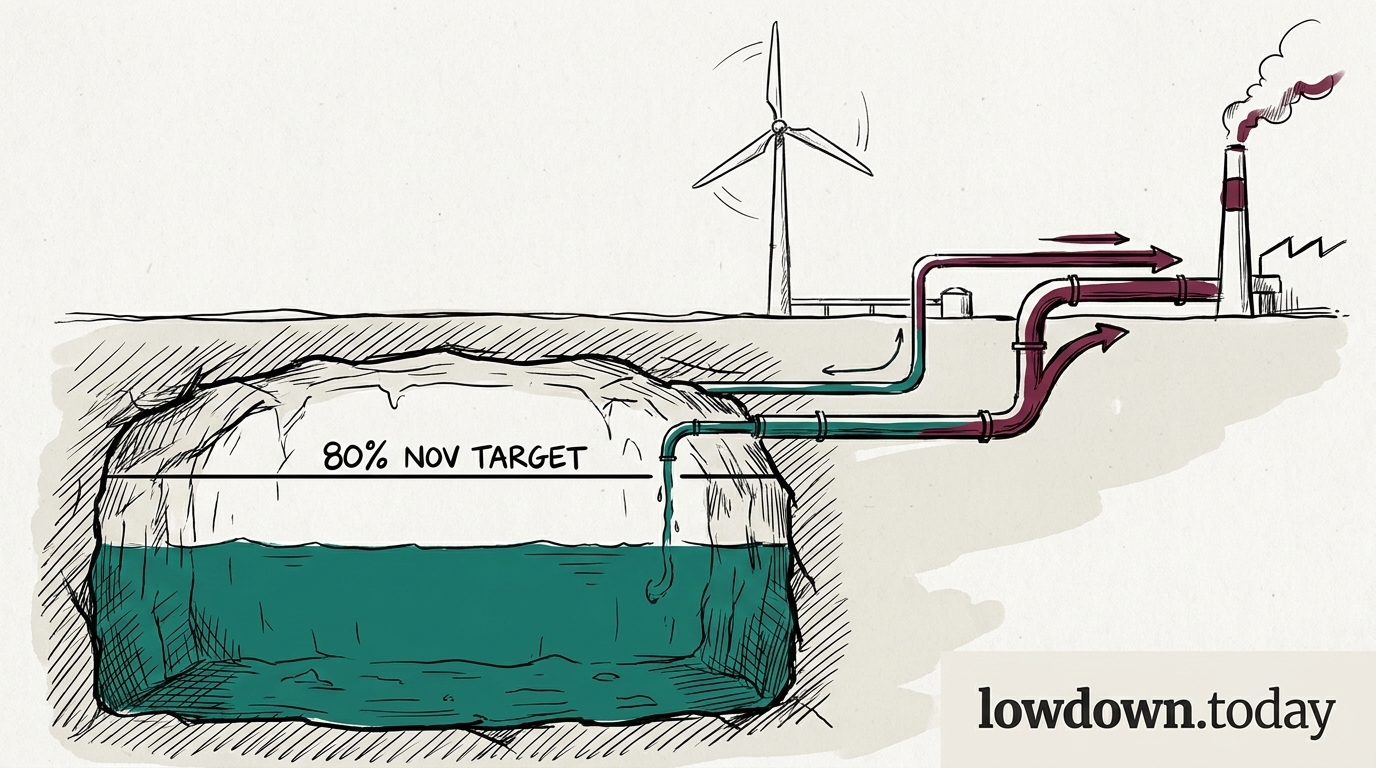
Either way the fleet stays off-merit, and the storage consequence does not change. Gas that would have gone into German turbines now has somewhere else to go, and the caverns need it: net EU injections since 1 July are running 17% below last year, the slowest July fill pace in six years against the 5 July baseline 3. The bloc still reached 52.49% on 15 July on data from GIE, the Gas Infrastructure Europe body that runs the AGSI+ transparency platform 4, so the level keeps climbing while the pace falls behind. Whether a spread this negative converts into a faster injection rate over the coming week is the practical test of whether demand destruction buys anything for the November floor.


Deep Analysis

In plain English

A "clean spark spread" is the profit a gas-fired power plant makes from selling electricity after paying for its gas and its carbon permits. When that number goes negative, as it did in Germany on 20 July, running the plant loses money. Two things happened at once: a burst of solar power pushed midday electricity prices to zero for four hours, and gas costs stayed high because of the Hormuz standoff in the Gulf. Plant operators are stuck between cheap power they cannot profit from and expensive fuel they still have to buy, which is why the country's gas fleet went "off-merit", meaning it is too costly to run right now.

Deep Analysis
Root Causes

A four-hour window of zero-priced solar generation removes the hours in which CCGT plants can recover their marginal cost, and German gas units face real start-up costs that make cycling off and back on within a single day expensive, so operators are stuck holding capacity that clears below cost rather than shutting down for a few hours.

The fuel side compounds the squeeze but is not the main driver: marginal cost of EUR 118 to EUR 124/MWh sits well above the EUR 103.16 day-ahead print, and only roughly EUR 7 to EUR 8/MWh of that gap traces to the Hormuz-linked gas premium. The remainder, more than EUR 50/MWh, is the power leg falling from Thursday's heat print into a Monday session with weak demand and heavy solar output.

What could happen next?
  • Consequence

    CCGT operators facing repeated negative spark spreads have a stronger incentive to bid into StromVKG's capacity auctions for guaranteed standby revenue rather than rely on wholesale margins alone.

  • Risk

    If the fuel-cost leg reverses once Hormuz risk eases while the solar-driven power leg persists through summer, the spread could stay negative even after gas prices fall, exposing operators who assumed today's loss was fuel-driven and temporary.

First Reported In

Update #28 · Hormuz premium inverts the German spark spread

SMARD / Bundesnetzagentur via energy-charts.info· 20 Jul 2026
Read original
Different Perspectives
Spain's LNG terminal operators
Spain's 9,145 GWh terminal inventory is the largest single stock in the EU LNG network, an option value that can reroute cargoes wherever the winter strip pays best rather than a cavern gas obligation tied to a fixed date. That flexibility matters more as Germany's cavern shortfall pushes more of the winter security question onto import infrastructure.
European Commission
European Commission
Brussels holds the bloc to 90% on a flexible window while Germany, holding roughly a quarter of EU storage capacity, tracks toward missing its own lower 80% figure by 21 points. A national shortfall this size in the anchor market matters more to bloc security than the flexible timetable alone can absorb.
French power exporters and CRE
French day-ahead rose in step with Germany but by less, reopening a EUR 7-17 premium that makes northward export flows commercially attractive again after the EUR 43.09 discount evaporated in days. CRE separately authorised RTE and Enedis to buy flexibility locally, betting the coming winter's binding constraint is grid congestion rather than a shortage of firm capacity.
TTF trading desk
TTF trading desk
A visible national shortfall like Germany's 21-point gap is a directional signal, not noise, for a desk holding the summer-winter spread. TTF's flat EUR 58-60 range through this week's German price swings says the market has not yet chosen to reprice refill risk into the front of the curve.
German cavern and CCGT operators
German caverns kept buying prompt gas at TTF near EUR 58-60 through the inversion; the wind collapse to 2.4 GW then flipped the spark spread to plus EUR 29 and put turbines back in the same queue. Every day turbines win that bid, injection at a third of the 877 GWh/day pace needed falls further behind.
Slovakia
Slovakia
Slovakia says it dropped its hold-out on the 21st sanctions package only after Ursula von der Leyen personally signed written gas-price and supply guarantees. The Council of the European Union's own 17,238-character release on the package names neither Slovakia nor any guarantee, leaving Bratislava's account unconfirmed by the institutional record.



