Skip to content
You can now search across every topic, entity and event.What's new
European Energy Markets
31JUL

US destroys Iran's satellite targeting

3 min read
09:44UTC

CENTCOM struck Iran's space command — the battlefield intelligence infrastructure that guided what remained of its ballistic missile capability. What follows may be less effective but harder to predict.

EconomicDeveloping
Key takeaway

Destroying Iran's space command severs central targeting coordination, but Mosaic Defence was explicitly designed to operate without central ISR — the strike degrades rather than eliminates Iran's residual launch capability.

CENTCOM confirmed on Friday that US forces struck Iran's space command — the infrastructure responsible for satellite-based targeting data and battlefield intelligence that guided Iranian Ballistic missile operations. The strikes eliminate the overhead surveillance capability that allowed Iranian launch crews to direct missiles at specific military installations across The Gulf.

Iran's Ballistic missile fire had already fallen 90% from Day 1 levels , a decline Admiral Brad Cooper attributed to strikes on launch infrastructure and buried missile storage. The space command strikes remove a different layer: not the missiles themselves, but the eyes that directed them. The IRGC activated its Decentralised Mosaic Defence doctrine earlier this week , devolving launch authority to 31 autonomous provincial units after decapitation strikes killed senior commanders on 28 February. Those units now operate without centralised command and without satellite targeting data — a double degradation that leaves each remaining launch less precise and less coordinated.

The military logic is straightforward: blind the adversary's residual strike capability. The second-order consequence is less comfortable. Iranian missiles aimed with satellite guidance struck identifiable military targets — the Fifth Fleet headquarters in Manama , Al Udeid Air Base in Qatar , the BAPCO refinery at Sitra . Missiles fired without that guidance, by autonomous provincial commanders operating under doctrine that authorises strikes without central approval, are more likely to miss intended targets. In the dense civilian geography of The Gulf — where Bahraini residential buildings, Dubai's Burj Al Arab , and Kuwaiti neighbourhoods where an eleven-year-old girl died from shrapnel have already absorbed impacts — reduced Iranian precision does not translate directly into reduced risk. It redistributes it.


Deep Analysis

In plain English

Iran uses satellites to help aim its missiles at specific targets, feeding real-time intelligence to launch crews. By destroying the ground facilities that operate those satellites, the US has broken that targeting link. Iran's missiles still exist, but now operate more like unguided rockets: capable of launching in a general direction, but unable to dynamically retarget specific ships, refineries, or military bases. The catch is that Iran specifically built its military to keep fighting even when central command is disrupted — the 'Mosaic Defence' system of independent provincial units was designed precisely for this scenario.

Deep Analysis
Synthesis

This is the first confirmed kinetic strike on adversary space ground infrastructure in a US regional campaign — not jamming, spoofing, or ASAT missile use, but physical destruction of the ground segment. This operationalises a counter-space doctrine developed theoretically for peer conflict and applies it against a regional power, establishing a normative precedent that adversary satellite ground stations are legitimate military targets in conventional warfare. China and Russia will read this as permission for symmetric action against US space ground infrastructure in any future conflict.

Escalation

The critical unanswered question the body does not address: whether Mosaic Defence provincial cells hold pre-programmed coordinates for high-value Gulf targets. If so, the space command strike eliminates dynamic targeting but does not prevent pre-planned strikes against fixed targets such as the Fifth Fleet's Bahrain pier, Saudi Aramco terminals, or UAE desalination infrastructure.

What could happen next?
  • Precedent

    First confirmed kinetic counter-space ground-segment strike in a US regional campaign establishes operational doctrine applicable to future peer and near-peer conflicts.

    Long term · Assessed
  • Consequence

    Iranian Mosaic Defence cells will likely attempt to compensate via commercial satellite imagery providers or pre-programmed GPS coordinates, partially restoring fixed-target capability with longer intelligence cycle times.

    Short term · Assessed
  • Risk

    China and Russia may interpret this strike as establishing normative permission to target US space ground infrastructure in any future conflict, accelerating their own counter-space operational planning.

    Medium term · Suggested
First Reported In

Update #24 · Trump demands unconditional surrender

Al Jazeera· 6 Mar 2026
Read original
Different Perspectives
Spain's LNG terminal operators
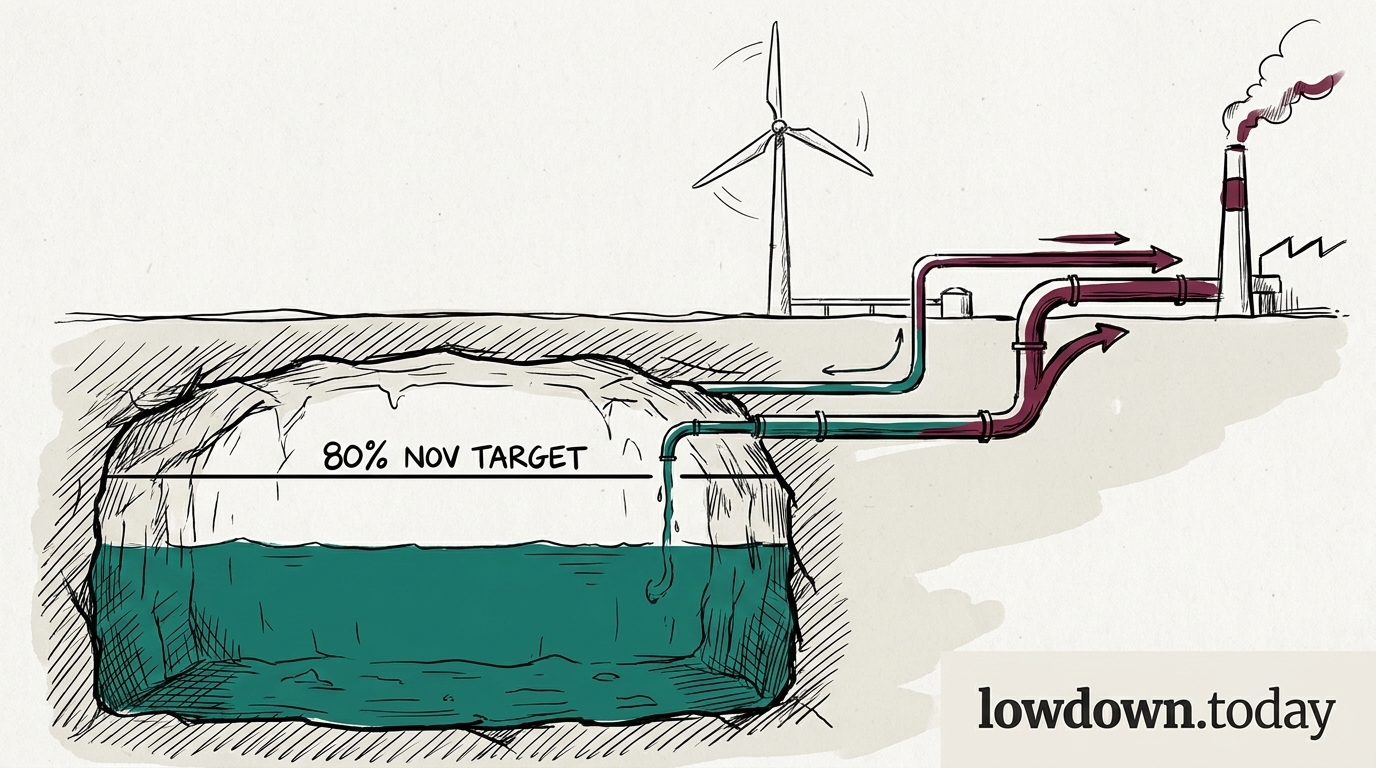
Spain's 9,145 GWh terminal inventory is the largest single stock in the EU LNG network, an option value that can reroute cargoes wherever the winter strip pays best rather than a cavern gas obligation tied to a fixed date. That flexibility matters more as Germany's cavern shortfall pushes more of the winter security question onto import infrastructure.
European Commission
European Commission
Brussels holds the bloc to 90% on a flexible window while Germany, holding roughly a quarter of EU storage capacity, tracks toward missing its own lower 80% figure by 21 points. A national shortfall this size in the anchor market matters more to bloc security than the flexible timetable alone can absorb.
French power exporters and CRE
French day-ahead rose in step with Germany but by less, reopening a EUR 7-17 premium that makes northward export flows commercially attractive again after the EUR 43.09 discount evaporated in days. CRE separately authorised RTE and Enedis to buy flexibility locally, betting the coming winter's binding constraint is grid congestion rather than a shortage of firm capacity.
TTF trading desk
TTF trading desk
A visible national shortfall like Germany's 21-point gap is a directional signal, not noise, for a desk holding the summer-winter spread. TTF's flat EUR 58-60 range through this week's German price swings says the market has not yet chosen to reprice refill risk into the front of the curve.
German cavern and CCGT operators
German caverns kept buying prompt gas at TTF near EUR 58-60 through the inversion; the wind collapse to 2.4 GW then flipped the spark spread to plus EUR 29 and put turbines back in the same queue. Every day turbines win that bid, injection at a third of the 877 GWh/day pace needed falls further behind.
Slovakia
Slovakia
Slovakia says it dropped its hold-out on the 21st sanctions package only after Ursula von der Leyen personally signed written gas-price and supply guarantees. The Council of the European Union's own 17,238-character release on the package names neither Slovakia nor any guarantee, leaving Bratislava's account unconfirmed by the institutional record.



