Skip to content
You can now search across every topic, entity and event.What's new
European Energy Markets
31JUL

StromVKG hearing keeps Sept date intact

4 min read
09:44UTC

The Bundestag's economic-affairs committee left StromVKG's 1 September auction date intact on 24 June and rejected the Greens' hydrogen-conversion motion. The Sudbonus regional uplift is the only amendment fight left before the summer recess.

EconomicDeveloping
Key takeaway

StromVKG's September auction date survived its hearing; the Sudbonus is the only live amendment risk before recess.

The Bundestag's Wirtschaftsausschuss, its economic-affairs committee, held its hearing on StromVKG on 24 June and left the 1 September first-auction date untouched 1. StromVKG is Germany's capacity-payment law, which pays for about 11 GW of dispatchable backup to keep firm capacity on the grid as coal and nuclear retire. BDEW chief Kerstin Andreae, speaking for the energy industry, said the first auctions should still start in 2026, and EnBW's Jörg Jasper called the design appropriate 2.

The Greens had pushed a motion, 21/6369, to force hydrogen-conversion conditions onto the subsidised plants ; it was heard but won no committee backing. What stays live is the Südbonus, a regional uplift that the chemical and energy union IGBCE says shortchanges East Germany, alongside the Bundeskartellamt's competition concerns, which were aired earlier but never entered the record as a formal amendment.

The accelerated procedure the Bundestag opened in committee held through the hearing, and the law is still expected to clear before the summer recess with the 1 September date intact. For German capacity forwards that leaves continuity, with the Südbonus the one regional variable still open.


Deep Analysis

In plain English

Germany plans to pay gas-fired power stations a guaranteed annual fee simply to remain available, even when they are not generating electricity. The aim is to ensure enough backup power exists during winter periods when wind and solar produce almost nothing. This type of arrangement is called a capacity market. The law creating this system, StromVKG, cleared a key parliamentary committee on 24 June with its planned 1 September first-auction date unchanged. The main dispute the committee resolved was the Greens' demand that plants receiving the subsidy must be hydrogen-ready: that condition was rejected. The remaining fight is over a payment bonus for plants in southern Germany, which critics say unfairly disadvantages East German operators. Germany targets 11 gigawatts of backup capacity, equivalent to roughly 11 large power stations.

Deep Analysis
Root Causes

Germany's Dunkelflaute adequacy gap is the structural driver behind StromVKG. Wind and solar penetration above 70% of installed capacity creates multi-day residual load periods where neither resource generates above 10% of nameplate, requiring dispatchable thermal backup to carry system frequency.

ENTSO-E's 2025 Winter Outlook identified Germany as the EU's highest-probability adequacy shortfall country during a three-day windless winter period at demand above 70 GW, the design event that StromVKG targets.

The September auction date reflects legislative urgency created by the accelerated Bundestag procedure: StromVKG needed a September 2026 first auction to produce contracted capacity available by winter 2028-29, the earliest point at which capacity gaps from coal exit and CCGT retirements begin biting materially.

Any delay past the summer recess would push the first contracted MW into 2029 and the first available winter into 2030-31, a two-year adequacy gap at the period of highest retirement pressure.

What could happen next?
  • Opportunity

    September first-auction confirmation creates a 2026-2031 capacity revenue floor on German CCGT new-build economics; utilities with shovel-ready gas plant planning permissions can now model a bankable capacity payment stream alongside energy market revenue, substantially improving project-finance viability over the energy-only case.

    Short term · Assessed
  • Risk

    If the Suedbonus enters the final text as an exclusive southern Germany uplift, East German plant operators may challenge it under non-discrimination provisions of the EMD Regulation 2024/1747, creating a post-passage legal risk for the September auction timeline if the challenge reaches the Commission or a German administrative court.

    Medium term · Reported
  • Precedent

    The 24 June rejection of the Greens' hydrogen-conversion motion confirms the CDU/CSU-led coalition will not impose technology mandates on subsidised gas capacity, making StromVKG a pure thermal capacity mechanism rather than a hydrogen-transition instrument and setting a precedent for future EU state aid discussions on capacity market designs.

    Medium term · Reported
First Reported In

Update #21 · Heat cracks the French-nuclear floor

Bundestag· 26 Jun 2026
Read original
Different Perspectives
Spain's LNG terminal operators
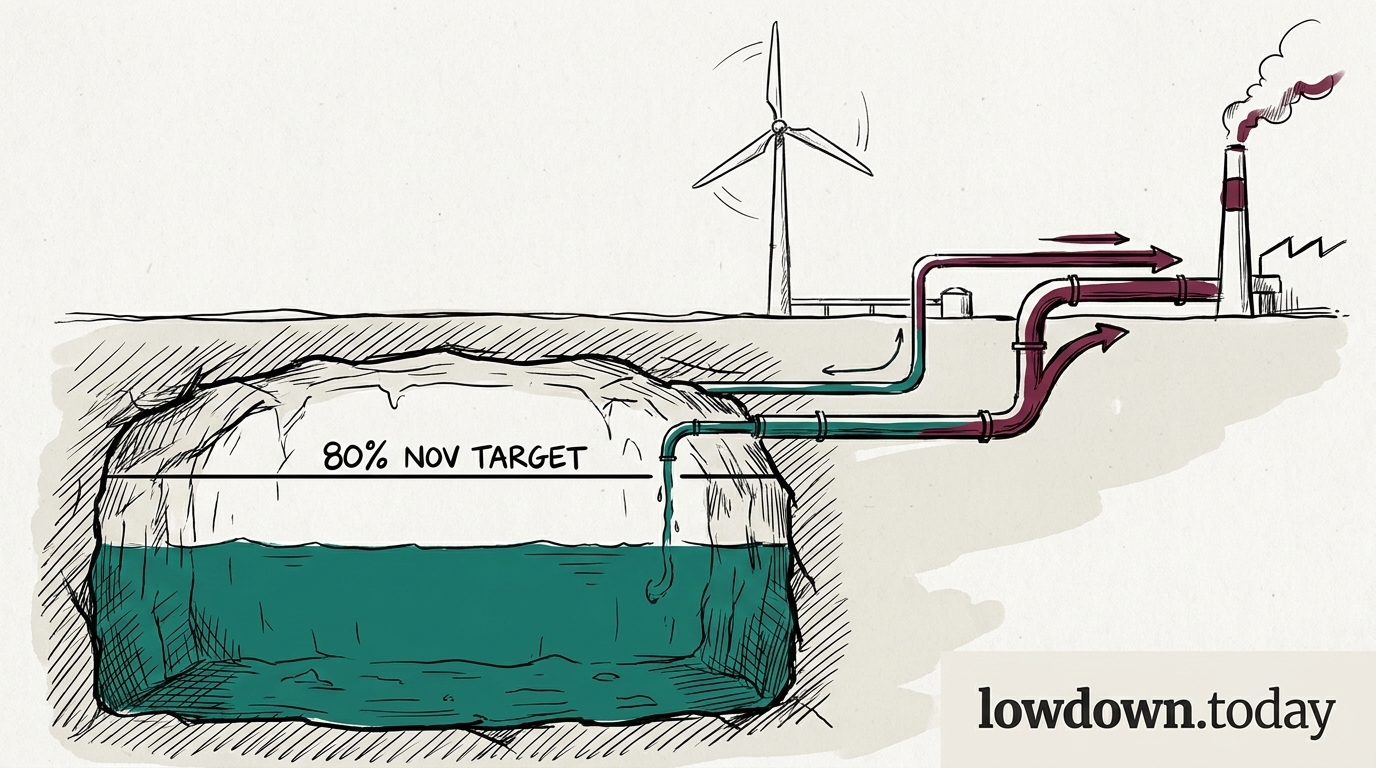
Spain's 9,145 GWh terminal inventory is the largest single stock in the EU LNG network, an option value that can reroute cargoes wherever the winter strip pays best rather than a cavern gas obligation tied to a fixed date. That flexibility matters more as Germany's cavern shortfall pushes more of the winter security question onto import infrastructure.
European Commission
European Commission
Brussels holds the bloc to 90% on a flexible window while Germany, holding roughly a quarter of EU storage capacity, tracks toward missing its own lower 80% figure by 21 points. A national shortfall this size in the anchor market matters more to bloc security than the flexible timetable alone can absorb.
French power exporters and CRE
French day-ahead rose in step with Germany but by less, reopening a EUR 7-17 premium that makes northward export flows commercially attractive again after the EUR 43.09 discount evaporated in days. CRE separately authorised RTE and Enedis to buy flexibility locally, betting the coming winter's binding constraint is grid congestion rather than a shortage of firm capacity.
TTF trading desk
TTF trading desk
A visible national shortfall like Germany's 21-point gap is a directional signal, not noise, for a desk holding the summer-winter spread. TTF's flat EUR 58-60 range through this week's German price swings says the market has not yet chosen to reprice refill risk into the front of the curve.
German cavern and CCGT operators
German caverns kept buying prompt gas at TTF near EUR 58-60 through the inversion; the wind collapse to 2.4 GW then flipped the spark spread to plus EUR 29 and put turbines back in the same queue. Every day turbines win that bid, injection at a third of the 877 GWh/day pace needed falls further behind.
Slovakia
Slovakia
Slovakia says it dropped its hold-out on the 21st sanctions package only after Ursula von der Leyen personally signed written gas-price and supply guarantees. The Council of the European Union's own 17,238-character release on the package names neither Slovakia nor any guarantee, leaving Bratislava's account unconfirmed by the institutional record.



