Skip to content
You can now search across every topic, entity and event.What's new
European Energy Markets
31JUL

Bruegel: the law leaves the chips problem

3 min read
09:44UTC

Bruegel published Analysis 13/2026 on 19 May finding Europe structurally dependent on US or Chinese computing infrastructure whatever CAIDA does, because the law governs the cloud layer and never reaches the silicon beneath it.

EconomicDeveloping
Key takeaway

Bruegel finds CAIDA cannot close Europe's chip dependency, because the law governs cloud residency, not silicon.

The Brussels think tank Bruegel published Analysis 13/2026 on Tuesday 19 May, finding Europe structurally dependent on US or Chinese computing infrastructure regardless of what CAIDA does 1. Bruegel is an economic policy institute whose work feeds directly into EU debate. Its finding is a layer argument: CAIDA can mandate where European public data is hosted, but it says nothing about where the silicon underneath that data comes from, and Europe has no leading-edge AI accelerator of its own to switch to.

The numbers frame the gap. Chinese domestic chips now power 41 per cent of China's data centres, and Huawei projects AI-chip revenue of $12bn in 2026, up from $7.5bn the year before 2. Both Washington and Beijing are manufacturing their way out of dependence; Europe is legislating around it. The dependency Bruegel measures is a cumulative-investment failure with no fab to point to: the cancelled Magdeburg and Crolles projects left the bloc with no leading-edge plant, and ASML's softening guidance is the only European hardware story with scale, and it sells the machines that make chips elsewhere, not the chips.

Bruegel's recommendation borrows the tool Chips Act II already adopts: coordinated EU procurement for compute on the Airbus model, plus subsidies to compensate firms that move off Nvidia. The Draghi report's delivery-gap diagnosis is the backdrop ; the correct prescription has been on record for a year. A law that governs the cloud layer leaves the hardware layer exactly where it was, which is the case Bruegel puts to a Commission about to adopt that law.


Deep Analysis

In plain English

A European think tank called Bruegel published a report in May 2026 showing that Europe cannot build or buy the computer chips needed to run cutting-edge AI, regardless of what the new EU cloud laws say. Both the US and China are spending tens of billions on their own chip factories and AI hardware. Europe is not. Huawei, the Chinese tech company, now makes enough AI chips to generate USD 12bn in sales in 2026. Europe has no equivalent chip company at that scale. Bruegel recommended that European governments pool their buying power to purchase AI computing capacity together, similar to how Airbus was built through coordinated European aerospace procurement.

What could happen next?
  • Risk

    If Chips Act II adopts without a subsidy mechanism for compute migration, European AI developers will remain on Nvidia infrastructure indefinitely, making CAIDA's data-residency mandate dependent on US-supplied hardware.

  • Consequence

    Huawei's USD 12bn 2026 AI-chip revenue trajectory suggests Chinese compute self-sufficiency by 2028, ending the period in which export controls could meaningfully constrain Chinese AI development.

First Reported In

Update #7 · Sovereignty arrives, minus Brussels

Bruegel· 3 Jun 2026
Read original
Different Perspectives
Spain's LNG terminal operators
Spain's 9,145 GWh terminal inventory is the largest single stock in the EU LNG network, an option value that can reroute cargoes wherever the winter strip pays best rather than a cavern gas obligation tied to a fixed date. That flexibility matters more as Germany's cavern shortfall pushes more of the winter security question onto import infrastructure.
European Commission
European Commission
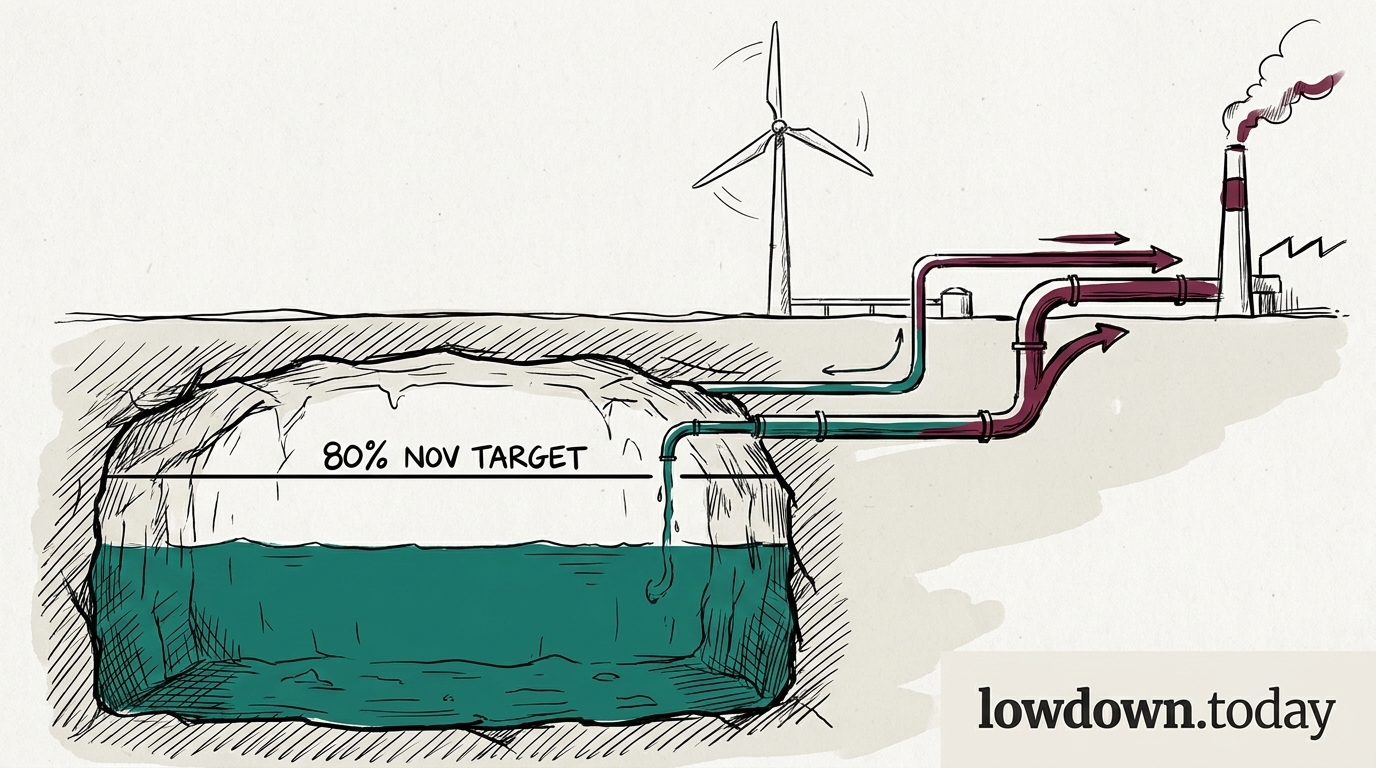
Brussels holds the bloc to 90% on a flexible window while Germany, holding roughly a quarter of EU storage capacity, tracks toward missing its own lower 80% figure by 21 points. A national shortfall this size in the anchor market matters more to bloc security than the flexible timetable alone can absorb.
French power exporters and CRE
French day-ahead rose in step with Germany but by less, reopening a EUR 7-17 premium that makes northward export flows commercially attractive again after the EUR 43.09 discount evaporated in days. CRE separately authorised RTE and Enedis to buy flexibility locally, betting the coming winter's binding constraint is grid congestion rather than a shortage of firm capacity.
TTF trading desk
TTF trading desk
A visible national shortfall like Germany's 21-point gap is a directional signal, not noise, for a desk holding the summer-winter spread. TTF's flat EUR 58-60 range through this week's German price swings says the market has not yet chosen to reprice refill risk into the front of the curve.
German cavern and CCGT operators
German caverns kept buying prompt gas at TTF near EUR 58-60 through the inversion; the wind collapse to 2.4 GW then flipped the spark spread to plus EUR 29 and put turbines back in the same queue. Every day turbines win that bid, injection at a third of the 877 GWh/day pace needed falls further behind.
Slovakia
Slovakia
Slovakia says it dropped its hold-out on the 21st sanctions package only after Ursula von der Leyen personally signed written gas-price and supply guarantees. The Council of the European Union's own 17,238-character release on the package names neither Slovakia nor any guarantee, leaving Bratislava's account unconfirmed by the institutional record.



