Skip to content
You can now search across every topic, entity and event.What's new
European Energy Markets
31JUL

Draghi report: 11% delivered after one year

3 min read
09:44UTC

Only 43 of the Draghi report's 383 competitiveness recommendations have been fully implemented. The report called for €800bn per year. The EU budget is under 1% of GDP.

EconomicDeveloping
Key takeaway

Europe's sovereignty gap is an implementation gap: right diagnosis, 11.2% delivery rate after one year.

An audit of the Draghi Report on European competitiveness, published in September 2024, found that only 43 of its 383 recommendations (11.2%) were fully implemented one year later 1. Another 77 were partially implemented. The remaining 263 were either in progress or untouched.

The report called for €800bn per year in EU investment, roughly 4 to 5% of GDP. The EU's annual budget is under 1% of GDP. Without a genuine fiscal instrument at EU level, the investment plan is a statement of intent rather than a programme. Europe's gap between diagnosis and delivery has been a recurring theme in EU industrial policy; the Draghi audit quantifies the shortfall directly.

The Cloud and AI Development Act (CADA), proposed by The Commission in Q1 2026, directly implements a Draghi recommendation on harmonising cloud procurement and removing obstacles to European data centre expansion 2. But CADA addresses infrastructure, not models. And EU legislative timelines mean practical effect is unlikely before 2028. European sovereignty initiatives share a common trajectory: the right diagnosis, defensible prescriptions, and a delivery mechanism that runs years behind the market it is trying to shape.


Deep Analysis

In plain English

In September 2024, former European Central Bank president Mario Draghi published a major report on European economic competitiveness. It identified an enormous problem: Europe is falling behind the United States and China in technology, productivity, and investment, and the gap is widening. Draghi's report contained 383 specific recommendations for what Europe should do to catch up. One year later, only 43 of those recommendations had been fully carried out; about 11%. Another 77 were partly done. The remaining 263 had barely moved. The report called for Europe to invest an additional €800 billion per year to catch up. To put that in context, the EU's entire annual budget is less than 1% of the combined GDP of EU countries; roughly €180 billion. The gap between what is needed and what the EU's governance structure can deliver is enormous.

Deep Analysis
Root Causes

The implementation gap has a simple structural cause: €800bn per year requires either a dramatically expanded EU budget (from under 1% of GDP to 4-5% of GDP) or coordinated national spending at EU-mandated levels. Both routes require unanimity among 27 member states with conflicting fiscal positions. Germany's constitutional debt brake, France's deficit constraints, and the fiscal hawks of northern Europe make the investment volume structurally unachievable through normal EU budget processes.

The CADA (Cloud and AI Development Act) is the specific legislative mechanism intended to bridge the AI and cloud components of the Draghi gap. Its Q1 2026 proposal means it cannot achieve practical effect before 2028 given typical EU ordinary legislative procedure timelines of 18-24 months plus transposition periods.

For European AI and cloud competitiveness, the 2028 effective date means the critical window of AI market formation (2024-2027) will pass before any CADA instruments are operational.

What could happen next?
  • Consequence

    CADA's 2028 effective date means the critical AI market formation period (2024-2027) passes with no operational EU AI investment instrument, ceding first-mover advantage in European AI infrastructure to US hyperscalers.

    Medium term · 0.8
  • Risk

    The pattern of ambitious EU competitiveness targets with 10-15% implementation rates (Lisbon Strategy, Draghi) suggests structural EU governance constraints make the €800bn investment target unachievable through voluntary coordination.

    Long term · 0.75
  • Opportunity

    If geopolitical crisis triggers a NextGenerationEU-equivalent emergency mechanism; as COVID-19 did in 2020; the €800bn annual investment figure is within political reach through off-balance-sheet EU borrowing.

    Long term · 0.4
First Reported In

Update #1 · Europe's chip ambitions meet reality

European Commission (Draghi Report)· 13 Apr 2026
Read original
Causes and effects
This Event
Draghi report: 11% delivered after one year
The implementation gap between Europe's sovereignty diagnosis and its delivery capacity is the central constraint, and the Draghi audit quantifies it precisely.
Different Perspectives
Spain's LNG terminal operators
Spain's 9,145 GWh terminal inventory is the largest single stock in the EU LNG network, an option value that can reroute cargoes wherever the winter strip pays best rather than a cavern gas obligation tied to a fixed date. That flexibility matters more as Germany's cavern shortfall pushes more of the winter security question onto import infrastructure.
European Commission
European Commission
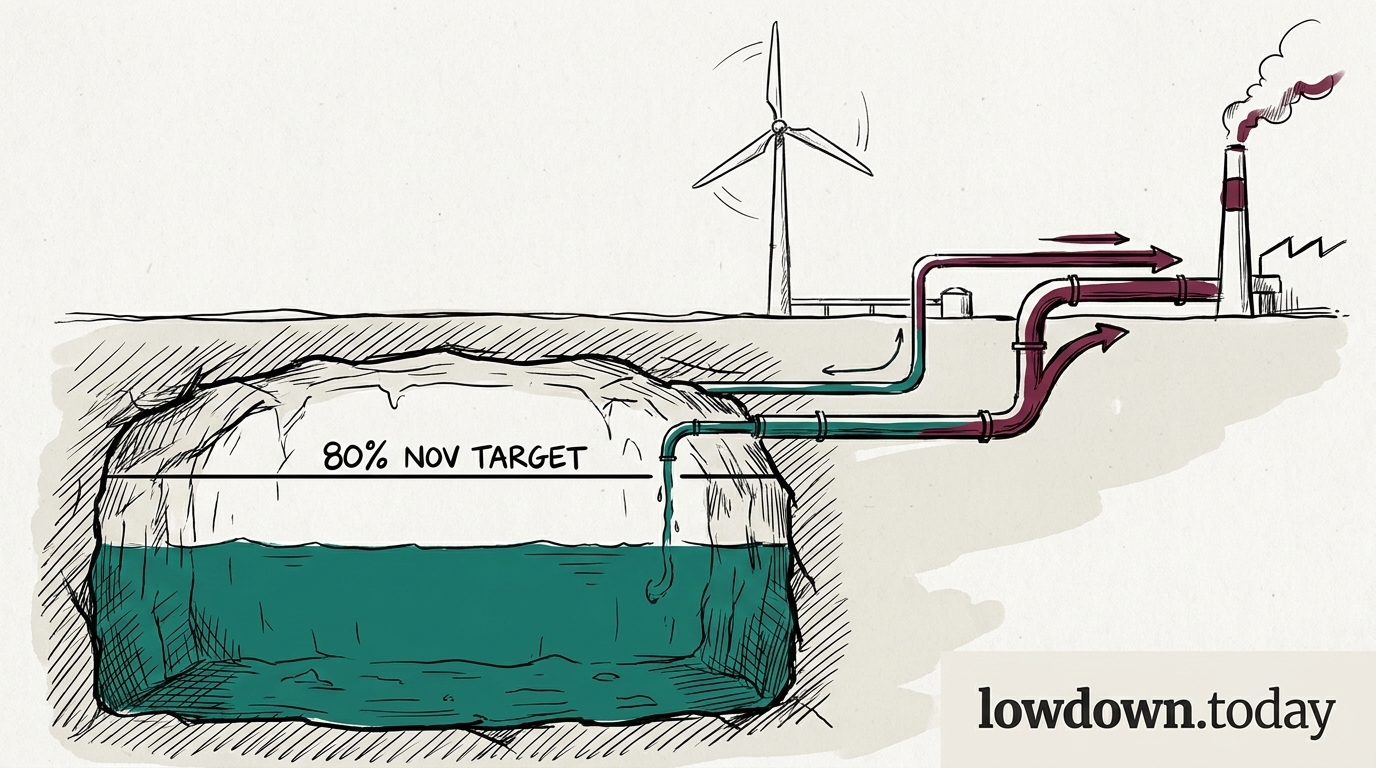
Brussels holds the bloc to 90% on a flexible window while Germany, holding roughly a quarter of EU storage capacity, tracks toward missing its own lower 80% figure by 21 points. A national shortfall this size in the anchor market matters more to bloc security than the flexible timetable alone can absorb.
French power exporters and CRE
French day-ahead rose in step with Germany but by less, reopening a EUR 7-17 premium that makes northward export flows commercially attractive again after the EUR 43.09 discount evaporated in days. CRE separately authorised RTE and Enedis to buy flexibility locally, betting the coming winter's binding constraint is grid congestion rather than a shortage of firm capacity.
TTF trading desk
TTF trading desk
A visible national shortfall like Germany's 21-point gap is a directional signal, not noise, for a desk holding the summer-winter spread. TTF's flat EUR 58-60 range through this week's German price swings says the market has not yet chosen to reprice refill risk into the front of the curve.
German cavern and CCGT operators
German caverns kept buying prompt gas at TTF near EUR 58-60 through the inversion; the wind collapse to 2.4 GW then flipped the spark spread to plus EUR 29 and put turbines back in the same queue. Every day turbines win that bid, injection at a third of the 877 GWh/day pace needed falls further behind.
Slovakia
Slovakia
Slovakia says it dropped its hold-out on the 21st sanctions package only after Ursula von der Leyen personally signed written gas-price and supply guarantees. The Council of the European Union's own 17,238-character release on the package names neither Slovakia nor any guarantee, leaving Bratislava's account unconfirmed by the institutional record.



