Skip to content
You can now search across every topic, entity and event.What's new
European Energy Markets
31JUL

Oil swings $30 in a single session

2 min read
09:44UTC

Brent hit $119.50 — the highest since 2012 — then crashed below $90 on a single presidential comment. The most volatile crude session in decades reveals a market trading on words, not barrels.

EconomicDeveloping

Brent Crude hit $119.50 per barrel on Monday morning — the highest since 2022 and a 77% rise from $67.41 on 27 February, the day the war began. WTI reached $119.48. By the US close, Brent had settled at $98.96, sinking below $90 in after-hours trading. WTI settled at $94.77. The $30 intraday reversal was driven by Trump's 'very soon' language on ending the war and profit-taking on overcrowded long positions.

The $30 swing dwarfs normal oil market volatility. Brent's average daily range through 2025 was approximately $2. Even during the 2020 pandemic price collapse, intraday moves rarely exceeded $10. Last Friday, US crude futures posted a 35.63% weekly gain — the largest since the contract began trading in 1983 . Qatar's energy minister warned of $150 per barrel if Hormuz remains closed . The market touched $119 and flinched — but the flinch was triggered by a presidential remark, not by any change in the physical supply picture. Brent had been at $116.08 just three days ago , itself a 72% rise in under two weeks. The 1990 Iraqi invasion of Kuwait doubled oil prices over two months; this war achieved the same effect in ten days and then gave back a third of it in an afternoon.

The underlying supply disruption has not changed. Tanker traffic through Hormuz remains down approximately 70%. Kuwait's force majeure removed 300,000 barrels per day from export markets. Combined with Iraq's curtailments of approximately 1.5 million barrels per day, roughly 3.5 million barrels per day of Gulf production capacity is shut in or unable to reach market. No tanker insurance has been restored. No diplomatic off-ramp for Hormuz has materialised. The fundamental imbalance — supply removed, demand unchanged — is identical to what it was at $119 in the morning. What moved was sentiment, and sentiment moved on words.

The question for Tuesday's Asian open is whether $90 or $100 becomes the new floor. If $90 holds, the oil shock remains a market event — painful but absorbable for import-dependent economies, even those already strained (South Korea's KOSPI triggered two circuit breakers in four sessions, . If $100 holds, it crosses into macroeconomic damage: compressed industrial margins, inflationary pressure on food and transport costs across Asia and Europe, and political pressure on governments to release strategic petroleum reserves or seek bilateral supply deals outside The Gulf. The market is not pricing oil. It is pricing the probability that one man's 'very soon' means what it says.


First Reported In

Update #31 · Iran moves to heavy warheads; China deploys

Euronews· 10 Mar 2026
Read original
Different Perspectives
Spain's LNG terminal operators
Spain's 9,145 GWh terminal inventory is the largest single stock in the EU LNG network, an option value that can reroute cargoes wherever the winter strip pays best rather than a cavern gas obligation tied to a fixed date. That flexibility matters more as Germany's cavern shortfall pushes more of the winter security question onto import infrastructure.
European Commission
European Commission
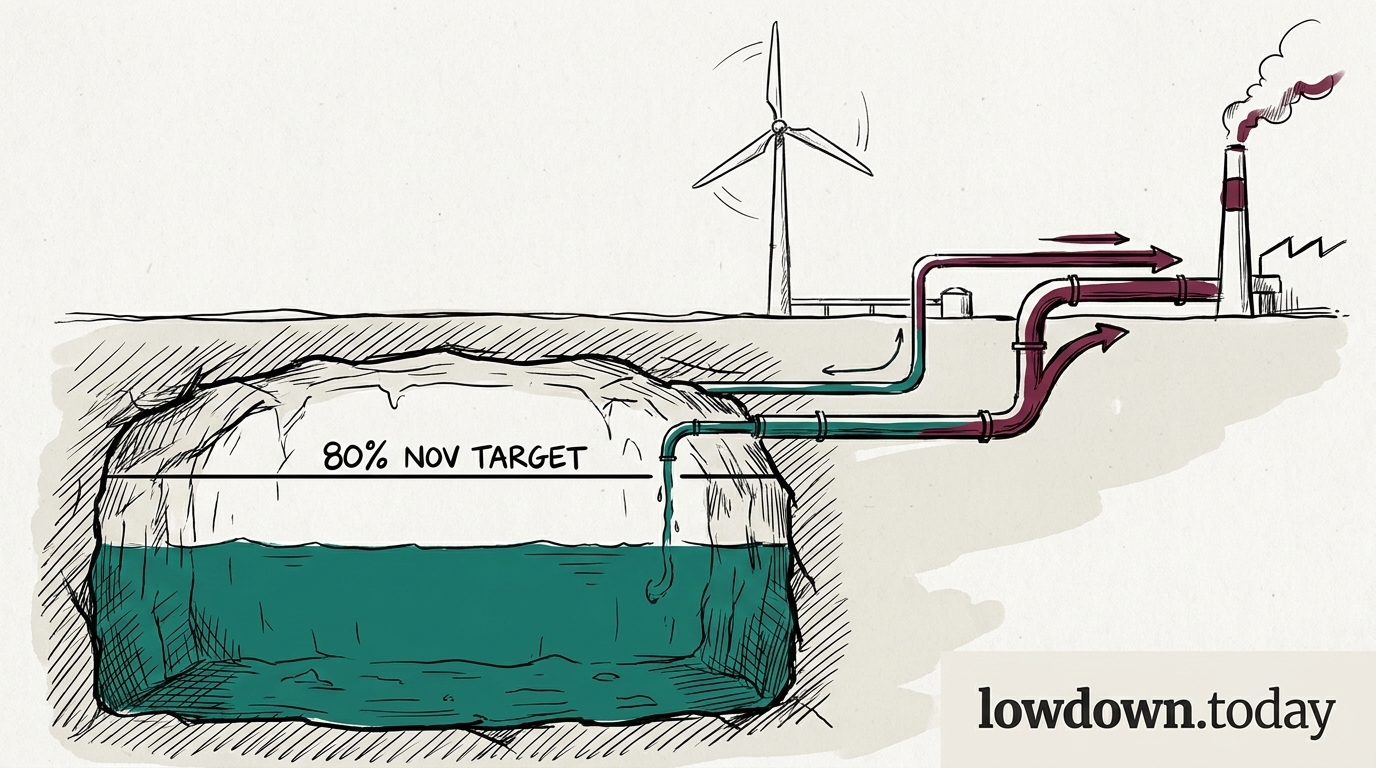
Brussels holds the bloc to 90% on a flexible window while Germany, holding roughly a quarter of EU storage capacity, tracks toward missing its own lower 80% figure by 21 points. A national shortfall this size in the anchor market matters more to bloc security than the flexible timetable alone can absorb.
French power exporters and CRE
French day-ahead rose in step with Germany but by less, reopening a EUR 7-17 premium that makes northward export flows commercially attractive again after the EUR 43.09 discount evaporated in days. CRE separately authorised RTE and Enedis to buy flexibility locally, betting the coming winter's binding constraint is grid congestion rather than a shortage of firm capacity.
TTF trading desk
TTF trading desk
A visible national shortfall like Germany's 21-point gap is a directional signal, not noise, for a desk holding the summer-winter spread. TTF's flat EUR 58-60 range through this week's German price swings says the market has not yet chosen to reprice refill risk into the front of the curve.
German cavern and CCGT operators
German caverns kept buying prompt gas at TTF near EUR 58-60 through the inversion; the wind collapse to 2.4 GW then flipped the spark spread to plus EUR 29 and put turbines back in the same queue. Every day turbines win that bid, injection at a third of the 877 GWh/day pace needed falls further behind.
Slovakia
Slovakia
Slovakia says it dropped its hold-out on the 21st sanctions package only after Ursula von der Leyen personally signed written gas-price and supply guarantees. The Council of the European Union's own 17,238-character release on the package names neither Slovakia nor any guarantee, leaving Bratislava's account unconfirmed by the institutional record.



