Skip to content
You can now search across every topic, entity and event.What's new
European Energy Markets
31JUL

Russia threatens walkout over oblasts

3 min read
09:44UTC

Russia demands Ukraine cede four oblasts before talks can continue — a familiar maximalist opening, now complicated by Kyiv's February battlefield gains and Moscow's collapsing oil revenue.

EconomicDeveloping
Key takeaway

Russia's constitutional annexation makes its pre-conditions harder to retreat from than previous ultimatums.

Bloomberg reported on 28 February that Russia is considering suspending peace negotiations unless Ukraine pre-commits to formally ceding the four partially occupied oblasts — Donetsk, Luhansk, Zaporizhzhia, and Kherson 1. A March trilateral involving the United States, Russia, and Ukraine had been expected at Abu Dhabi.

The demand follows Abu Dhabi Round 2 in February, which produced technical progress on ceasefire monitoring mechanics but deadlocked on territory 2. Three unresolved questions remain unchanged: territorial status, security guarantees for Ukraine, and who deploys ceasefire monitors. On guarantees, Zelenskyy has stated the US text is "essentially ready"; on territory, neither side has moved.

Russia has issued structurally identical ultimatums before every major negotiating round since the Istanbul talks collapsed in March 2022. The sequence is established: Moscow sets maximalist preconditions, gauges the degree of Western pressure on Kyiv to accept them, then attends regardless. Until Russia formally recalls its Abu Dhabi delegation, this is more consistent with tactical positioning than genuine withdrawal.

The timing, however, is not incidental. Ukraine recaptured an estimated 300–400 sq km in the Zaporizhzhia–Dnipropetrovsk sector during February, reducing Kyiv's incentive to concede territory at the table. Russia's oil revenues fell 65% year-on-year in January 2026 3, eroding Moscow's fiscal capacity to sustain the war's expenditure rate indefinitely. Trump told Zelenskyy on 25 February that he wants the war ended "in a month"; Russia's stated position remains "no deadlines." Both sides face pressure to negotiate and reasons to delay — Ukraine because the battlefield has improved, Russia because conceding flexibility on territory would contradict four years of stated war aims.


Deep Analysis

In plain English

Russia is demanding Ukraine formally hand over four regions before peace talks can even begin. Ukraine cannot accept this — it would mean legally surrendering nearly a fifth of its territory before a single negotiation takes place. Russia wrote these territorial claims into its own constitution in September 2022. That makes any Russian leader who later accepts less look as though he broke his own country's law. So the threat to walk away from talks is partly about domestic Russian politics, not just bargaining tactics. Putin cannot publicly retreat from a constitutional position without a Duma supermajority and enormous political risk from hardliners.

Deep Analysis
Synthesis

Russia's pre-condition ultimatums have historically preceded attendance, but the September 2022 constitutional annexation introduces a legal ratchet absent from all prior rounds. Reversing that annexation would require a Duma supermajority — politically inconceivable under current conditions. This creates a structural asymmetry: Ukraine's territorial position can shift with battlefield outcomes, but Russia's legal position cannot shift without a domestic political rupture.

Root Causes

The ultimatum serves a dual function the body does not identify. It is simultaneously a negotiating posture toward Ukraine and a domestic signal to Russian hardliners that Putin has not conceded the constitutional annexation. Without the domestic audience, the ultimatum would have less structural rigidity — it is as much internal political management as external pressure.

Escalation

Ukraine's February territorial gains structurally reduce Kyiv's incentive to accept pre-conditions. Russia's fiscal deterioration simultaneously weakens Moscow's capacity to sustain a walkout threat. The two forces partially cancel: both sides are less willing to concede, yet neither can easily absorb prolonged stalemate. The net direction is lateral — continued talks with continued deadlock — rather than escalation or de-escalation.

What could happen next?
  • Risk

    If Russia formally withdraws its delegation, the March Abu Dhabi trilateral collapses, removing the only active multilateral channel for negotiation.

    Immediate · Assessed
  • Consequence

    Ukraine's improved February military position reduces Kyiv's incentive to offer pre-concessions, making Russian attendance at any March round less likely on Moscow's stated terms.

    Short term · Assessed
  • Precedent

    If constitutional annexation establishes that territorial demands are non-negotiable, it creates a template for similar annexation-then-demand sequences in future conflicts elsewhere.

    Long term · Suggested
First Reported In

Update #1 · Ukraine best month as Russia triples drones

Bloomberg· 3 Mar 2026
Read original
Causes and effects
This Event
Russia threatens walkout over oblasts
Russia's demand that Ukraine cede four oblasts before talks continue follows a pattern of pre-negotiation maximalism since 2022, but the convergence of Ukraine's February territorial gains, Russia's 65% revenue collapse, and Trump's one-month deadline creates genuine uncertainty about whether the March trilateral proceeds.
Different Perspectives
Spain's LNG terminal operators
Spain's 9,145 GWh terminal inventory is the largest single stock in the EU LNG network, an option value that can reroute cargoes wherever the winter strip pays best rather than a cavern gas obligation tied to a fixed date. That flexibility matters more as Germany's cavern shortfall pushes more of the winter security question onto import infrastructure.
European Commission
European Commission
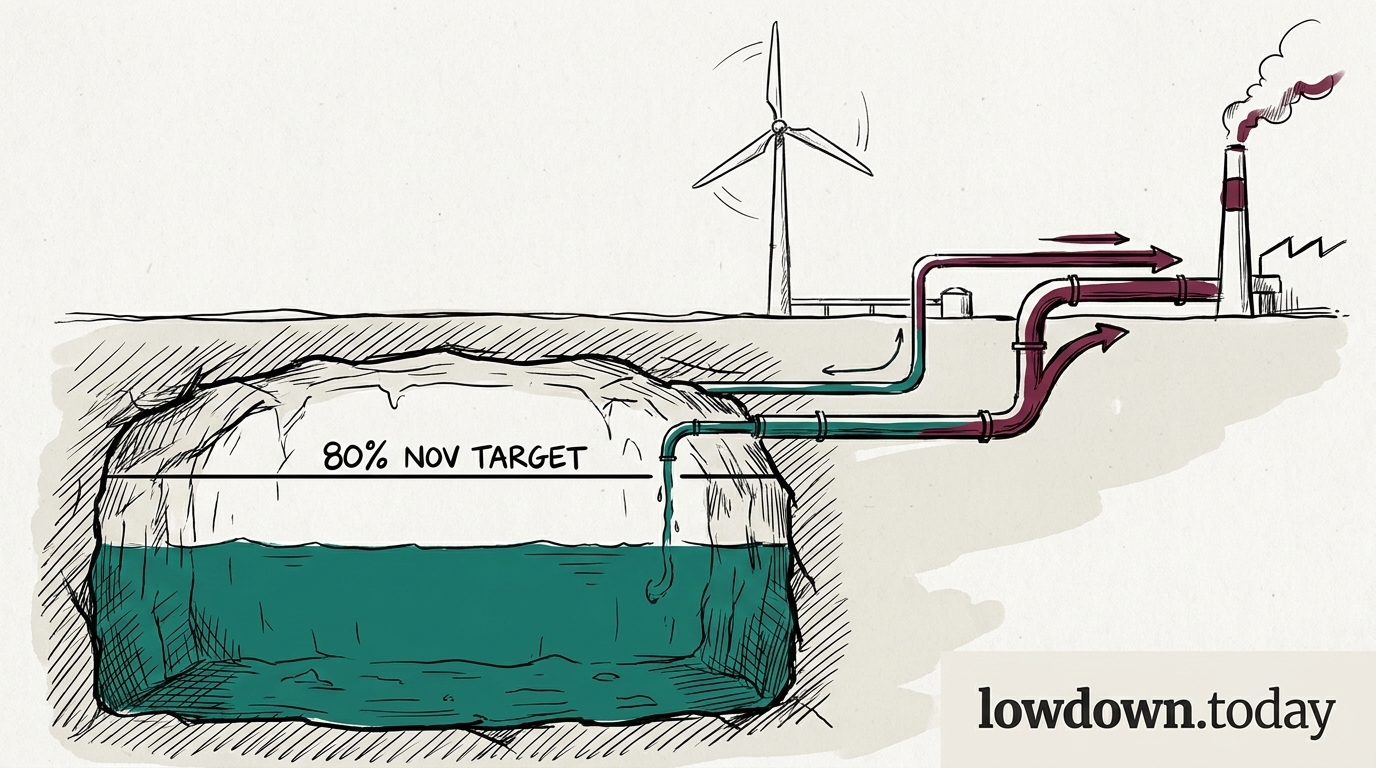
Brussels holds the bloc to 90% on a flexible window while Germany, holding roughly a quarter of EU storage capacity, tracks toward missing its own lower 80% figure by 21 points. A national shortfall this size in the anchor market matters more to bloc security than the flexible timetable alone can absorb.
French power exporters and CRE
French day-ahead rose in step with Germany but by less, reopening a EUR 7-17 premium that makes northward export flows commercially attractive again after the EUR 43.09 discount evaporated in days. CRE separately authorised RTE and Enedis to buy flexibility locally, betting the coming winter's binding constraint is grid congestion rather than a shortage of firm capacity.
TTF trading desk
TTF trading desk
A visible national shortfall like Germany's 21-point gap is a directional signal, not noise, for a desk holding the summer-winter spread. TTF's flat EUR 58-60 range through this week's German price swings says the market has not yet chosen to reprice refill risk into the front of the curve.
German cavern and CCGT operators
German caverns kept buying prompt gas at TTF near EUR 58-60 through the inversion; the wind collapse to 2.4 GW then flipped the spark spread to plus EUR 29 and put turbines back in the same queue. Every day turbines win that bid, injection at a third of the 877 GWh/day pace needed falls further behind.
Slovakia
Slovakia
Slovakia says it dropped its hold-out on the 21st sanctions package only after Ursula von der Leyen personally signed written gas-price and supply guarantees. The Council of the European Union's own 17,238-character release on the package names neither Slovakia nor any guarantee, leaving Bratislava's account unconfirmed by the institutional record.



