Skip to content
You can now search across every topic, entity and event.What's new
European Energy Markets
31JUL

ASML booms, Europe's fab gap holds

3 min read
09:44UTC

ASML raised full-year guidance to €43-45bn on 15 July, its second increase in two quarters, and dropped the export-control hedge it carried in Q1. The added capacity is booked for fabs in Taiwan, Korea and Arizona, not Europe.

EconomicDeveloping
Key takeaway

ASML is booming on AI demand, but its new capacity serves fabs outside Europe.

ASML raised its full-year 2026 guidance to €43-45bn on 15 July, its second increase in two quarters, and dropped the export-control language it had written into Q1 guidance. The Dutch firm in Veldhoven builds the lithography machines every advanced chipmaker depends on, and it has gone quiet on the risk that defined its previous quarter. None of the added strength reaches a European leading-edge fab. 1

The quarter beat expectations: €9.3bn in net sales, a 54.0% gross margin, €2.9bn of net income, and 86 lithography systems sold, up from 67 in Q1. The earlier Q1 range of €36-40bn had sat €300m below analyst consensus . In that first-quarter release, chief executive Christophe Fouquet wrote that guidance "accommodates potential outcomes of ongoing discussions around export controls", a line that wrote Washington's trade policy into ASML's forward numbers. The Q2 release and earnings call carried no such hedge, even with the MATCH Act, the US bill to govern ASML's deep ultraviolet (DUV) lithography sales to China, live in Congress since 24 June . 2

Fouquet attributed the raise to demand for advanced logic and memory chips, the processors that train and run AI systems. China guided at roughly 20% of full-year sales, close to Q1's 19% and far below the 36% of late 2025, so the collapse that defined the Q1 story has stabilised rather than deepened. ASML is adding 30% to its 2026 low-numerical-aperture (low-NA) extreme ultraviolet (EUV) capacity, from about 65 units to about 85, for delivery in 2027, with matching expansion under study for its DUV immersion tools.

Those tools serve the fabs that already lead the world: TSMC in Taiwan, Samsung in South Korea and US plants in Arizona. No new European leading-edge fab has been announced to receive them. ASML builds the tools; the most advanced chips get printed elsewhere, and an order book running well ahead of last year does nothing to close that distance .


Deep Analysis

In plain English

ASML is a Dutch company that makes the machines used to print the tiny circuits onto computer chips. Only ASML makes the newest type, called EUV (extreme ultraviolet) lithography systems, so nearly every advanced chip in the world, from smartphones to AI processors, depends on its equipment. On 15 July, ASML told investors it now expects to sell €43-45bn worth of equipment this year, up from its earlier €36-40bn forecast, driven largely by chipmakers building capacity for AI processors. ASML also stopped warning investors about the risk that new US export rules could block some of its China sales, a sign it feels more confident about that risk than it did in April, even though a proposed US law, the MATCH Act, could still tighten those restrictions.

Deep Analysis
Root Causes

ASML holds a global monopoly on EUV lithography, the only tool capable of printing chips below roughly 7 nanometres, so demand from AI-driven leading-edge fab expansion flows through one company regardless of where the fab sits.

Europe has no domestic customer for ASML's most advanced EUV tools: the fabs actually running them are in Taiwan, South Korea and the US. That means this quarter's results measure Asian and American capital spending, not European fab capacity, even though the machines themselves are built in Veldhoven.

What could happen next?
  • Consequence

    A further tightening of the MATCH Act would directly cut into ASML's roughly 20% China revenue share without affecting its AI-driven order book elsewhere.

  • Risk

    Dropping the export-control hedge from guidance removes an early-warning signal for investors if the MATCH Act does pass.

First Reported In

Update #12 · ASML's tool boom skips Europe's logic gap

ASML· 16 Jul 2026
Read original
Causes and effects
This Event
ASML booms, Europe's fab gap holds
ASML's record quarter widens rather than narrows the gap between European tool-making and European chip-making.
Different Perspectives
Spain's LNG terminal operators
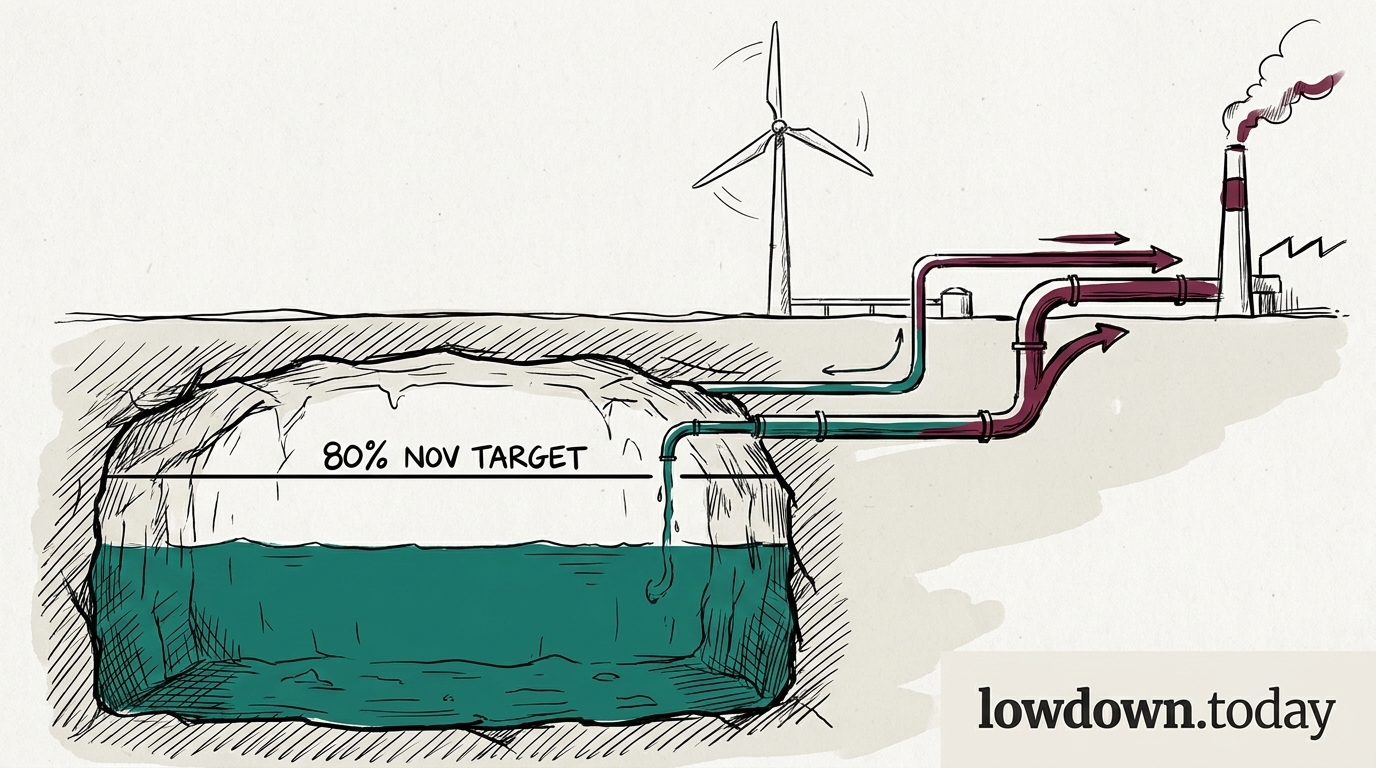
Spain's 9,145 GWh terminal inventory is the largest single stock in the EU LNG network, an option value that can reroute cargoes wherever the winter strip pays best rather than a cavern gas obligation tied to a fixed date. That flexibility matters more as Germany's cavern shortfall pushes more of the winter security question onto import infrastructure.
European Commission
European Commission
Brussels holds the bloc to 90% on a flexible window while Germany, holding roughly a quarter of EU storage capacity, tracks toward missing its own lower 80% figure by 21 points. A national shortfall this size in the anchor market matters more to bloc security than the flexible timetable alone can absorb.
French power exporters and CRE
French day-ahead rose in step with Germany but by less, reopening a EUR 7-17 premium that makes northward export flows commercially attractive again after the EUR 43.09 discount evaporated in days. CRE separately authorised RTE and Enedis to buy flexibility locally, betting the coming winter's binding constraint is grid congestion rather than a shortage of firm capacity.
TTF trading desk
TTF trading desk
A visible national shortfall like Germany's 21-point gap is a directional signal, not noise, for a desk holding the summer-winter spread. TTF's flat EUR 58-60 range through this week's German price swings says the market has not yet chosen to reprice refill risk into the front of the curve.
German cavern and CCGT operators
German caverns kept buying prompt gas at TTF near EUR 58-60 through the inversion; the wind collapse to 2.4 GW then flipped the spark spread to plus EUR 29 and put turbines back in the same queue. Every day turbines win that bid, injection at a third of the 877 GWh/day pace needed falls further behind.
Slovakia
Slovakia
Slovakia says it dropped its hold-out on the 21st sanctions package only after Ursula von der Leyen personally signed written gas-price and supply guarantees. The Council of the European Union's own 17,238-character release on the package names neither Slovakia nor any guarantee, leaving Bratislava's account unconfirmed by the institutional record.



