Skip to content
You can now search across every topic, entity and event.What's new
European Energy Markets
31JUL

62 wounded vanish from Pentagon toll

3 min read
09:44UTC

The department's published wounded count fell from 482 to 420 overnight, with no names, no incident and one phrase of explanation: "temporary data disruptions".

EconomicDeveloping
Key takeaway

Sixty-two wounded troops left the Pentagon's public toll with no names and no incident attached.

The Pentagon's published count of Americans wounded in the Iran war fell from 482 to 420 overnight on 24 July, CBS News reported, in the same database update that cut the war's official dead from 18 to 14 1. Acting press secretary Joel Valdez attributed the change to "temporary data disruptions", offering no names, no incident and no revised methodology 2.

Four deaths cannot account for 62 wounded, and the department has not tried to make them. The four names removed were 1st Lt Tyler James Feehan, 25, and Pvt Isabella Gonzales, 19, both named on 20 July after Iran struck Muwaffaq Salti Air Base in Jordan on 17 July ; Sgt Angel S. Rampersad, 28, moved from Duty Status Whereabouts Unknown to believed killed in that same attack ; and Sgt Michael Emmanuel Swinton, 30, killed on 19 July at Erbil Air Base in Iraq during a controlled detonation of a downed Iranian one-way drone, a separate incident in a different country. The Department of War posthumously promoted Swinton to Staff Sergeant, then removed him from the count 3.

Three military officials told The New York Times the removal of the dead was deliberate, on the reasoning that the four deaths fell after the April ceasefire declaration and outside the war's official window 4. Valdez's technical-fault explanation covers the wounded. Two different answers now cover two halves of one night's revision, and the department has published no cutoff rule that would let an outsider check either.

That sits on top of an earlier failure: on 21 July the tracking system briefly showed zero troops wounded for the whole of July, against Parnell's own on-record figure of "nearly 100" the same week. An anonymous US official told the Associated Press the true wounded total "could be more than 500", above every figure the department has published 5. Casualty systems built for declared wars run on a single published rule for what counts and from when; an undeclared campaign running past an unacknowledged ceasefire boundary has no such rule, which is precisely why "technical fault" and "post-ceasefire cutoff" can both be offered for the same database change without either being disprovable. Senate Democrats have written to Hegseth demanding an accounting.


Deep Analysis

In plain English

The Pentagon keeps an official count of how many US troops have been killed or wounded in the Iran conflict. That count has changed in confusing ways three times recently. First it briefly showed zero wounded for the whole of July, even though the Pentagon's own spokesman had said "nearly 100" on the record days earlier. Then the number of dead dropped from 18 to 14, because officials say those four died after a ceasefire was declared in April, a technical rule rather than any dispute about what happened to them. Then, the same night, the wounded count dropped too, from 482 to 420, with no explanation beyond "temporary data disruptions". Four fewer dead does not explain 62 fewer wounded.

Deep Analysis
Root Causes

The Pentagon's casualty database ties a service member's official killed-in-action status to declared periods of hostility; three military officials told the New York Times the four dead were removed because their deaths fell after Trump's late-April ceasefire declaration, a technical cutoff rather than a factual dispute about how they died.

No equivalent public rule governs the wounded count, which is why a 62-person swing there has no comparable explanation on offer: the system has a documented process for reclassifying the dead and none at all for the wounded.

What could happen next?
  • Consequence

    Senate Democrats have written to War Secretary Hegseth demanding an explanation, raising the chance of a congressional oversight hearing.

    Short term · Reported
  • Risk

    A third unexplained change to the casualty count erodes public confidence in official figures at exactly the moment Congress is voting on continued US involvement.

    Immediate · Assessed
  • Meaning

    The gap between the two explanations, a ceasefire-cutoff rule for the dead and an unnamed "disruption" for the wounded, suggests the department does not have a single coherent accounting method.

    Immediate · Reported
First Reported In

Update #162 · Munitions, not Iran, halted US bombing

CBS News· 26 Jul 2026
Read original
Different Perspectives
Spain's LNG terminal operators
Spain's 9,145 GWh terminal inventory is the largest single stock in the EU LNG network, an option value that can reroute cargoes wherever the winter strip pays best rather than a cavern gas obligation tied to a fixed date. That flexibility matters more as Germany's cavern shortfall pushes more of the winter security question onto import infrastructure.
European Commission
European Commission
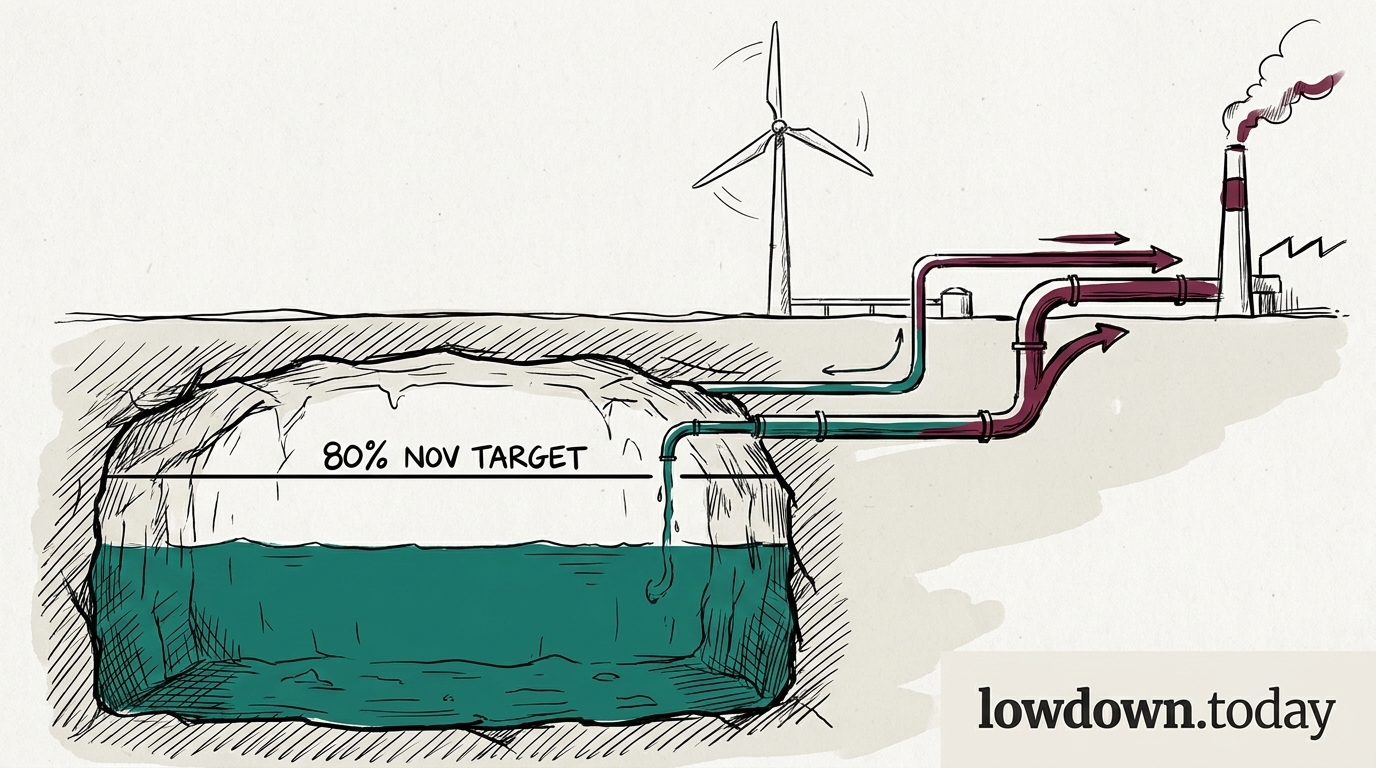
Brussels holds the bloc to 90% on a flexible window while Germany, holding roughly a quarter of EU storage capacity, tracks toward missing its own lower 80% figure by 21 points. A national shortfall this size in the anchor market matters more to bloc security than the flexible timetable alone can absorb.
French power exporters and CRE
French day-ahead rose in step with Germany but by less, reopening a EUR 7-17 premium that makes northward export flows commercially attractive again after the EUR 43.09 discount evaporated in days. CRE separately authorised RTE and Enedis to buy flexibility locally, betting the coming winter's binding constraint is grid congestion rather than a shortage of firm capacity.
TTF trading desk
TTF trading desk
A visible national shortfall like Germany's 21-point gap is a directional signal, not noise, for a desk holding the summer-winter spread. TTF's flat EUR 58-60 range through this week's German price swings says the market has not yet chosen to reprice refill risk into the front of the curve.
German cavern and CCGT operators
German caverns kept buying prompt gas at TTF near EUR 58-60 through the inversion; the wind collapse to 2.4 GW then flipped the spark spread to plus EUR 29 and put turbines back in the same queue. Every day turbines win that bid, injection at a third of the 877 GWh/day pace needed falls further behind.
Slovakia
Slovakia
Slovakia says it dropped its hold-out on the 21st sanctions package only after Ursula von der Leyen personally signed written gas-price and supply guarantees. The Council of the European Union's own 17,238-character release on the package names neither Slovakia nor any guarantee, leaving Bratislava's account unconfirmed by the institutional record.



