Skip to content
You can now search across every topic, entity and event.What's new
European Energy Markets
16JUL

Goldman and OIES split the winter

4 min read
09:48UTC

Goldman Sachs held EUR 41/MWh for H2 2026 and pushed LNG normalisation to end-July, while OIES read the same data into a 70% November floor needing TTF above EUR 60 to pull cargoes west.

EconomicDeveloping
Key takeaway

The Goldman-OIES split turns the winter strip into a clean relative-value trade.

Goldman Sachs held its EUR 41/MWh forecast for H2 2026 and pushed its LNG normalisation call to end-July from end-June, while flagging a EUR 100+ winter if a Hormuz blockade holds, with around 500 vessels still anchored outside the strait at the time of the note 1. The same week, the Oxford Institute for Energy Studies (OIES), an independent research body whose gas reviews trading desks size balances against, read the identical data and landed somewhere else entirely.

OIES puts EU storage on track for 70% by November, ten points under the mandated floor . Closing that gap, on its read, needs TTF above roughly EUR 60 (about USD 20/MMBtu) to redirect Asian cargoes west against a net LNG shortfall of 2.1 bcm a month. The divergence sits on the same Atlantic cargo wave: Goldman prices a clean Qatari recovery that brings molecules back, while OIES prices a shortfall that only a price spike resolves by outbidding Asia for the new supply .

The investable point is the Q4 curve, not the prompt that event 2 covers. Desks long the winter strip against Goldman's base case are trading exactly that gap: the front-month can sit calm while the forward prices a fat tail on either side. One scenario pays if LNG normalises on schedule; the other pays if it does not.

What makes this a clean relative-value trade rather than a directional bet is that both forecasters agree on the inputs. They differ only on the LNG normalisation date, so the spread between them isolates a single, datable variable.


Deep Analysis

In plain English

Two major research institutions are looking at the same gas market and reaching very different conclusions about what winter energy prices will look like. Goldman Sachs, the investment bank, thinks prices will stay roughly where they are now; around EUR 41 per unit. The Oxford Institute for Energy Studies (OIES) thinks prices could need to reach EUR 60 before enough gas ships change course from Asia to Europe. The difference comes down to timing. Goldman expects Qatar's gas exports to start recovering by the end of July, once the disputed Strait of Hormuz shipping lane sorts itself out. OIES expects the same recovery, but reckons it will take two months longer because of insurance hurdles and the need to sweep mines from the shipping channel. That two-month difference sounds small, but it covers the peak of the summer filling season. If Qatar's gas arrives in September instead of July, the tanks will be two months' worth of fill behind, and winter gas prices would need to spike high enough to force factories and power stations to cut back; which is how prices reach EUR 60.

What could happen next?
  • Risk

    If JKM holds above USD 18/MMBtu through Q3; which Asian industrial restocking data suggests is plausible; Goldman's LNG normalisation call fails even if Hormuz reopens cleanly, making the OIES 70% floor scenario the base case rather than the downside.

    Short term · Assessed
  • Opportunity

    Desks long the Q4 2026 TTF strip against Goldman's EUR 41 base case gain roughly EUR 5,000 per lot for every EUR 1/MWh the winter strip settles above the Goldman forecast.

    Medium term · Assessed
  • Risk

    Goldman's EUR 100+ winter tail activates if Hormuz stays legally and physically closed through August, removing the end-July LNG normalisation assumption entirely and compressing the injection window to three months.

    Medium term · Suggested
First Reported In

Update #20 · Spark spread now feeds the winter deficit

InvestingLive· 22 Jun 2026
Read original
Different Perspectives
LNG spreads desk
LNG spreads desk
The JKM-TTF arb flipped to a TTF premium of roughly USD 0.6/MMBtu on 15 July, the first time this cycle Europe has outbid Asia, yet no Atlantic cargo has rerouted west. Until a cargo actually moves, the desk reads the Hormuz premium as unconfirmed and the EUR 55 print as vulnerable to a fast reversal.
United States
United States
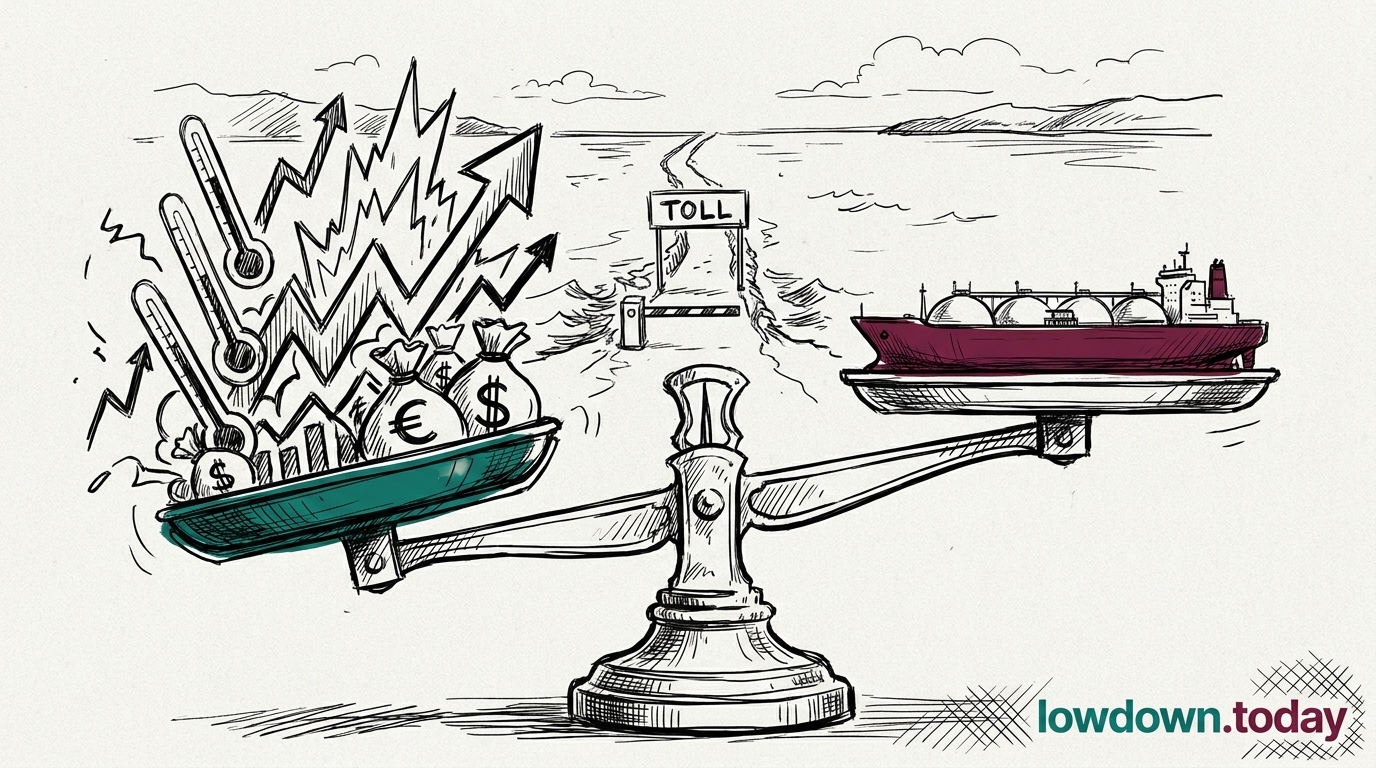
Washington reimposed a blockade on Iranian ports and a 20% Strait of Hormuz cargo toll on 13 July, driving TTF's 9% two-session rally to EUR 54.995/MWh. The posture is again setting Europe's gas benchmark by sentiment rather than by any confirmed change in cargo flows.
EDF
EDF
EDF slipped the Bugey 3, Golfech 2 and Chooz 2 restarts to 19, 22 and 25 July, pushing all three past the 20 July Bugey heat exemption, after river-cooling limits on the Rhone, Garonne and Meuse forced the cuts. The same thermal ceiling has capped the fleet in every major heatwave since 2003, and this cycle is no exception.
German power desk
German power desk
German day-ahead power climbed from EUR 126 to EUR 156/MWh over 14-16 July as the heat dome held, flipping the clean spark spread positive for the first time since 14 July. Gas-for-power demand is now back in competition with mandate storage injection right as the injection margin itself is thinning.
EU carbon and storage regulators
EUA carbon broke EUR 81/tonne on 13 July as the ETS Market Stability Reserve's scheduled withdrawals met fresh fuel-switching demand from France's nuclear curtailment. Brussels' mandatory storage-fill rule kept German and French injection running regardless of the TTF swings, the mechanism working as designed four years after the 2022 shock.
Equinor
Equinor
Equinor returned its Asgard field from maintenance on 11 July, lifting Gassco's exit nominations to 319.8 mcm/day just as TTF round-tripped on Hormuz risk. The restart gave Norway spare pipeline capacity to help Europe absorb the gas rally without drawing down storage, reinforcing its role as the post-2022 swing supplier.
