Skip to content
You can now search across every topic, entity and event.What's new
European Energy Markets
10JUL

OIES puts refill on track for 70%

4 min read
10:05UTC

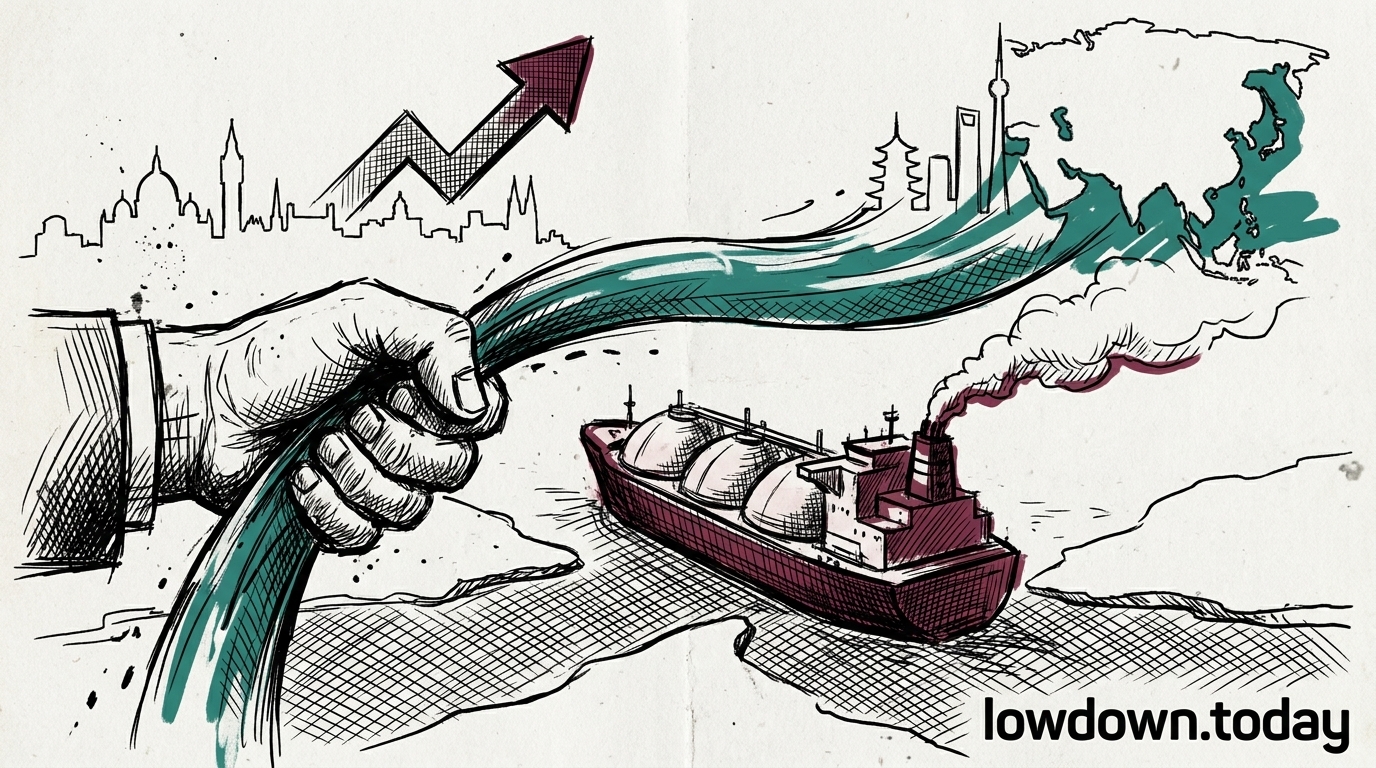
The Oxford Institute for Energy Studies put EU storage on track for 70% by November, not the mandated 80%, against a forward curve at $14.72/MMBtu that prices a fuller supply recovery than the physical balance supports.

EconomicDeveloping
Key takeaway

OIES puts the November refill on track for 70%, not 80%, against a forward curve pricing a faster supply recovery.

The Oxford Institute for Energy Studies (OIES) published its June Comment putting EU storage on track to reach 70% by 1 November, not the mandated 80%, on a net European LNG shortfall of 2.1 bcm a month through October 1. OIES is the Oxford-based research body whose gas reviews are reference material for European trading desks. Its balance nets an 8.6 bcm Qatar-UAE loss against only 4.3 bcm replaced from other suppliers and 2.2 bcm shaved from non-EU and UK demand.

The Comment opens a wedge against the forward curve. TTF forwards average $14.72/MMBtu for 2026, below even the $13.50 OIES modelled in March for a rapid Qatari reopening, while OIES warns that above $20/MMBtu may be needed to choke enough demand to refill if Hormuz stays shut. The curve is pricing the optimistic leg of a distribution whose central case is materially worse, a roughly 40% gap below the level OIES says a closed strait requires.

Storage stood at 45.3% on 18 June, filling about 10% below the pace required for the 80% floor and continuing the under-pace trajectory that projected 67% in early June from a 40% reading 2. The mandates remain the only structural injector , with commercial arbitrage absent while the summer-winter strip holds inverted on the 58 mtpa of new global LNG capacity due in H2 . This is a relative-value asymmetry rather than a directional call: the prompt has priced relief that the back of the curve, carrying the risk the supply recovery cannot arrive before the window closes, has not.


Deep Analysis

In plain English

The Oxford Institute for Energy Studies is a respected research group that publishes detailed analyses of gas supply and demand. In June 2026 they calculated that Europe will end up with underground storage only 70% full by the start of November, not the 80% the EU requires as a minimum safety buffer before winter heating season begins. The reason is a shortfall in deliveries of liquefied natural gas, gas chilled to liquid for shipping by sea. Because the Strait of Hormuz, the main exit route for Qatar's massive gas export terminal, was closed since March, about 2.1 billion cubic metres less LNG arrives in Europe each month than normal. Qatar, which produces roughly a fifth of the world's gas, had two of its production facilities destroyed during the conflict. Even now that the strait is reopening, those two facilities cannot be repaired for years. To attract enough extra gas from elsewhere, OIES estimate European gas prices may need to rise about 40% above where they are today. That would make energy significantly more expensive for households and businesses over winter.

Deep Analysis
Root Causes

The OIES 70% central case rests on three independent structural constraints that compound each other. First, Qatar's Ras Laffan export complex, which supplied close to a fifth of global LNG before the conflict, cannot return to pre-conflict volumes at any opening date because two production trains were destroyed in March. OIES models only the trains that can physically restart, capping Qatari contribution in any reopening scenario.

Second, the JKM-TTF spread at USD 4.35/MMBtu remains above OIES's USD 2.50-3.00 diversion breakeven , meaning Atlantic LNG cargoes face stronger commercial incentives to route east than west. The Disha, the first post-conflict Hormuz transit, cleared India not Europe, this pattern establishes the commercial routing priority that OIES's non-EU demand reduction assumption has to overcome.

Third, EU storage fill at 45.3% on 18 June is already running at 3,257 GWh/day , 10% below the 3,615 GWh/day floor needed for 80% by November, and the only injectors are the EBN, CRE and ARERA mandate programmes . Commercial injection economics at EUR 41 TTF with an inverted or flat strip offer no arbitrage incentive.

What could happen next?
  • Risk

    If OIES's 70% central case materialises and cold weather arrives before mid-November, the European Commission would face pressure to invoke emergency supply-sharing measures under Regulation (EU) 2022/1369, the crisis regulation previously activated in summer 2022.

    Medium term · Assessed
  • Consequence

    The 10 bcm gap between 70% and 80% storage implies a TTF price recovery toward USD 20/MMBtu through August-September if Qatari LNG normalisation is slower than Goldman's end-July timeline.

    Medium term · Assessed
  • Opportunity

    Desks long winter TTF or long H1 2027 TTF carry a structural upside tail if OIES's 70% case proves accurate; the spread between EUR 41 current spot and the USD 20 demand-choke level is the pricing range for that optionality.

    Medium term · Assessed
First Reported In

Update #19 · German spark spread flips +EUR 15 in 48hrs

EnergyRiskIQ· 18 Jun 2026
Read original
Causes and effects
This Event
OIES puts refill on track for 70%
The 80% floor is unreachable on current pace without a demand shock or faster Qatari return, opening a back-curve refill risk the front-month relief does not reflect.
Different Perspectives
EU carbon and storage regulators
EUA carbon broke EUR 81/tonne on 13 July as the ETS Market Stability Reserve's scheduled withdrawals met fresh fuel-switching demand from France's nuclear curtailment. Brussels' mandatory storage-fill rule kept German and French injection running regardless of the TTF swings, the mechanism working as designed four years after the 2022 shock.
Equinor
Equinor
Equinor returned its Asgard field from maintenance on 11 July, lifting Gassco's exit nominations to 319.8 mcm/day just as TTF round-tripped on Hormuz risk. The restart gave Norway spare pipeline capacity to help Europe absorb the gas rally without drawing down storage, reinforcing its role as the post-2022 swing supplier.
Germany
Germany
Germany briefly became the cheaper leg of the FR-DE spread on 12 July as French reactors went offline, while its own storage injection tripled to 723 GWh on 11 July under the EU's mandatory fill rule. Berlin's CCGT fleet absorbed the extra load at a time when EUA's climb past EUR 81 is raising its own marginal cost too.
EDF
EDF
EDF took Chooz, Golfech and Bugey fully offline on 12 July under river-cooling discharge limits, then secured a temperature exemption for Bugey to 20 July rather than wait for the rivers to cool. The government's willingness to relax the environmental ceiling shows French grid security now outweighs the permit breach when reactor hardware itself is undamaged.
Storage and injection-pace desk
EU storage sat at 51.1% on 8 July, still running below the pace needed for an 80% November target, and the JKM-TTF Asia premium of roughly USD 1.4-2.4/MMBtu was already pulling marginal cargoes east before Qatar's withdrawal compounded the gap. October's top-up remains the binding constraint, not this week's price level.
EDF / France
EDF / France
EDF added Chooz to its heat-curtailment watch list as a precaution against the second heat dome peaking 9-14 July, alongside standing warnings at Blayais, Bugey, Golfech and Saint-Alban. No output cut has been confirmed at any site as of 10 July.
