Skip to content
You can now search across every topic, entity and event.What's new
European Energy Markets
3JUL

CEGH pays a one-day ban premium

3 min read
09:57UTC

The CEGH-TTF day-ahead basis widened to roughly EUR 1.62/MWh on 17 June, four times its pre-ban reading, then compressed back toward flat the next day as Iran relief firmed TTF.

EconomicDeveloping
Key takeaway

CEGH paid a EUR 1.62 ban premium over TTF for one session, then compressed to flat as TTF firmed.

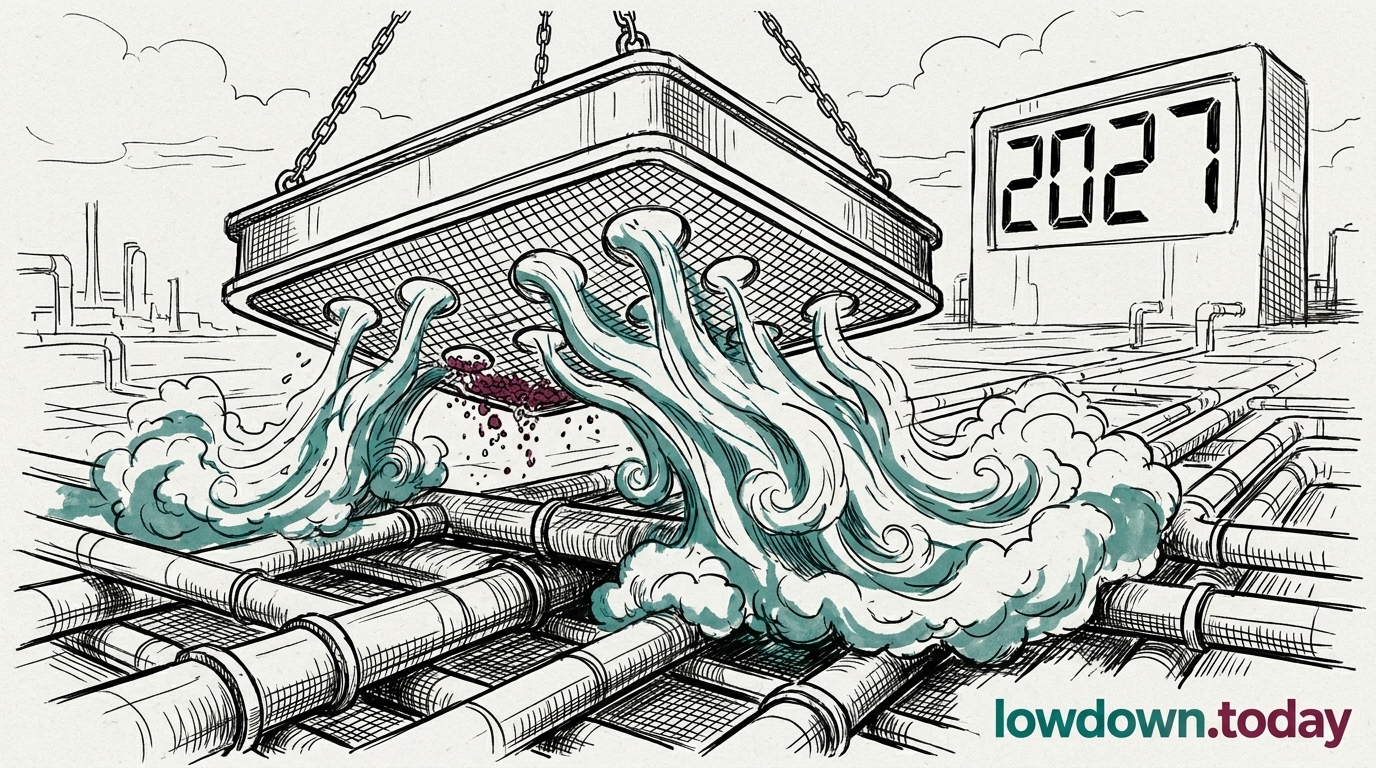
The basis between the Central European Gas Hub (CEGH) and TTF widened to roughly EUR 1.62/MWh on a day-ahead basis on 17 June, the ban-binding day, around four times the EUR 0.41 reading of 11 June , on CEGH exchange data 1. CEGH is Austria's virtual trading point at Baumgarten, historically tracking TTF closely; the basis is the premium Central European buyers pay over the Dutch benchmark. CEGH day-ahead settled EUR 42.742, the EUR 1.62 gap sitting above the same-day TTF print covered in event 2.

The widening reflected one-day supply uncertainty at the Kipi margin, the Greek-Turkish pipeline crossing through which non-EU molecules enter the grid, as the ban bound. It was small and physical, consistent with TurkStream's long-term contracts staying exempt to September 2027 , which limited the volume the regulation actually removed. The market had already isolated this premium as an uncorroborated bid that diverged from the flat prompt .

The premium did not hold. On 18 June, the Iran-relief session, CEGH eased to EUR 42.050 and the basis compressed back toward flat as TTF firmed 2. The widening was a single-session event, not a structural step-change, but it was tradeable: a desk that bought the CEGH-TTF basis into the binding date and sold it the next day captured the one mark the ban Left on the curve. The lesson for a Central European basis trader is narrow: the regulation's physical bite was a one-day move at one hub, not a durable repricing.


Deep Analysis

In plain English

Austria trades gas at a virtual hub called CEGH. Usually it costs very slightly more than the main European price (TTF in the Netherlands) because Austria sits further from the main supply routes. When a new EU rule banning short-term Russian gas pipeline contracts took effect on 17 June, traders buying gas for delivery into Austria the next day were uncertain whether supplies arriving via a Turkish pipeline at the Greek border would still flow. To be safe, they paid a bit more for Austrian gas, about EUR 1.62 above the Dutch price, four times the usual gap. By the next day it was clear the pipelines had kept flowing and the uncertainty had passed. The premium evaporated. The episode showed that the ban had real, if brief, supply implications for Central European buyers, even though the biggest pipeline; TurkStream, is exempt from the ban until 2027.

Deep Analysis
Root Causes

Baumgarten's virtual clearing price (CEGH) reflects the risk that physical molecules nominated at the Kipi border crossing might not flow at contracted volumes. When Regulation 2026/261 bound on 17 June, the short-term contracts at Kipi became unenforceable, creating a one-day uncertainty over whether day-ahead nominations would clear.

TurkStream's long-term contracts for Hungary (MVM 3.5 bcm, ) and Slovakia were exempt, but the Kipi margin, covering short-term contracts for Austrian and Czech buyers, was not.

The one-day nature of the widening shows the physical volume at the Kipi short-term margin was small relative to total Central European supply. Once the 18 June day-ahead nominations cleared normally, the supply uncertainty resolved and CEGH eased back toward TTF. The residual structural question is whether BOTAS origin-blending at Kipi means the effective supply was never disrupted, in which case the EUR 1.62 widening overstated the physical risk.

What could happen next?
  • Risk

    A successful Slovakia CJEU interim stay would reopen short-term contract volumes at Kipi and could generate a CEGH-TTF basis compression of EUR 1-2/MWh, the inverse of the 17 June widening, as the ban uncertainty would lift.

  • Precedent

    The single-session basis widening with same-day compression confirms that CEGH-TTF basis trading requires intraday risk management around ban-binding dates; overnight positions face gap risk that one-day implied volatility models underestimate.

First Reported In

Update #19 · German spark spread flips +EUR 15 in 48hrs

Central European Gas Hub· 18 Jun 2026
Read original
Different Perspectives
EU carbon and storage regulators
EUA carbon broke EUR 81/tonne on 13 July as the ETS Market Stability Reserve's scheduled withdrawals met fresh fuel-switching demand from France's nuclear curtailment. Brussels' mandatory storage-fill rule kept German and French injection running regardless of the TTF swings, the mechanism working as designed four years after the 2022 shock.
Equinor
Equinor
Equinor returned its Asgard field from maintenance on 11 July, lifting Gassco's exit nominations to 319.8 mcm/day just as TTF round-tripped on Hormuz risk. The restart gave Norway spare pipeline capacity to help Europe absorb the gas rally without drawing down storage, reinforcing its role as the post-2022 swing supplier.
Germany
Germany
Germany briefly became the cheaper leg of the FR-DE spread on 12 July as French reactors went offline, while its own storage injection tripled to 723 GWh on 11 July under the EU's mandatory fill rule. Berlin's CCGT fleet absorbed the extra load at a time when EUA's climb past EUR 81 is raising its own marginal cost too.
EDF
EDF
EDF took Chooz, Golfech and Bugey fully offline on 12 July under river-cooling discharge limits, then secured a temperature exemption for Bugey to 20 July rather than wait for the rivers to cool. The government's willingness to relax the environmental ceiling shows French grid security now outweighs the permit breach when reactor hardware itself is undamaged.
Storage and injection-pace desk
EU storage sat at 51.1% on 8 July, still running below the pace needed for an 80% November target, and the JKM-TTF Asia premium of roughly USD 1.4-2.4/MMBtu was already pulling marginal cargoes east before Qatar's withdrawal compounded the gap. October's top-up remains the binding constraint, not this week's price level.
EDF / France
EDF / France
EDF added Chooz to its heat-curtailment watch list as a precaution against the second heat dome peaking 9-14 July, alongside standing warnings at Blayais, Bugey, Golfech and Saint-Alban. No output cut has been confirmed at any site as of 10 July.
