Skip to content
Briefings are running a touch slower this week while we rebuild the foundations.See roadmap
European Energy Markets
4JUN

TTF holds EUR 46-47 range; NBP reaches parity

3 min read
10:45UTC

TTF front-month range-traded EUR 46-47/MWh on 28 May while NBP settled at 112.3p/therm, equivalent to roughly EUR 46.5/MWh, eliminating the UK's historical LNG-import discount.

EconomicDeveloping
Key takeaway

NBP-TTF parity eliminates the UK's historical discount and removes a structural relief valve for Continental gas supply.

TTF front-month traded in a EUR 46-47/MWh range on Wednesday 28 May, with intraday prints at EUR 46.93 (up 0.75%) and EUR 46.02 (down 3.38% session-on-session). The one-month price change stands at +0.15%, confirming the market is range-trading between diplomatic signals rather than trending. The EUR 50 diplomatic ceiling established when a US-Iran deal headline knocked 8.1% off the benchmark remains intact despite more than 50 mcm/day of verified Norwegian outages.

The price action confirms Timera's framing : the strip is a Troll-restart long, not a supply-disruption trade. TTF failing to sustain EUR 47+ with 51 mcm/day of Norwegian capacity offline tells desks that the market is pricing restart, not sustained loss.

NBP settled at 112.3p/therm on 28 May, equivalent to roughly EUR 46.5/MWh at prevailing FX. That is effective parity with TTF. Historically NBP has traded at a persistent discount, reflecting the UK's superior regasification capacity through South Hook, Dragon LNG and Isle of Grain. At parity, UK regasification capacity no longer offers a discount to attract marginal cargoes. South Hook alone handles roughly 20% of UK gas supply; losing the NBP discount that routed cargoes there removes a buffer that Continental buyers have relied on since 2011. For LNG procurement desks, parity eliminates any routing-cost incentive to send flexible cargoes preferentially to UK terminals over Continental ones.


Deep Analysis

In plain English

TTF and NBP are the wholesale gas price benchmarks for Continental Europe and the UK respectively, similar to how Brent crude is used for oil. For years the UK paid slightly less for gas than Continental Europe because it has good LNG import terminals and can receive cargoes from many global sources. That discount has now disappeared: UK gas costs the same as European gas. This matters because gas prices set the marginal cost of electricity generation in most of Europe. When TTF and NBP converge, UK electricity bills track Continental electricity costs rather than benefiting from a structural discount.

Deep Analysis
Root Causes

NBP-TTF convergence reflects two structural changes: the BBL interconnector capacity halving to 22 mcm/day in December 2024, and the IUK (Interconnector UK) capacity reduction to 36 mcm/day from 1 October 2026, cutting Continental-to-GB import capacity from 17% to 12% of UK demand. These reduce the UK's ability to draw supplementary gas from Continental surplus, forcing domestic LNG terminals to clear UK demand without arbitrage relief from the Continent.

The JKM-TTF spread at approximately USD 2.30/MMBtu still favours Asian buyers at the margin, meaning flexible Atlantic LNG cargoes are not routing to Europe; the UK and Continental markets are competing for the same limited inbound cargo flow rather than drawing from a shared surplus.

What could happen next?
  • Consequence

    The structural NBP-TTF convergence means the UK cannot use its LNG import infrastructure as a buffer for Continental supply shocks; every future European supply disruption will now transmit to UK prices at near-full parity rather than the historical 5-10% discount.

  • Risk

    The TTF EUR 50 diplomatic ceiling will break to the upside if the Iran negotiation collapses and Hormuz closure duration extends beyond the IEA mid-year base case, removing the geopolitical price cap and allowing physical fundamentals to drive price formation above EUR 55/MWh.

First Reported In

Update #13 · Storage on track by 45 GWh; one outage away

IndexBox / Carbon Pulse / Reuters· 29 May 2026
Read original
Different Perspectives
TTF traders / Amsterdam hub desks
TTF broke its 38-session EUR 46-47 band on 2 June to EUR 48.9 on stalled Iran diplomacy and an unconfirmed Troll A restart; Dutch EBN mandates carry storage trajectory while commercial injection books nothing. The 17 June pipeline expiry is the next binary level: Central European hub premium above EUR 2/MWh widens sharply on any physical step-down.
Red Electrica / Spanish grid operators
Spain logged 397 negative-price hours in Q1 2026, eight times the 48 hours of Q1 2025, documenting midday solar surplus now embedding structurally into Continental pricing. Spain is four to six quarters ahead of France and Germany on the solar-penetration curve, making it the clearest forward indicator of where Continental midday clearing is heading.
Equinor
Equinor
Equinor issued no Troll A restart notice through 4 June despite extending the combined outage to 31 May, keeping up to 51 mcm/day of Norwegian supply offline alongside Hammerfest LNG dark since 22 April. The company's silence follows its 2025 Hammerfest pattern, which ran 24 days past target, and each day without a notice sustains the TTF supply premium.
European Commission / GMTF
SWD(2026)147 found EU gas spot and derivatives markets functioning well on 2 June, recommending MiFID-REMIT legislative alignment rather than emergency intervention. The GMTF verdict addressed derivatives-market integrity, not the physical injection mechanism FNB Gas declared broken five days earlier: the Commission's immediate next step is a legislative proposal, not an emergency storage order.
FNB Gas / Bundesnetzagentur
FNB Gas declared the storage-refill mechanism broken on 27 May after zero bookings in January 2026 auctions, and German day-ahead cleared EUR 102.64 on 3 June on a CCGT stack set by TTF near EUR 49 plus EUA near EUR 78. Winter storage fill now depends on state mandates with no commercial self-correction.
EDF / French government
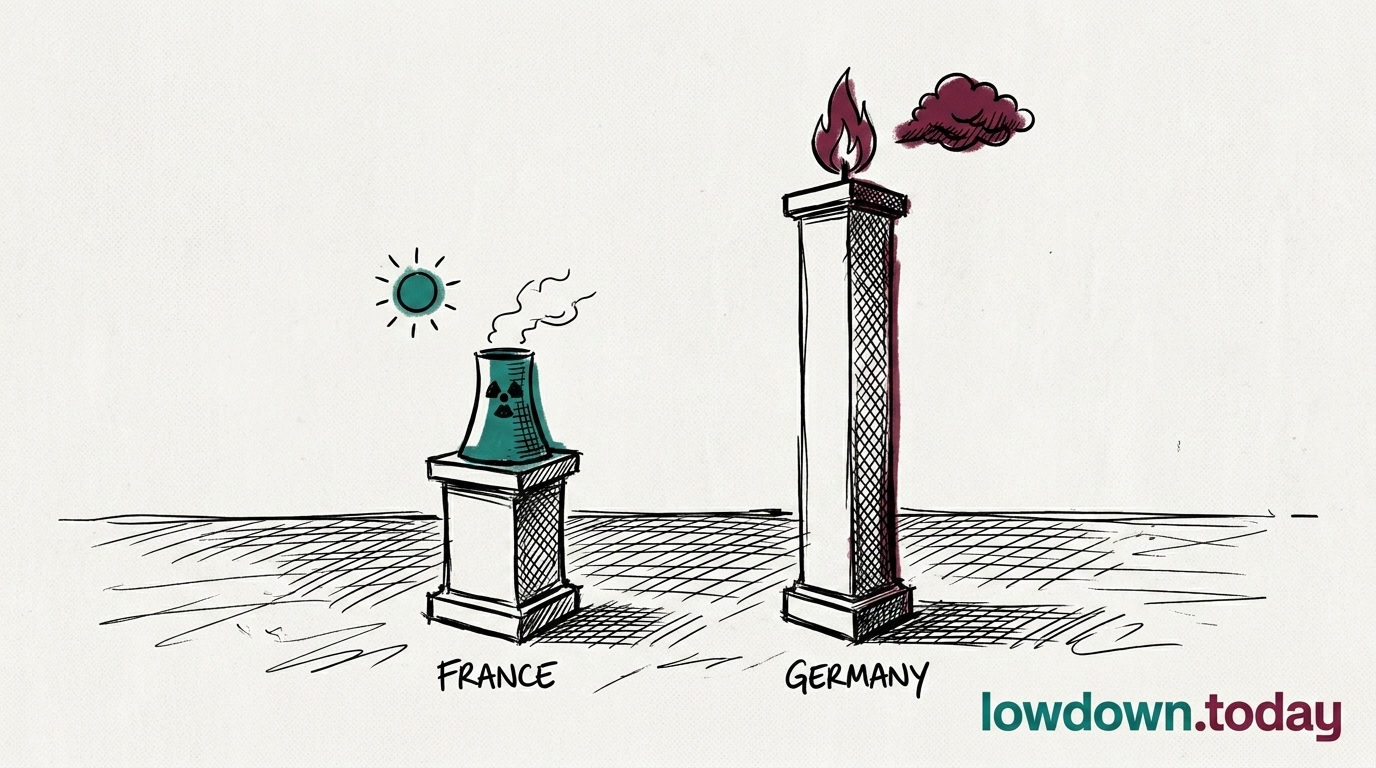
EDF held full-year nuclear guidance at 350-370 TWh after April output of 29.3 TWh, anchoring the surplus that collapsed French day-ahead to EUR 8.96 on 3 June and passed that price to VNU industrials. Flamanville-3's September overhaul removes 1.6 GW at heating-season onset, reversing the nuclear surplus that made VNU pricing competitive.
