Skip to content
Briefings are running a touch slower this week while we rebuild the foundations.See roadmap
European Energy Markets
18MAY

Germany at 27.2%; pace track 52% by Nov

3 min read
11:11UTC

Germany's gas storage reached 27.2% on 5 May after a season-strong 959 GWh net injection, but the average pace since 13 April projects roughly 52% fill by 1 November.

EconomicDeveloping
Key takeaway

Germany's 0.179 pp/day average since 13 April projects roughly 52% storage fill by 1 November.

Germany's gas storage reached 27.2% fill (64.7 TWh) on 5 May, the Bundesnetzagentur's daily print shows, after a season-strong net injection of 959 GWh on 4 May. The headline single-day rate masks a 22-day average pace of 0.179 pp/day, well below the roughly 0.27 pp/day required from here for a 75% November target.

The Bundesnetzagentur is Germany's Federal Network Agency, publishing daily storage and grid data. Germany operates the EU's largest underground storage estate, and its trajectory drives the bloc's compositional risk: an aggregate floor met by Spain and Italy without Germany delivers the headline number on a fragile geographical mix. The 13 April starting point is not arbitrary either, that is the date Germany flipped from net withdrawal of 459 GWh/day to net injection.

The 745 GWh/day season-high on 25 April was not sustained, and 959 GWh on 4 May has read as the same kind of isolated spike rather than a step change. At the 22-day average, Germany lands near 52% fill on 1 November. The aggregate pace floor carries an implicit composition assumption: that Germany delivers the ground share. Germany missing it by nearly 0.08 pp/day is the geographical mix that breaks the bloc-level number from the inside, even when Spain and Italy hit theirs.


Deep Analysis

In plain English

Germany has the biggest underground gas storage system in Europe, think of it as the central warehouse that helps keep the whole continent supplied through winter. Right now that warehouse is only 27.2% full, and it is filling up much more slowly than it needs to. At the current pace, Germany will reach about 52% full by the start of November. That sounds like more than half, but gas storage needs to be much fuller than that to comfortably handle a cold winter. Germany's shortfall pulls the EU aggregate down from inside: because it holds the largest store in the bloc, other member states filling on target cannot compensate for a German pace gap of 0.09 pp/day.

Deep Analysis
Root Causes

Germany's injection rate tracks the summer-winter spread net of cavern operating costs and capital cost of gas held in inventory. At EUR 44/MWh TTF against an implied Q4 level, the spread is insufficient for high-operating-cost salt-cavern operators to justify aggressive injection. The gas storage levy, the instrument that bridged the gap between commercial injection economics and policy-required pace, was abolished on 1 January 2026.

A second structural cause: Germany entered the injection season at 21% fill in April, its lowest winter-end level since 2018, having drawn storage harder than any comparable EU state through the extended cold period. The lower the starting point, the further to travel, which compounds the pace requirement on the same infrastructure envelope.

The failed 10 GW hydrogen-ready gas plant auction law (blocked by the SPD Environment Ministry, ) removed the forward infrastructure signal that would have incentivised cavern operators to invest in higher sustained injection rates. Long-range infrastructure financing responds to policy certainty; without it, cavern operators optimise for short-cycle returns.

What could happen next?
  • Risk

    Germany's 52% November trajectory triggers the Bundesnetzagentur's early warning framework assessment; if pace does not accelerate by June, emergency market intervention instruments become the base case rather than the contingency.

    Medium term · 0.72
  • Consequence

    Below-floor German pace drags the bloc-level aggregate even if peripheral EU markets (Spain, France, Italy) meet their national targets, making the EU 80% aggregate unachievable through peripheral over-performance alone.

    Short term · 0.82
  • Opportunity

    A summer-winter TTF spread widening to EUR 10–12/MWh above current levels would shift injection economics for German cavern operators into positive territory, potentially closing the pace gap without policy intervention.

    Short term · 0.55
First Reported In

Update #8 · Storage 34.3 as 12 May test nears; Hammerfest silent

news.de (relaying Bundesnetzagentur data)· 8 May 2026
Read original
Different Perspectives
US LNG exporter (Sabine Pass / Corpus Christi)
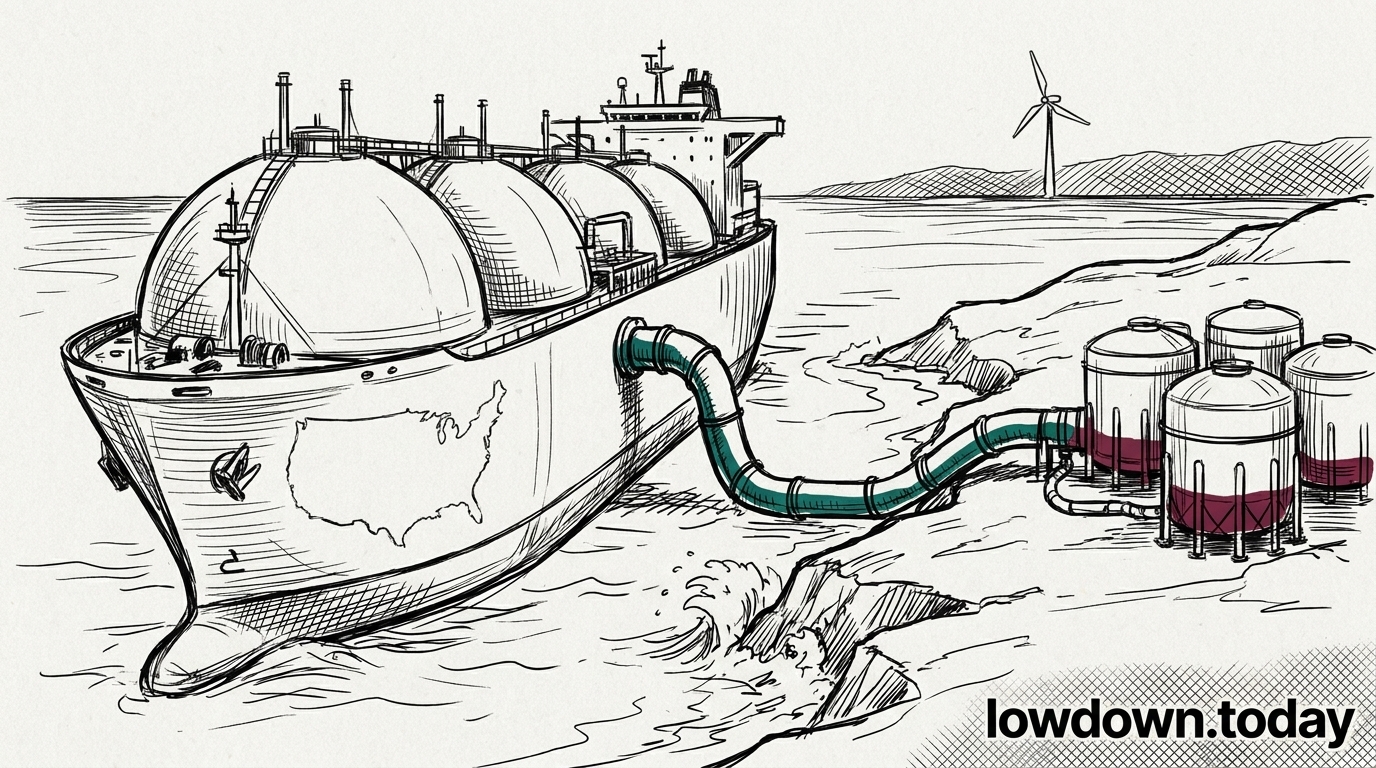
The 58% EU import share confirmed by ACER, heading toward 65% in 2026, represents a structural long-term offtake position that European terminal operators are now willing to underwrite against the German 2031 gas-demand floor. Ribera's warning lands inside a commercial relationship that is expanding, not contracting.
Teresa Ribera, European Commission EVP
Ribera warned Europe should 'avoid replacing one energy dependency with another', framing the ACER 58% US LNG figure as a supply-security risk in the same week TTF broke EUR 50. Her institution has spent EUR 117 billion on US LNG since 2022.
Yara International (ammonia producer)
Front-month TTF at EUR 50+ touches the demand-destruction threshold at which ammonia output curtailments have historically been triggered. Yara faces the same lock-or-ride binary as financial desks, but the downside is production loss rather than mark-to-market exposure.
Katherina Reiche, German Economy Minister
Reiche confirmed the 12 GW hydrogen-ready gas tender is formally agreed with the EU Commission, with first auctions in 2026 and all units operational by 2031. The confirmation closes three years of SPD environment-ministry obstruction and anchors German gas demand through the early 2030s.
European gas trader (Amsterdam desk)
The EUR 50 break is a watershed signal, not a squeeze: the forward curve at EUR 55.21 twelve months out implies the market has repriced structural winter risk, not a positioning overshoot. The lock-or-ride decision on winter hedges closes in June when injection-pace data for May lands.
Hungarian and Slovak gas buyers and regulators
Hungary cleared EUR 123.23/MWh on 12 May, EUR 54 above Spain's same-day clearing and the largest single-market premium of the briefing series, as ACER named it among seven NRAs in TurkStream derogation opinions with the 5 August EC ruling pending. A denial of derogation removes the only available pipeline substitute for Russian LNG banned since 25 April.
