Skip to content
Briefings are running a touch slower this week while we rebuild the foundations.See roadmap
Drones: Industry & Defence
21MAY

Arsenal-1 opens months early in Columbus

3 min read
11:11UTC

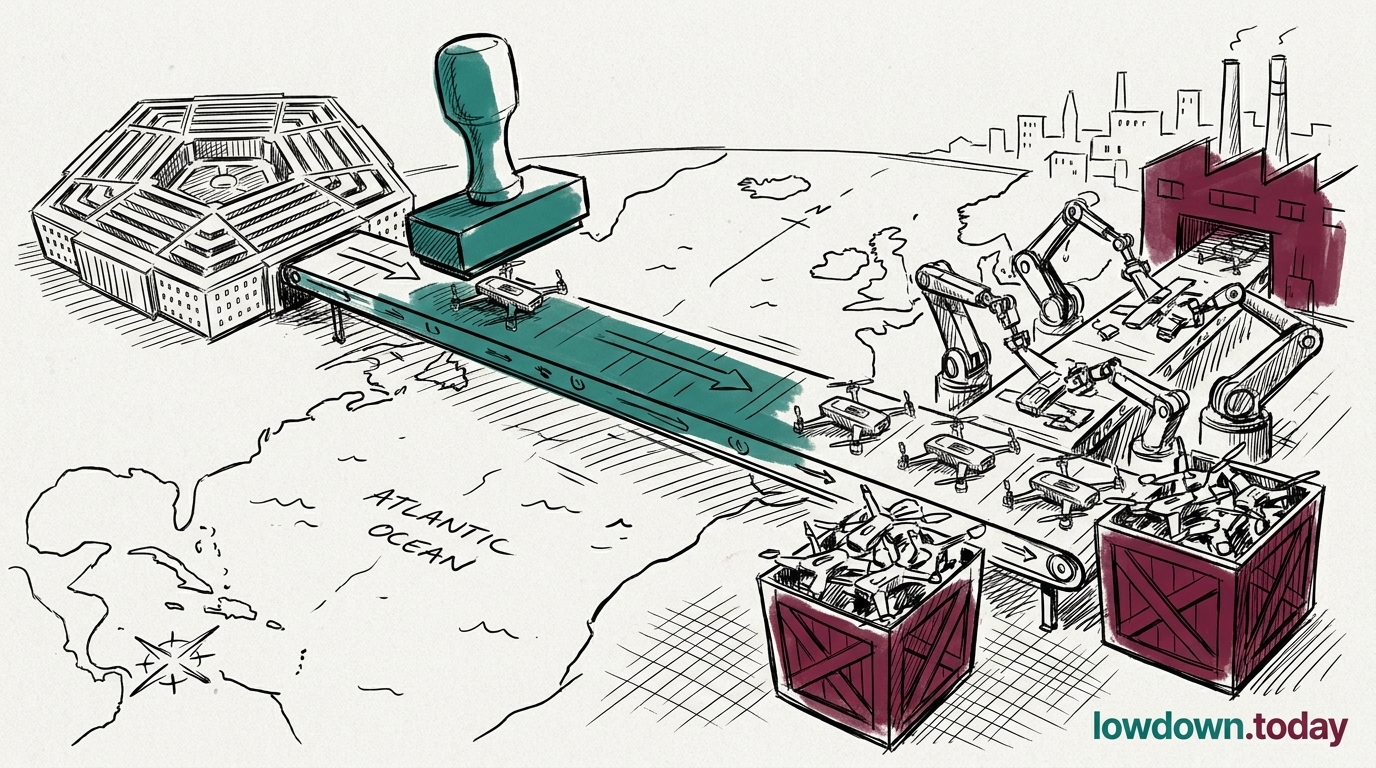
The 5-million-square-foot Arsenal-1 facility, backed by Ohio's largest-ever single employer incentive, will begin producing Fury autonomous combat aircraft before the Pentagon selects a CCA winner.

TechnologyDeveloping
Key takeaway

Arsenal-1 repositions Anduril as a tier-1 prime contractor — scale manufacturing is the new competitive moat.

Anduril's Arsenal-1 manufacturing facility in Columbus, Ohio will begin production "in a matter of days" — months ahead of its announced July 2026 opening 1. The 5-million-square-foot plant sits on a 500-acre site near Rickenbacker International Airport. A $310 million JobsOhio grant backs the project — the state's largest single incentive package — with 4,000 jobs promised 2.

The first product off the line: the YFQ-44A Fury, Anduril's entry in the Air Force's Collaborative Combat Aircraft competition. Jason Levin, Anduril's SVP of Engineering, said the facility will produce "YFQ-44s at rate, but also many other Anduril products" 3.

Anduril was founded in 2017. Nine years later, it is building out manufacturing floor space that exceeds most legacy defence contractors' individual plants. The acceleration from announced timeline to production suggests a company that has structured its build-out around speed — a contrast with the multi-year facility programmes typical of established primes. Ohio's $310 million incentive, its largest ever for a single employer, is one measure of how aggressively US states are competing for defence manufacturing capacity as Pentagon procurement shifts toward newer entrants.

The timing carries competitive weight. Anduril faces General Atomics and Northrop Grumman for the initial CCA production contract, with a decision expected this fiscal year. Having a factory producing Fury airframes before that decision is a manufacturing readiness demonstration that planned future capacity, however credible, cannot fully replicate.

Deep Analysis

In plain English

Anduril has built a factory the size of 87 football pitches in Ohio, and it is opening ahead of schedule. The state of Ohio contributed over $300 million to support its construction because it will employ 4,000 people. The first products will be autonomous military aircraft, but the facility is designed to manufacture many different Anduril weapons systems. This matters because it signals a fundamental shift in who makes America's weapons. Traditionally, a handful of giant defence companies — Lockheed, Northrop, Raytheon — dominated military manufacturing. Anduril, founded only in 2017, now operates a facility that rivals theirs in scale, and it got there faster than any of them have expanded in decades.

Deep Analysis
Synthesis

Arsenal-1's 5-million-square-foot scale exceeds any single product's foreseeable demand, and the confirmation that it will produce many other Anduril products reveals the factory as a platform for industrial diversification rather than a programme-specific asset. This mirrors SpaceX's Starbase strategy: proprietary scale manufacturing creates a cost structure that incumbent prime contractors, operating through fragmented subcontractor networks, structurally cannot replicate at equivalent per-unit economics.

Root Causes

The $310M JobsOhio grant reflects a structural shift in US industrial policy not addressed in the body: states are now competing aggressively for defence manufacturing through direct subsidy, mirroring the semiconductor incentive architecture of the CHIPS Act. This pattern — federal acquisition increasingly shaped by state-level industrial competition — is accelerating the geographic consolidation of defence manufacturing capacity in subsidy-competitive states.

Escalation

The months-early opening implies Anduril received sufficient advance commitment — either confirmed orders or high-confidence forecast demand — to justify accelerating capital deployment ahead of the announced schedule. The CCA source selection expected this fiscal year creates a hard deadline: production readiness demonstrated before the award is a material competitive argument in source selection evaluation.

What could happen next?
  • Precedent

    A defence tech firm founded in 2017 now operates America's largest single job-creation manufacturing investment, demonstrating that the traditional prime contractor model can be bypassed through integrated capital and manufacturing strategy.

    Immediate · Reported
  • Opportunity

    Arsenal-1 positions Anduril to bid the lowest per-unit cost in follow-on CCA and counter-UAS production contracts, where manufacturing scale rather than development heritage determines competitive position.

    Short term · Assessed
  • Risk

    Single-site concentration of critical autonomous weapons production creates a supply chain vulnerability — a natural disaster, labour action, or facility incident would disrupt the entire production line simultaneously.

    Medium term · Assessed
  • Consequence

    Traditional primes face structural margin compression as Arsenal-1 reaches capacity utilisation and Anduril's per-unit economics fall below those achievable through subcontractor-dependent production models.

    Medium term · Assessed
First Reported In

Update #2 · UK startup tops Pentagon's drone gauntlet

Defense One· 19 Mar 2026
Read original
Causes and effects
This Event
Arsenal-1 opens months early in Columbus
A defence startup founded in 2017 is opening one of the largest new weapons manufacturing facilities in the US months ahead of schedule, backed by $310 million in state funding. The early production start gives Anduril a manufacturing readiness argument in the CCA competition that its legacy competitors have not publicly matched.
Different Perspectives
Institutional investors and defence-sector equity markets
Perennial's IDIQ gives revenue-visibility that earlier Schmidt ventures lacked; Northrop's dual award places a heritage prime on the attritable-payload standard-setting layer analysts had reserved for startups. Rheinmetall at €650 per share, up from €500 in January, prices auto-grade drone conversion as margin-accretive; DroneShield's ASIC probe introduces a governance-discount variable proxy advisers will apply at the 29 May AGM.
Korean defence-industrial sector (LIG Nex1, Hanwha Aerospace)
LIG Nex1's $2.2 billion Cheongung-III win and the KUS-FS service introduction together close Seoul's sovereign layered air-defence stack; both firms face multi-year backlog revisions on the Korea Exchange. The unresolved sensor-to-shooter integration risk between Hanwha's LAMD sensors and LIG Nex1's Cheongung-III engagement layer sits publicly unaddressed ahead of the 2029 fielding date.
Ukrainian export regulator (SSEC)
Ukraine's wartime export ban blocks Gulf sales of combat-proven interceptors at $2,100 to $2,500 per unit while Perennial Autonomy, built on Ukrainian combat data, wins a $500 million US IDIQ. Perennial's Merops, credited with 4,000-plus Russian drone kills in Ukraine, can now reach NATO allies via Munich; a direct Ukrainian sale to those same buyers remains legally blocked.
DJI and Autel Robotics
Autel's Ralls Corp filing attacks the classified-evidence foundation of its Covered List designation; DJI's parallel Ninth Circuit case has quantified $1.56 billion in 2026 regulatory losses. Both companies are now betting the D.C. Circuit will extend due-process protections to FCC product certification, a constitutional route that does not require contesting the intelligence allegations directly.
US Pentagon defence-industrial-base policy
JIATF-401's IDIQ names Perennial the benchmark holder while Anduril's $20 billion Lattice vehicle and Northrop's Drone Dominance payload role run in parallel lanes; the DoD bet is that named holders at each tier cut order-to-delivery cycles. The Section 232 clock 54 days overdue signals the administration treats FCC and FAR exclusions as sufficient to manage Chinese market access.
European defence procurement community
Germany's three-tier award demonstrates that EU member states can fund loitering-munition production at scale without single-supplier dependency, and Perennial's Munich line gives procurement offices a domestic-source justification for Merops orders outside US Foreign Military Sales channels. The Bundeswehr's split across Helsing, Stark and Rheinmetall has become the reference architecture other European buyers are mapping their own industrial bases against.
