Skip to content
You can now search across every topic, entity and event.What's new
Data Centres: Boom and Backlash
7JUL

Seattle locks in its data-centre freeze

3 min read
09:27UTC

Seattle's City Council voted 9 to 0 on 9 and 10 June to enact the 365-day moratorium it introduced on 30 April, attaching dated power and water deliverables the introduction lacked.

IndustryDeveloping
Key takeaway

Seattle made its data-centre freeze binding 9-0 and set July power and October water deadlines for city utilities.

Seattle's City Council voted 9 to 0 on 9 and 10 June to enact the 365-day moratorium it had introduced on 30 April , making the freeze legally binding rather than provisional 1. The threshold is any new load above 20 MVA (megavolt-amperes, a measure of apparent electrical capacity, here roughly the draw of 16,000 homes). The ordinance exempts Seattle's existing data centres, which may keep expanding under current rules, so the freeze bites only on new arrivals.

The enactment carries a delivery calendar the introduction did not. Seattle City Light, the municipal electric utility, must propose rate and capacity changes by 1 July, and Seattle Public Utilities must deliver a water-usage assessment by 30 October. A moratorium that names deadlines and assigns them to specific agencies is harder to let quietly expire than a blanket pause with no homework attached, because each missed date is a visible failure rather than an absence.

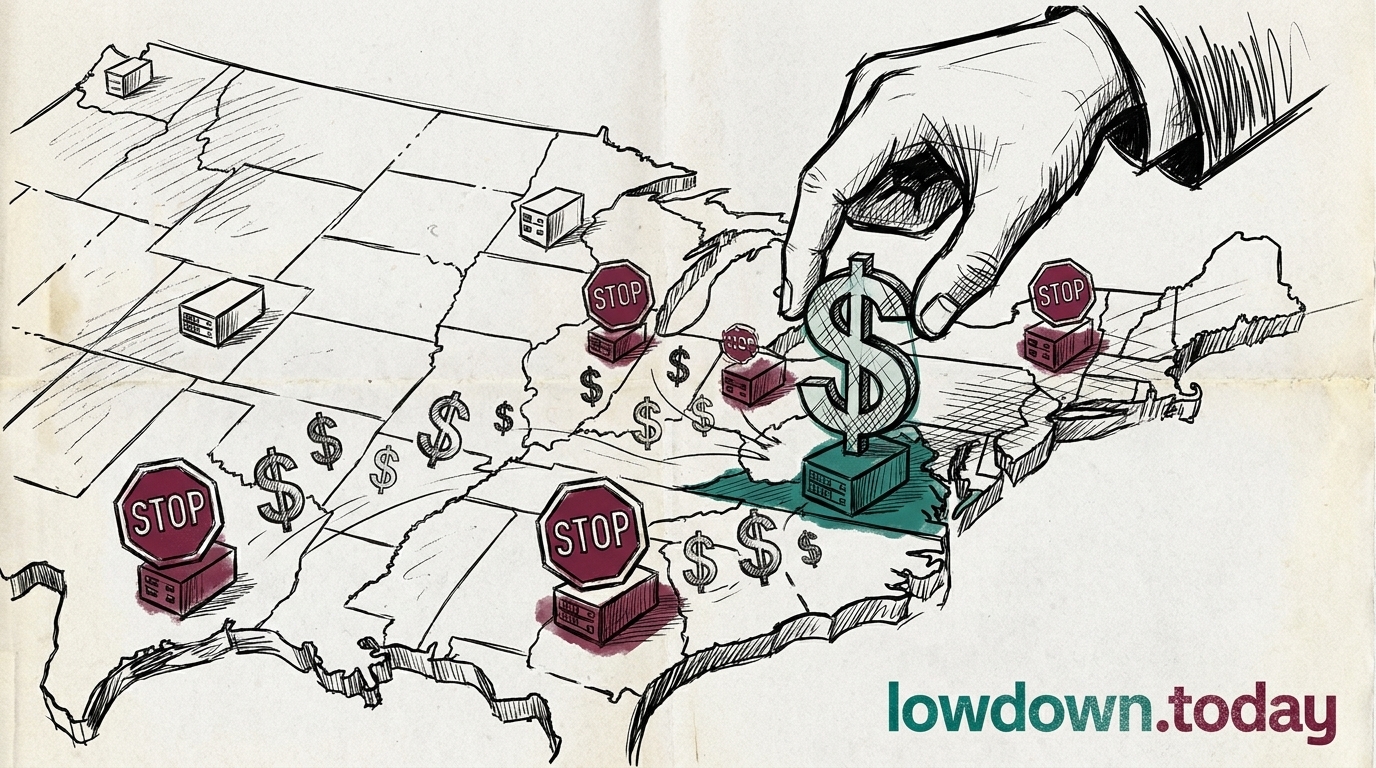
Seattle now joins more than 70 US cities and counties carrying bans or pauses 2. Where Indiana is rural breadth with no veto point, Seattle is a major metro committing to concrete deliverables on power and water before it writes permanent rules. The two routes answer the same demand from opposite ends: one distributes refusal across many small boards, the other concentrates it in a single council willing to put dates on the page.

Deep Analysis

In plain English

Seattle's city council voted unanimously on 9 and 10 June to stop any new large data-centre connections for a year. The cut-off is 20 MVA, which is megavolt-amperes, a measure of electrical capacity roughly equivalent to the combined draw of 16,000 homes. Anything smaller than that threshold can still connect. Existing data centres in Seattle keep their current connections and can expand under pre-moratorium rules. Only new proposals above 20 MVA are blocked. The council also set specific things that must happen during the year-long pause. Seattle City Light, the city's electricity company, must propose how it would change rates and capacity rules by 1 July 2026. Seattle Public Utilities, which manages the water supply, must report how much water data centres use by 30 October 2026. Seattle owns its electricity company, City Light, rather than buying power from a private utility. That ownership gives the city council a direct lever: it can instruct City Light to refuse load requests, which most US cities with investor-owned utilities cannot do. The moratorium works here because of that municipal ownership.

What could happen next?
  • Precedent

    Seattle's binding delivery calendar, with specific dates for utility rate and water studies, makes it the most structurally complete US moratorium, giving other cities a legislative template that pairs the freeze with a policy development process.

First Reported In

Update #7 · Virginia taxes the backup, not the draw

Seattle City Council· 17 Jun 2026
Read original
Causes and effects
This Event
Seattle locks in its data-centre freeze
A major metro has committed to specific rate and water assessments before it writes permanent data-centre rules.
Different Perspectives
Global hyperscale operators
Operators are still filing gigawatt-scale campuses and Meta is proceeding with its $10bn Lebanon, Indiana site despite the county-level bans nearby, betting Q2 capex outruns the patchwork of restrictions. Industry framing casts New York's freeze, Oregon's surcharge and Indiana's bans as taxes and levies that push build-out toward faster-permitting jurisdictions such as India and the Gulf.
EirGrid
EirGrid
EirGrid set a 900 MW instantaneous demand-loss ceiling because a single voltage dip can trip many data centres onto backup power at once, risking imbalance above 1,150 MW. It wrote the limit into a standing procedure rather than waiting for an emergency to force one.
US host communities and ratepayers
Prince William residents backed the 8-0 denial of Dulles South over the Occoquan watershed, drinking water for eight million people, while Oregon's approved tariff cuts residential bills 1.3% by charging large loads 29% more. Their position: consent and cost-attribution belong in law, not left to a developer's or a utility's discretion.
Hassan Allam Digital Infrastructure
Hassan Allam Digital Infrastructure, an Egyptian conglomerate rather than a foreign hyperscaler, reportedly secured a domestic hyperscale licence with a $400m first phase, per single-source reporting still to be verified. It reads as home-grown sovereign compute ambition, building national capacity rather than importing a US or Gulf operator's campus.
Damac Digital
Damac Digital
Damac Digital keeps building toward roughly 6,000 megawatts of hyperscale capacity across 13 countries while Virginia taxes power and New York weighs a freeze. Every dollar or month of delay a US state adds is capacity a Gulf developer can site somewhere with faster permitting and no equivalent levy.
Acequia communities, Santa Fe County
Santa Fe County commissioners voted unanimously on 2 July to freeze any data centre over one megawatt, citing the acequia irrigation commons that has shared scarce water since Spanish colonial rule. They expect the low threshold to draw the same Fifth Amendment challenge RCM Hill brought against Hill County, Texas.

