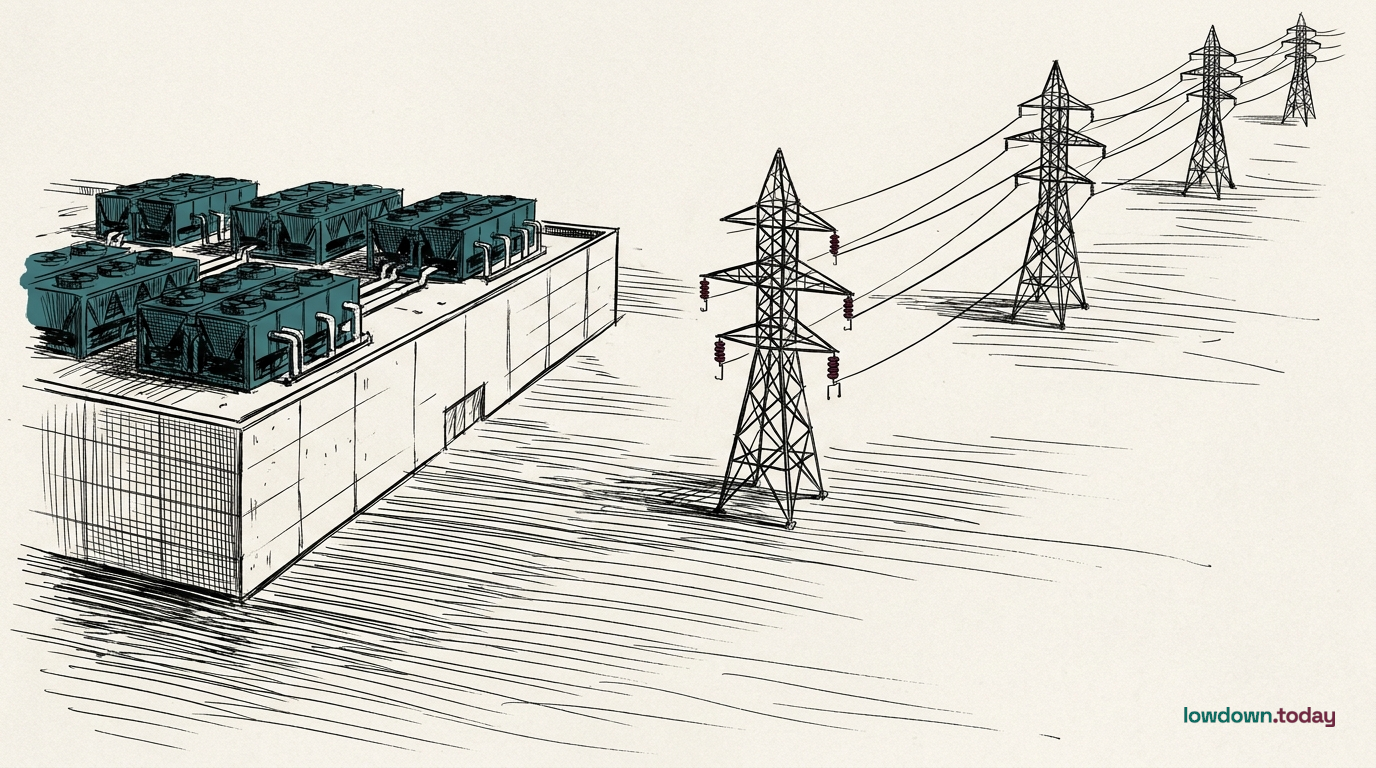
The Redheughs Avenue appeal in Edinburgh, case reference PPA-230-2794, was recalled on 17 August and now sits on hold with Scottish Ministers, carrying a target decision date of 28 September1. A recall lifts the decision away from the reporter appointed to hear it and puts it in ministers' hands. The application seeks planning permission in principle only, which settles whether a development of this kind belongs on the site without approving a design.
The scheme's agent confirmed in August that it would produce a full environmental impact assessment, the formal study of a development's environmental effects. Cases like this now turn on evidence about power and water demand rather than on land use alone, and that evidence has to come from a published dataset somewhere.
Britain's national demand figures come apart under the same scrutiny. Britain's data-centre connection queue is most often checked against the Transmission Entry Capacity register published by NESO, the National Energy System Operator that runs Great Britain's electricity system. Transmission Entry Capacity is the contracted right to put power on to the transmission system, and a data centre does the opposite: it takes power off. Lowdown counted the register's 2,202 entries on 8 September. 106 of them, 4.8%, carry any demand component in their plant type, and not one is demand alone; where demand appears it is compounded with generation at hybrid sites, in forms such as "Demand;Energy Storage System"2. The register updates twice weekly, so those counts carry that date.
A register holding no demand-only entries cannot produce a demand-queue total. The 125 GW that circulates as one traces instead to a NESO presentation on future demand increase, which attributes the figure there to Energy Networks Association connection data3. That presentation is an image-only document, so the attribution stands as what the slide says rather than as something we could verify at source. NESO's own reformed connections pipeline, published with its December 2025 reform results, reports 99 GW of transmission-connected demand4. Two datasets, two definitions, and a third number that belongs to neither.
Both figures already do work in live policy arguments. Ofgem proposed a refundable deposit on grid connection offers in late July, priced at up to £712,500 per MW, which means the case for pricing a queue rests on a queue length nobody has published authoritatively. Edinburgh shows the same problem at one address. Ministers hold a decision that turns on how much power a single scheme would draw, in a country where the national total cannot be read off the register everyone reaches for.





