Skip to content
You can now search across every topic, entity and event.What's new
Data Centres: Boom and Backlash
4AUG

GE Vernova backlog hits 116 GW

2 min read
10:53UTC

Synergy Research counted a near-45 GW US build pipeline across 74 companies on 23 July, while GE Vernova's gas-turbine backlog climbed to 116 GW, twin readings of demand still accelerating.

IndustryDeveloping
Key takeaway

GE Vernova's turbine backlog and Synergy's project count both show data-centre demand still accelerating.

Synergy Research Group, a technology-market research firm, counted a US forward pipeline near 45 GW across 74 companies on 23 July, with operational capacity set to double within three years. A forward pipeline is the order book of announced and planned builds not yet running. 1

GE Vernova, the turbine maker whose backlog tracks physical demand more closely than any hyperscaler's guidance, grew its gas-turbine order book from 100 GW to 116 GW, with data-centre orders alone reaching $5bn so far this year, more than double all of 2025. Chief executive Scott Strazik has watched that book lengthen through every quarter of the boom . 2

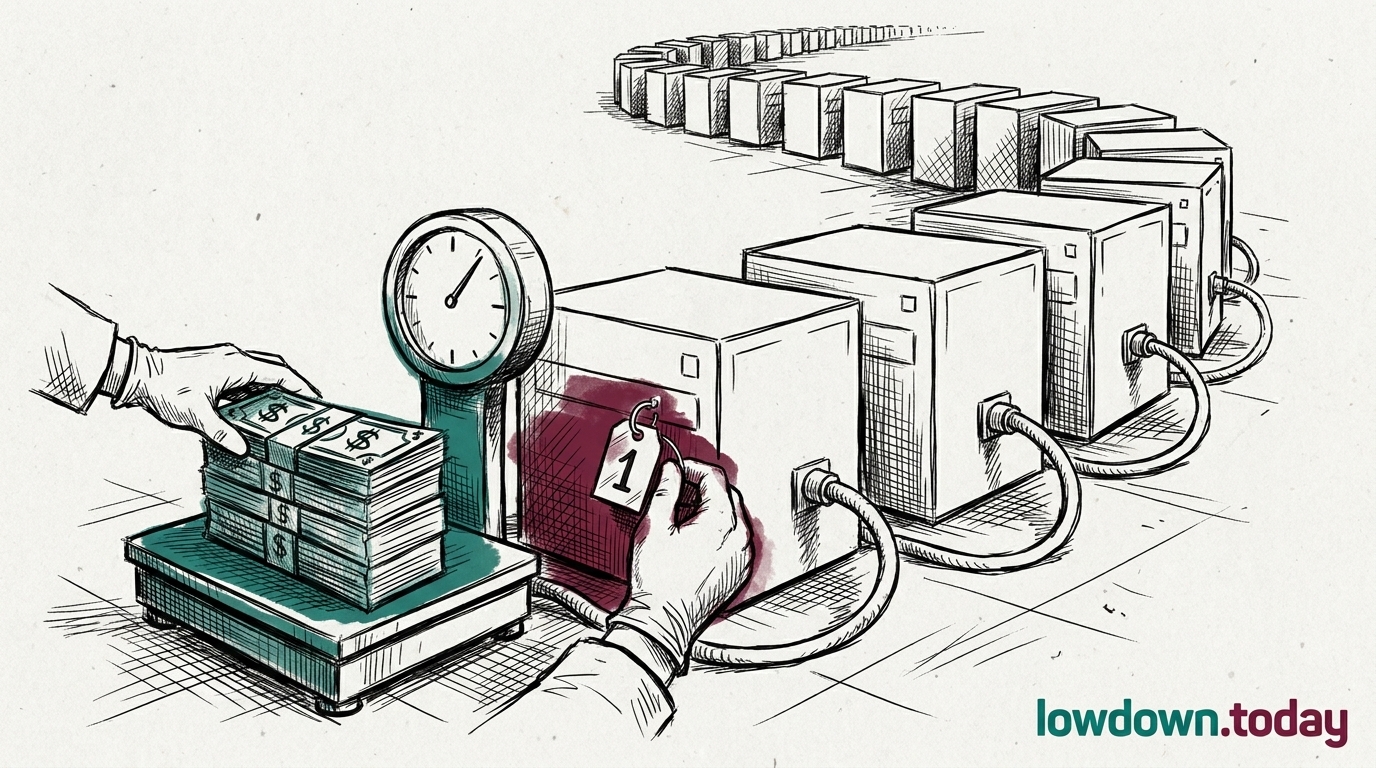
A lengthening turbine backlog reads as more than a sales figure; each order booked now is a delivery date pushed years out. Orders placed today wait years for hardware, pushing gas-turbine delivery further past 2029 and tightening the exact bottleneck that behind-the-meter gas plants, onsite generators wired straight to the load, were built to dodge. The analyst count, the order book and Alphabet's raised guidance move together because each measures the same physical demand, not one company's optimism.

Deep Analysis

In plain English

Synergy Research Group, a firm that tracks the data-centre industry, counted nearly 45 gigawatts (a measure of electricity capacity) worth of planned US data centres across 74 different companies as of 23 July. That is enough to roughly double the amount of data-centre capacity actually running today, within three years, if everything gets built on schedule. But building that much depends on gas turbines, the machines that generate backup and sometimes primary power for these sites. GE Vernova, a major turbine maker, said its order backlog grew to 116 gigawatts, up from 100, with new orders already worth over $5 billion this year, more than all of last year. Turbines ordered now will not arrive for years, which limits how fast the pipeline can actually get built.

Deep Analysis
Root Causes

The 45 GW pipeline's operational-capacity doubling claim depends on hardware Synergy does not control: gas turbines from GE Vernova and its competitors, whose backlogs are booked years out, are the physical bottleneck standing between an announced project and a running data centre.

Seventy-four companies competing for the same limited pool of turbine manufacturing slots means individual project timelines increasingly depend on where in the queue a given order landed, not on how quickly permits clear.

What could happen next?
  • Risk

    If turbine lead times stretch further as GE Vernova's backlog grows, a meaningful share of Synergy's 45 GW pipeline is likely to slip well past the three-year doubling timeline regardless of how permitting disputes resolve.

First Reported In

Update #11 · Pipeline vetoed, campus keeps building

Synergy Research Group· 25 Jul 2026
Read original
Causes and effects
This Event
GE Vernova backlog hits 116 GW
Two independent instruments, an analyst's project count and a turbine-maker's order book, register the same physical demand climbing in step.
Different Perspectives
Government of Odisha
Odisha signed a $1.5bn agreement with HCLTech and Sarvam AI on 24 July for a sovereign AI data centre in Bhubaneswar, targeting 2028 operations. While regulators elsewhere price developers out of the queue, Odisha is bidding state financial assistance to bring capacity in, betting the AI infrastructure boom is worth courting rather than rationing.
Switch Datacenters and Uithoorn
The developer, the municipality, Liander and dozens of greenhouse growers signed a waste-heat agreement letting a 60 MVA facility proceed under a provincial rule that bans sites above 5 MVA. The public-interest exception argues the site relieves rather than adds to grid congestion, working around a standing ban from inside rather than waiting for it to change.
Iskandar Puteri residents
Residents protested in February over falling water pressure they attribute to ZDATA's 300 MW construction; ZDATA disputes causation and has not yet resolved the dispute with its wastewater-only pivot. The complaint sits unadjudicated while the operator advertises compliance to state authorities the residents cannot address directly.
Microsoft
Microsoft
DC Byte reports Microsoft looking to the Nordics for new capacity while Dublin's regional share falls to 15 per cent, though this is a market-intelligence inference rather than a company statement. Microsoft keeps its existing Dublin cloud region, which is costly to relocate, while directing new investment where power is cheaper and the queue is shorter.
ISO New England
ISO New England
ISO-NE proposed excluding new large loads from its Installed Capacity Requirement entirely, forcing data centres to bring their own generation or accept curtailment, even though New England's demand has been flat or falling for a decade. The reform is pre-emptive, written before the region has felt the strain PJM and MISO already report.
Ofgem
Ofgem
Ofgem opened its Data Centre Commitment Fee consultation on 29 July, arguing that free options on grid capacity let developers bank places on ten sites and abandon nine, crowding out projects that would build. It expects the deposit to filter the queue before the rule even takes final form.

