Skip to content
You can now search across every topic, entity and event.What's new
Autonomous Systems: Land & Sea
12AUG

World Cup as a counter-drone audition

3 min read
14:17UTC

DroneShield and Ondas-owned Sentrycs were both selected to provide counter-drone coverage at the 2026 FIFA World Cup in Kansas City, against a $250m federal security budget.

TechnologyDeveloping
Key takeaway

Counter-drone vendors are using the World Cup as a public audition for military and border contracts.

DroneShield was selected to provide counter-drone coverage for the 2026 FIFA World Cup in Kansas City, and Sentrycs, acquired this year by Ondas Holdings (NASDAQ: ONDS), was selected alongside it 1. Counter-unmanned-aircraft-system (C-UAS) work means detecting and defeating hostile or stray drones over a venue, the kind of perimeter a stadium hosting matches watched worldwide now requires. The federal C-UAS budget for the tournament was set at $250m by FEMA, the US disaster-and-security agency .

The selection works as a shop window. A marquee event seen by a global audience doubles as a live audition for the same vendors chasing military and border contracts, and securing a slot is a reference customer of a kind a glossy brochure cannot buy. For Sentrycs the win lands weeks after Ondas folded it into a roll-up of drone and counter-drone firms, so a freshly acquired name gets a high-visibility deployment to point future buyers at. For DroneShield it is a second US revenue stream sitting beside its border-system work. A clean, well-run World Cup deployment becomes a procurement credential; a visible failure becomes the opposite, which is the risk that comes attached to any audition this public.

Deep Analysis

In plain English

The 2026 FIFA World Cup, hosted across multiple US cities, has a $250m federal budget just to protect matches from drone threats. Two companies have been chosen for the work in Kansas City: DroneShield, the Australian counter-drone firm whose gear jams hostile drone signals, and Sentrycs, an Israeli company recently bought by a US drone roll-up group called Ondas Holdings. For both companies, performing well in front of billions of television viewers is a better sales tool than any brochure. Governments and militaries around the world will be watching. A clean deployment with no drone incidents becomes a reference they can use in future tenders; a visible problem becomes a story they cannot escape.

Deep Analysis
Root Causes

Two forces combined to produce a $250m C-UAS budget for a sporting event.

First, the 2024 New Orleans attack (a vehicle attack at a New Year's celebration) sharpened DHS and FEMA's assessment that mass events with international audiences represent prime soft-target environments.

The US intelligence community upgraded its threat assessment for the 2026 World Cup specifically because it is jointly hosted across multiple cities with a multi-month run, creating a sustained exposure window rather than a concentrated one. The $250m reflects that extended threat window, not a single-event security cost.

Second, the Section 232 UAS tariff investigation (still pending as of 21 May 2026 per ) incentivised DHS to pre-commit C-UAS budget before any tariff regime changed the vendor market. Locking contracts with DroneShield and Sentrycs before tariffs potentially raised the cost of non-US components removes procurement risk from an already complex logistics operation.

What could happen next?
  • Opportunity

    A successful World Cup C-UAS deployment gives DroneShield and Sentrycs a government-validated civilian reference that military and border procurement agencies in non-combat NATO countries use as a low-risk entry point for C-UAS adoption, accelerating sales cycles in markets that require a reference customer before committing.

    Short term · Reported
  • Risk

    If the World Cup deployment reveals integration failures between DroneShield's and Sentrycs' systems, or if a drone incident occurs, both vendors face a publicly documented operational failure that competitors can cite in subsequent tender processes. The audition risk is proportional to the reference-value opportunity.

    Short term · Assessed
  • Consequence

    Sentrycs' World Cup win, landing weeks after Ondas Holdings acquired it, accelerates the return-on-acquisition timeline for Ondas: a freshly bought firm with a high-visibility US government deployment is significantly more attractive to the next institutional buyer or as an IPO candidate than one with only commercial references.

    Medium term · Assessed
First Reported In

Update #12 · Pentagon's drone buy lands a third short

Parsons Corporation· 15 Jun 2026
Read original
Different Perspectives
Conservative opposition
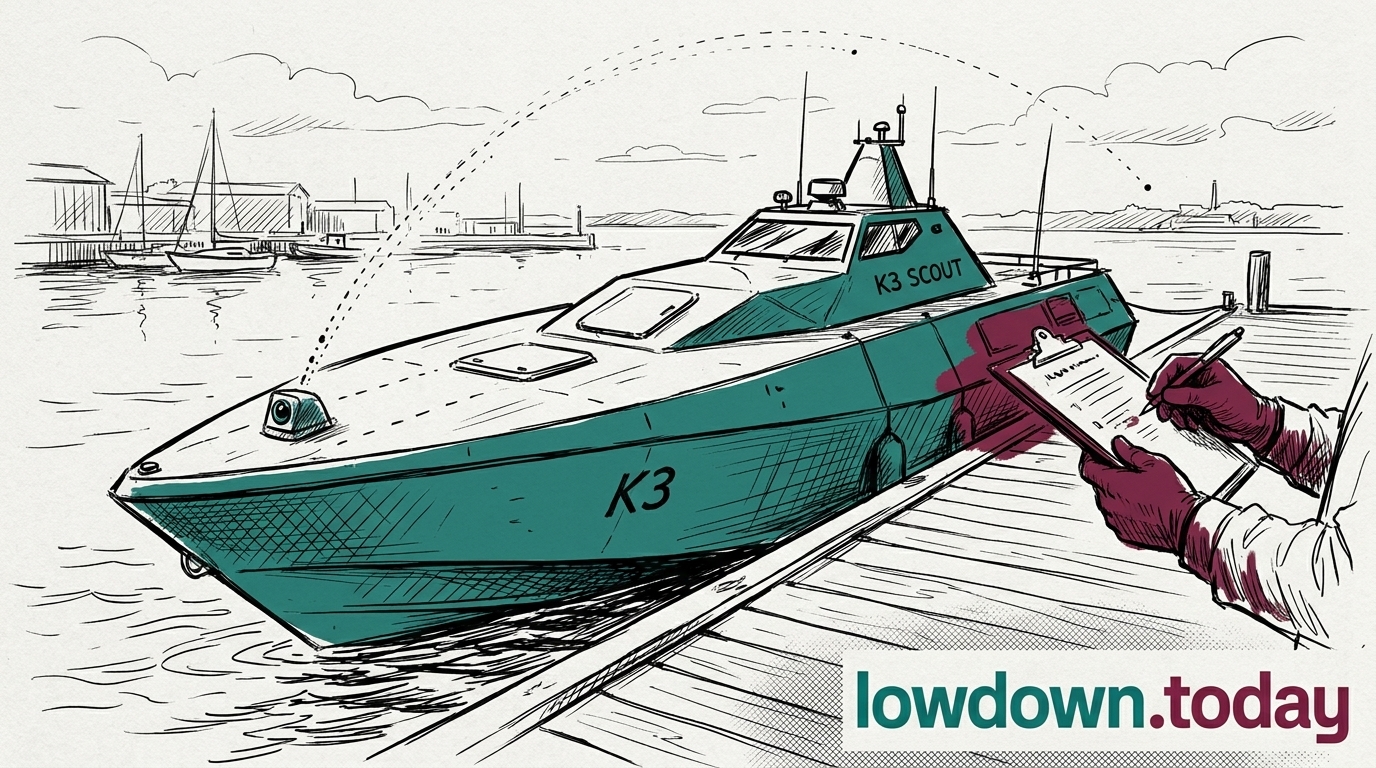
The Conservative opposition called on the Government on 9 August to 'urgently audit' equipment for hidden Chinese components, after the Telegraph's K3 SCOUT report. No named MP has been quoted on the record; the call came at party level, alongside the Ministry of Defence's own 10 August statement that no data had been compromised.
Netherlands Ministry of Defence
The Netherlands Ministry of Defence authorised Dutch Naval Design on 4 August to design 12-metre anti-submarine warfare uncrewed vessels for the Dutch-Belgian frigate programme, and to buy an adapted Compact FLASH dipping sonar from Thales Underwater Systems France. The order commits money and a named supplier while Britain's own certification body remains at the market-engagement stage.
Kraken Technology Group
Kraken Technology Group is a UK maritime-defence company based in Portsmouth that builds the K3 SCOUT, and crossed a $1bn valuation in July on a single-sourced $175m raise. The camera components reached the fleet under a third party's written security assurance, which the Platform Authority, which does not yet exist, was never positioned to check.
Navy Commercial
Navy Commercial
Navy Commercial at Whale Island published two notices on 5 August: 074032-2026, asking industry how to build a Platform Authority to certify uncrewed vessels, and 074351-2026, a GBP10m multi-role USV testbed for the Defence Chief Technology Officer. Responses on the Platform Authority close 19 August, ten days after the cameras were found transmitting to China.
Ministry of Defence
Ministry of Defence
The Ministry of Defence said on 10 August that a routine cyber vulnerability assessment found the camera fault, and a thorough investigation found no evidence that MoD data or systems had been accessed, compromised or transmitted externally. It stripped the cameras of internet connectivity but did not say whether it acted against the supplier.
Thales
Thales
Thales converted its 6 July engaging accord with Exail into a definitive combination agreement on 30-31 July, but the tender offer for Exail's remaining shares now closes by early 2028, later than July's timetable implied. Thales integrates its new undersea prime while still bidding against Kongsberg and DRASS's 2027 target for the AUKUS Pillar II contest.
