Skip to content
Welcome, thoughtbot's Giant Robots listeners!Start here
Autonomous Systems: Land & Sea
12AUG

FCC adds Chinese drones to banned list

4 min read
14:17UTC

DJI and Autel Robotics can no longer certify new products for American sale after the FCC designated all foreign-manufactured drones as covered equipment — and the Commerce Department stepped aside to let it stick.

TechnologyDeveloping
Key takeaway

The FCC ban converts a patchwork of agency restrictions into a single, durable template for excluding dual-use Chinese hardware.

The Federal Communications Commission added all foreign-manufactured drones and critical components to its Covered List on 22 December 2025, invoking Section 1709 of the FY25 National Defence Authorisation Act⁠1. DJI and Autel Robotics — which together account for the majority of US commercial drone sales — can no longer receive equipment authorisation for new products on the American market.

The Commerce Department had been developing separate restrictions under its own authority but withdrew them in January 2026, concluding the FCC action was sufficient⁠2. The consolidation avoided competing regulatory frameworks but introduced a transition gap: the ban targets new certifications, not existing inventory. Drones already in retail and distributor channels remain legal to sell and operate. The practical market closure begins when shelf stock depletes — a window measured in months, not years, given DJI's inventory turnover rates.

DJI holds an estimated 70–80% of the global consumer and commercial drone market and has built an integrated hardware-software ecosystem no single US manufacturer replicates. For agricultural surveyors, infrastructure inspectors, emergency responders, and filmmakers who depend on DJI products, the ban removes their primary supplier without a domestic alternative at comparable price or capability. Industry groups warned of higher costs and reduced functionality for smaller operators⁠3.

The regulatory rationale centres on supply chain security. Chinese-manufactured drones transmit flight telemetry and sensor data that, under China's 2017 National Intelligence Law, could be compelled for state intelligence purposes. DJI has consistently denied any unauthorised data exfiltration and offers local data processing modes in its products⁠4. The FCC did not adjudicate the technical dispute — it applied a supply chain exclusion framework that treats manufacturing origin as a proxy for risk, the same logic used against Huawei's telecommunications equipment in 2019. The approach is efficient from a regulatory standpoint but imposes real costs on an American drone sector that had no adequate domestic substitute ready at the point of implementation.

Deep Analysis

In plain English

The US government has blocked Chinese drone makers DJI and Autel from certifying new products for the American market. FCC certification is required to sell any wireless electronic device in the US, so without it, DJI cannot legally sell new products here — even though existing drones already in consumers' hands remain legal to use. Separately, the Commerce Department withdrew its own parallel ban, leaving the FCC as the sole mechanism. This consolidation matters because it sets a replicable template: any wireless hardware from a covered Chinese firm can be excluded through the same process.

Deep Analysis
Synthesis

The Commerce Department's withdrawal — deferring entirely to the FCC — consolidates domestic market exclusion authority under a single agency with a lighter administrative burden than Commerce's entity-list process. This is not merely procedural tidying: it creates a lower-friction pathway for future hardware bans and signals that the FCC, rather than Commerce, will be the primary instrument for domestic market exclusion of Chinese tech hardware. The two agencies retain distinct roles — Commerce for export controls, FCC for domestic market access — but the division of labour is now clearer and more operationally efficient for future restrictions.

Root Causes

The FCC's Section 1709 mechanism was originally designed for telecoms equipment but its wireless-device scope was always broad enough to cover any networked hardware. The FY25 NDAA explicitly expanded this scope to drones, reflecting a congressional consensus that drone data-collection and RF-emission capabilities constitute equivalent security risks to telecoms infrastructure — a threat-model extension that prior Congresses had not formally codified for hardware outside the telecoms sector.

Escalation

The consolidation of drone restrictions under the FCC Covered List rather than Commerce's entity list is architecturally significant beyond the DJI case. The FCC mechanism applies to any wireless device and involves a simpler administrative process than Commerce's entity-list procedures. The template for extending restrictions to other categories of Chinese consumer electronics with wireless connectivity is now established and operationally tested.

What could happen next?
1 precedent1 risk1 opportunity2 consequence
  • Precedent

    The FCC Covered List mechanism, initially designed for telecoms, is now established as the primary US instrument for domestic market exclusion of Chinese consumer electronics hardware with wireless capability.

    Long term · Assessed
  • Risk

    Chinese manufacturers may route production through third-country subsidiaries to circumvent FCC certification restrictions, as occurred with solar panels and telecoms equipment under earlier US restrictions.

    Medium term · Suggested
  • Opportunity

    US, European, and allied drone manufacturers face structurally reduced Chinese competition in the world's largest defence and commercial drone market, with the revenue transfer running into the billions annually.

    Immediate · Assessed
  • Consequence

    US industries dependent on affordable drone hardware — agriculture, infrastructure inspection, cinematography, insurance — face near-term cost increases until domestic alternatives achieve price parity with former DJI products.

    Short term · Assessed
  • Consequence

    The component-level scope of the ban raises manufacturing costs for all US drone producers sourcing Chinese-made parts, compressing margins across the domestic industry even as headline revenues grow.

    Short term · Suggested
First Reported In

Update #2 · UK startup tops Pentagon's drone gauntlet

CBS News· 19 Mar 2026
Read original →
Different Perspectives
Conservative opposition
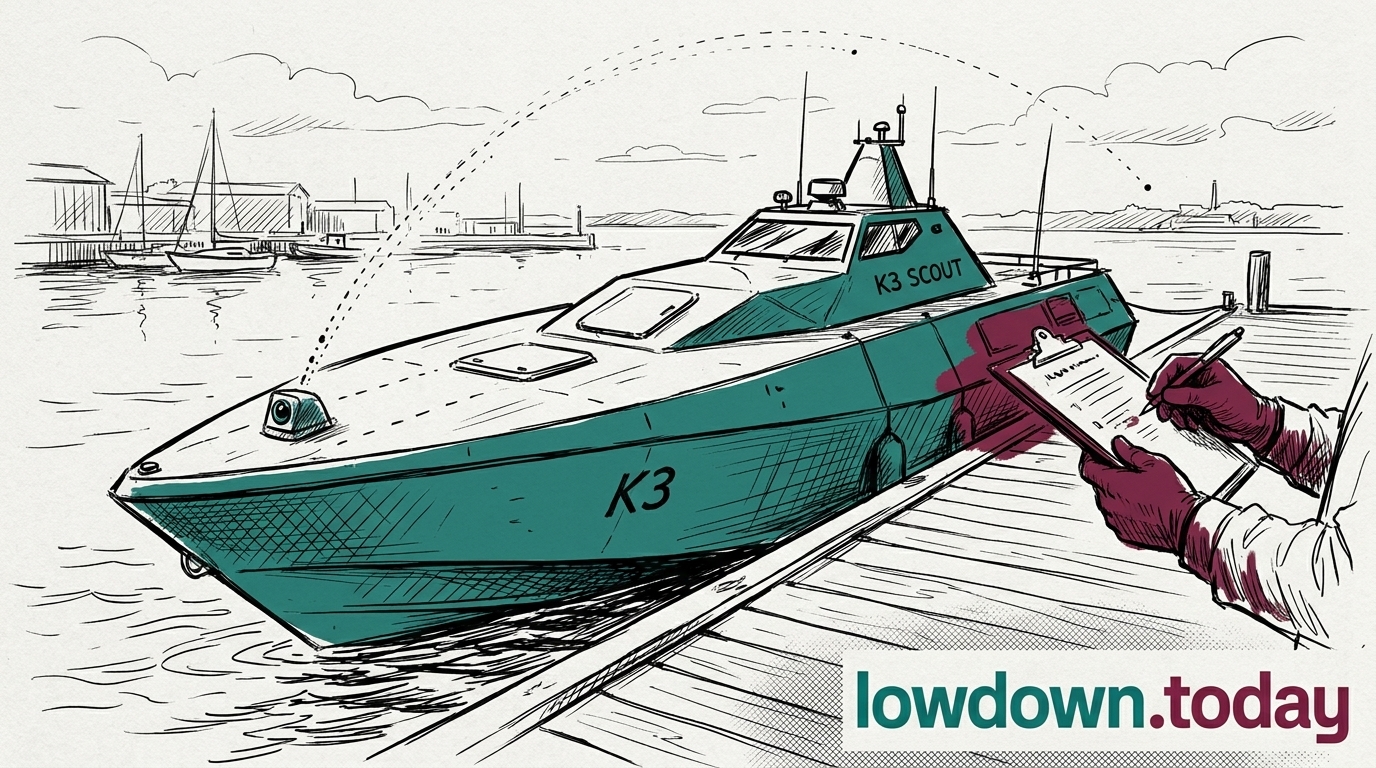
The Conservative opposition called on the Government on 9 August to 'urgently audit' equipment for hidden Chinese components, after the Telegraph's K3 SCOUT report. No named MP has been quoted on the record; the call came at party level, alongside the Ministry of Defence's own 10 August statement that no data had been compromised.
Kraken Technology Group
Kraken Technology Group is a UK maritime-defence company based in Portsmouth that builds the K3 SCOUT, and crossed a $1bn valuation in July on a single-sourced $175m raise. The camera components reached the fleet under a third party's written security assurance, which the Platform Authority, which does not yet exist, was never positioned to check.
Navy Commercial
Navy Commercial
Navy Commercial at Whale Island published two notices on 5 August: 074032-2026, asking industry how to build a Platform Authority to certify uncrewed vessels, and 074351-2026, a GBP10m multi-role USV testbed for the Defence Chief Technology Officer. Responses on the Platform Authority close 19 August, ten days after the cameras were found transmitting to China.
HUMAIN
HUMAIN
HUMAIN and Applied Intuition stated a 2030 target for thousands of autonomous trucks on Saudi logistics corridors. The announcement disclosed no order, fleet baseline or contract value.
Saildrone
Saildrone
Saildrone and Lockheed Martin demonstrated two JAGM launches from a Surveyor-class vessel at RIMPAC. The accepted record identifies no requirement, customer or production configuration behind the demonstration.
Taiwan Legislative Yuan
Taiwan's Legislative Yuan passed the Act at third reading with a small suicide uncrewed boat on the named development list. The NT$240 billion ceiling covers all unmanned domains, and the Act was not promulgated by 4 September.
