Skip to content
Welcome, thoughtbot's Giant Robots listeners!Start here
Autonomous Systems: Land & Sea
12AUG

Chinese drones banned from US contracts

2 min read
14:17UTC

A new procurement rule converts the FCC's foreign drone ban into a binding compliance requirement for every federal contractor.

TechnologyAssessed
Key takeaway

Federal contractors must now certify their drone supply chains are free of covered foreign components.

FAR clause 52.240-1 took effect on 13 March 2026, prohibiting drones manufactured or assembled by American Security Drone Act covered foreign entities from any federal contract.⁠1 Every federal contractor must now certify compliance.

The clause is the enforcement mechanism for the FCC's December 2025 decision to add foreign-manufactured drones and components to its Covered List. Where the FCC action blocked new product certifications, FAR 52.240-1 reaches into existing supply chains. Contractors using DJI, Autel Robotics, or any other covered manufacturer's components in federally funded work must now find alternatives or lose eligibility. The compliance burden falls hardest on smaller integrators who lack the procurement teams to audit complex component supply chains.

Deep Analysis

In plain English

Until now, companies doing work for the US government could use drones containing Chinese-made parts. From 13 March, they cannot, and they must sign a legal declaration saying their equipment is clean. In practice, Chinese companies like DJI dominate global drone component manufacturing, so this creates a significant problem for contractors who built their products using cheaper Chinese motors, cameras, or flight controllers. They must now either find alternatives or stop bidding on government contracts. The rule applies to the whole supply chain, not just the final product, which makes compliance complicated and expensive.

Deep Analysis
Root Causes

The FAR clause is the legislative terminus of a policy chain begun with Section 889 of the FY2019 NDAA. Each successive layer restricted Chinese technology further: Section 889 (2019), FCC Covered List (December 2025), and now FAR 52.240-1. The escalation reflects intelligence assessments of data exfiltration risk from DJI telemetry, which remains classified but has informed congressional action since 2017.

The enforcement gap between the FCC's certification block and FAR's supply chain audit requirement also reflects the practical limits of US government monitoring capacity. Certifying that a component is compliant requires the government to accept contractor representations it cannot independently verify at scale.

What could happen next?
  • Consequence

    Supply chain audits across the federal contractor base will cost tens of millions in aggregate compliance expenditure, disproportionately affecting smaller integrators.

    Immediate · High
  • Opportunity

    US-manufactured drone component suppliers gain an immediate captive federal market as covered foreign components must be replaced.

    Short term · High
  • Risk

    Self-certification without mandatory audit mechanisms creates legal exposure rather than actual supply chain change, potentially leaving Chinese components in the supply chain.

    Short term · Medium
  • Precedent

    The FAR clause model, combining FCC certification block with procurement exclusion, will become the template for restricting other Chinese technology categories from federal supply chains.

    Long term · Medium
First Reported In

Update #3 · Anduril wins $20 billion counter-drone deal

Acquisition.gov· 30 Mar 2026
Read original →
Different Perspectives
Conservative opposition
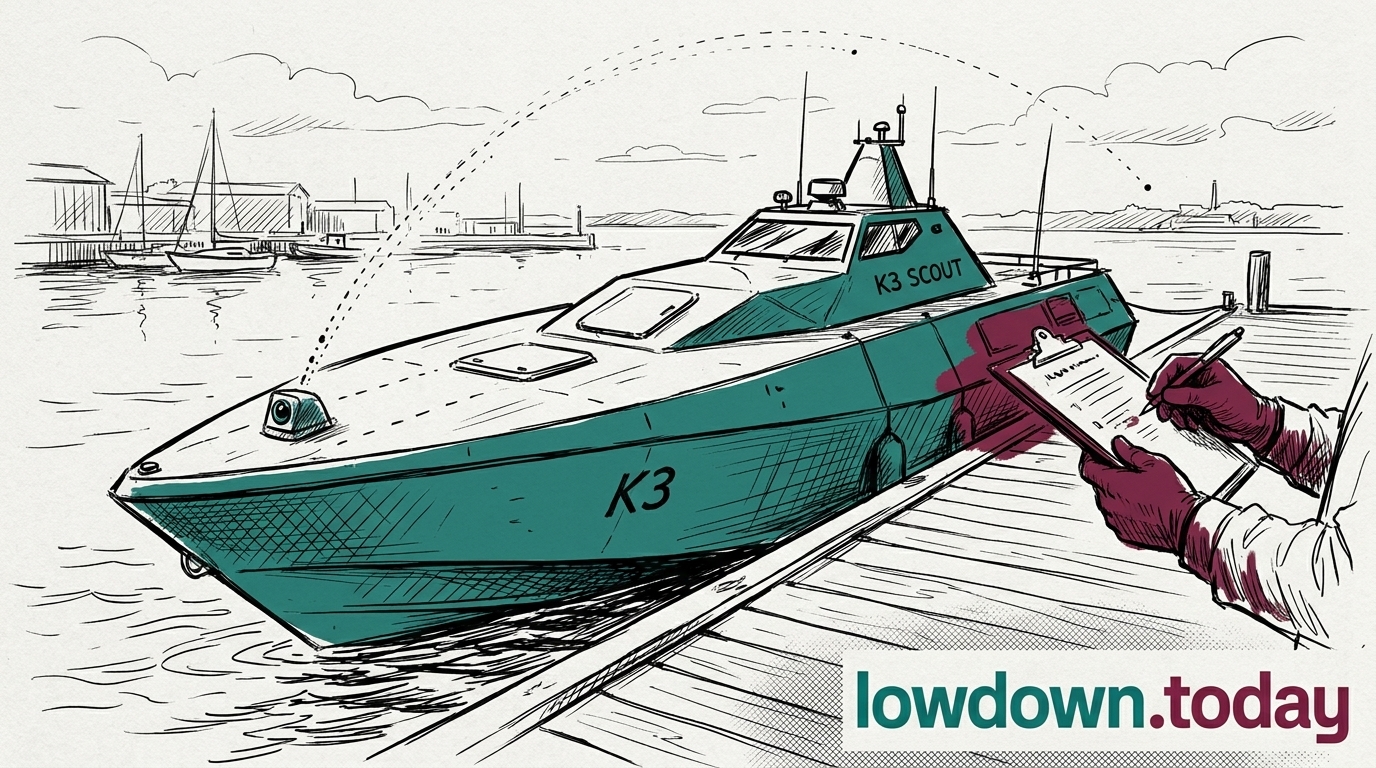
The Conservative opposition called on the Government on 9 August to 'urgently audit' equipment for hidden Chinese components, after the Telegraph's K3 SCOUT report. No named MP has been quoted on the record; the call came at party level, alongside the Ministry of Defence's own 10 August statement that no data had been compromised.
Kraken Technology Group
Kraken Technology Group is a UK maritime-defence company based in Portsmouth that builds the K3 SCOUT, and crossed a $1bn valuation in July on a single-sourced $175m raise. The camera components reached the fleet under a third party's written security assurance, which the Platform Authority, which does not yet exist, was never positioned to check.
Navy Commercial
Navy Commercial
Navy Commercial at Whale Island published two notices on 5 August: 074032-2026, asking industry how to build a Platform Authority to certify uncrewed vessels, and 074351-2026, a GBP10m multi-role USV testbed for the Defence Chief Technology Officer. Responses on the Platform Authority close 19 August, ten days after the cameras were found transmitting to China.
HUMAIN
HUMAIN
HUMAIN and Applied Intuition stated a 2030 target for thousands of autonomous trucks on Saudi logistics corridors. The announcement disclosed no order, fleet baseline or contract value.
Saildrone
Saildrone
Saildrone and Lockheed Martin demonstrated two JAGM launches from a Surveyor-class vessel at RIMPAC. The accepted record identifies no requirement, customer or production configuration behind the demonstration.
Taiwan Legislative Yuan
Taiwan's Legislative Yuan passed the Act at third reading with a small suicide uncrewed boat on the named development list. The NT$240 billion ceiling covers all unmanned domains, and the Act was not promulgated by 4 September.
