Skip to content
You can now search across every topic, entity and event.What's new
Autonomous Systems: Land & Sea
12AUG

Anduril's $87 million Lattice order

4 min read
14:17UTC

The first task order under Anduril's $20 billion enterprise contract makes Lattice the counter-drone command platform for the entire US military — and collapses 120 separate procurement vehicles into one.

TechnologyDeveloping
Key takeaway

Lattice's DoD-wide C2 designation creates a structural platform monopoly, not merely a procurement convenience.

The Army's Joint Interagency Task Force 401 awarded Anduril an $87 million task order — the first under the $20 billion enterprise contract announced on 14 March 1. The order designates Lattice, Anduril's command-and-control software, as the counter-UAS operations platform across the entire Department of Defense 2. The enterprise vehicle consolidates 120 separate Army contracts into a single procurement instrument with pre-negotiated terms. Any federal buyer can now purchase Anduril products through it without separate contracting actions. Anduril president Matthew Steckman described the structure as removing "friction in things that shouldn't have it" 3.

The structural consequence matters more than the dollar figure. Lattice as the DoD-wide counter-drone C2 layer positions Anduril as the integration platform through which other companies' sensors and effectors must operate. In procurement terms, this is platform entrenchment: once Lattice is the backbone, hardware that integrates with it has an acquisition advantage over hardware that does not. The pattern resembles how Palantir's Gotham became embedded in intelligence community workflows during the 2010s — the software layer, not the hardware, becomes the switching cost. Competitors can build better sensors or effectors, but if those products require a separate C2 integration effort, procurement officers facing schedule pressure will default to what already works with the installed base.

The $87 million first order against a $20 billion ceiling is a fraction — 0.4% — but it tests whether consolidated procurement actually accelerates acquisition across service branches. The further Gauntlet competitions will generate tens of thousands of attack drones that need a command layer. Anduril has positioned Lattice as that layer before the hardware production decisions are finalised. For competing C2 providers — L3Harris, Northrop Grumman's IBCS, and others — the window to contest that designation narrows with every task order that flows through the enterprise vehicle.

The broader market signal is that the Pentagon is consolidating drone defence procurement around fewer, larger vendors rather than distributing it across specialists. Anduril now holds both the C2 designation and the manufacturing capacity at Arsenal-1 to produce its own hardware. That vertical integration — software platform plus factory — is the competitive position that traditional primes have struggled to replicate at the speed the counter-drone mission demands.

Deep Analysis

In plain English

The US Army previously had 120 separate contracts with Anduril — each requiring its own negotiation and approval process. A new enterprise contract replaces all of these with a single pre-agreed deal. Any part of the US government can now buy Anduril products without starting from scratch. The first order under this contract puts Anduril's Lattice software in charge of drone-defence operations across the entire Pentagon. Lattice acts as the digital brain that detects, tracks, and co-ordinates responses to hostile drones. Making it the universal standard means all branches of the US military now share a single system — for better or worse.

Deep Analysis
Synthesis

The Lattice enterprise designation mirrors Palantir's 2023 TITAN intelligence contract, which transformed Palantir from a software vendor into the Army's intelligence data backbone. Both cases show DoD is willing to create single-vendor platform monopolies when interoperability benefits appear to outweigh concentration risks. If Lattice becomes as embedded as Palantir's systems, displacing it becomes a multi-year, politically contentious undertaking — regardless of competitive performance.

Root Causes

The 120 separate contracts reflected bottom-up, unit-level adoption of counter-UAS tools during the 2017–2023 period, when drone threats emerged faster than acquisition doctrine. Each Army unit procured what worked locally, creating a patchwork of incompatible systems. The enterprise contract is a second-order institutional response — normalising technology that was adopted tactically before it was procured strategically.

Escalation

The enterprise vehicle elevates Anduril from a vendor to a platform monopolist in DoD counter-UAS. Competing vendors — Dedrone, D-Fend Solutions, Epirus — now face a structural disadvantage in the largest single procurement category. The consolidation dynamic is accelerating: the $87 million first order will likely be followed by Air Force, Navy, and combatant command orders. Each follow-on deepens lock-in and raises switching costs.

What could happen next?
  • Precedent

    The enterprise vehicle model, if successful, may be replicated across other defence technology categories — normalising platform-based DoD procurement for AI, autonomy, and electronic warfare.

    Medium term · Assessed
  • Risk

    Single-vendor C2 architecture creates a strategic single point of failure for DoD counter-UAS operations, exploitable by adversaries targeting the Lattice platform directly.

    Medium term · Assessed
  • Opportunity

    Any federal buyer can now access Anduril's counter-UAS stack without a new contracting process, accelerating cross-service adoption well beyond the Army.

    Immediate · Reported
  • Consequence

    Competing C2 vendors face marginalisation unless they integrate with Lattice or win equivalent enterprise vehicles — a winner-takes-most outcome in the counter-UAS C2 market.

    Short term · Assessed
First Reported In

Update #2 · UK startup tops Pentagon's drone gauntlet

Breaking Defense· 19 Mar 2026
Read original
Causes and effects
This Event
Anduril's $87 million Lattice order
Anduril's software layer is now the designated command-and-control backbone for counter-UAS operations across all DoD branches, creating a platform integration advantage that will shape which hardware vendors can compete for follow-on drone defence contracts.
Different Perspectives
Conservative opposition
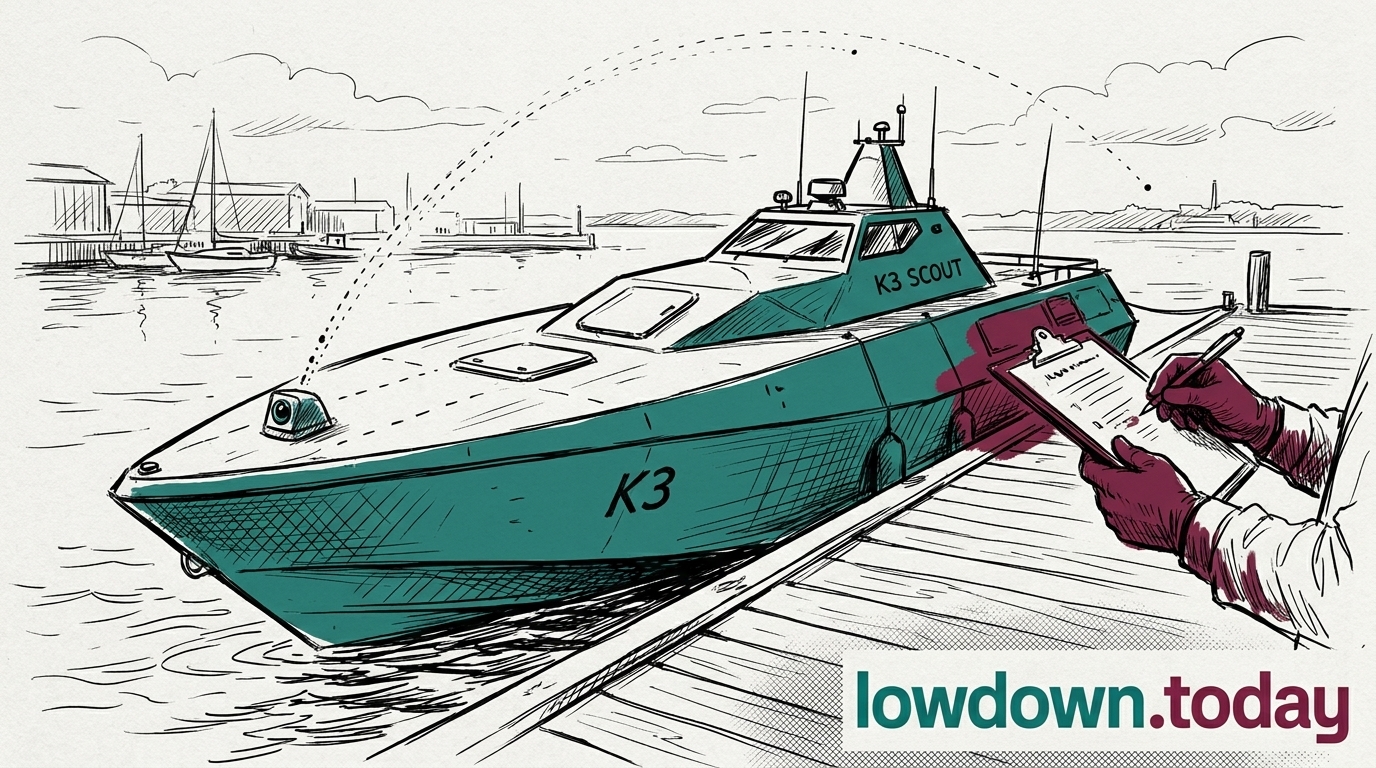
The Conservative opposition called on the Government on 9 August to 'urgently audit' equipment for hidden Chinese components, after the Telegraph's K3 SCOUT report. No named MP has been quoted on the record; the call came at party level, alongside the Ministry of Defence's own 10 August statement that no data had been compromised.
Netherlands Ministry of Defence
The Netherlands Ministry of Defence authorised Dutch Naval Design on 4 August to design 12-metre anti-submarine warfare uncrewed vessels for the Dutch-Belgian frigate programme, and to buy an adapted Compact FLASH dipping sonar from Thales Underwater Systems France. The order commits money and a named supplier while Britain's own certification body remains at the market-engagement stage.
Kraken Technology Group
Kraken Technology Group is a UK maritime-defence company based in Portsmouth that builds the K3 SCOUT, and crossed a $1bn valuation in July on a single-sourced $175m raise. The camera components reached the fleet under a third party's written security assurance, which the Platform Authority, which does not yet exist, was never positioned to check.
Navy Commercial
Navy Commercial
Navy Commercial at Whale Island published two notices on 5 August: 074032-2026, asking industry how to build a Platform Authority to certify uncrewed vessels, and 074351-2026, a GBP10m multi-role USV testbed for the Defence Chief Technology Officer. Responses on the Platform Authority close 19 August, ten days after the cameras were found transmitting to China.
Ministry of Defence
Ministry of Defence
The Ministry of Defence said on 10 August that a routine cyber vulnerability assessment found the camera fault, and a thorough investigation found no evidence that MoD data or systems had been accessed, compromised or transmitted externally. It stripped the cameras of internet connectivity but did not say whether it acted against the supplier.
Thales
Thales
Thales converted its 6 July engaging accord with Exail into a definitive combination agreement on 30-31 July, but the tender offer for Exail's remaining shares now closes by early 2028, later than July's timetable implied. Thales integrates its new undersea prime while still bidding against Kongsberg and DRASS's 2027 target for the AUKUS Pillar II contest.
