Skip to content
You can now search across every topic, entity and event.What's new
Autonomous Systems: Land & Sea
12AUG

Army awards Anduril $20 billion Lattice

2 min read
14:17UTC

A single enterprise contract consolidates 120 separate procurement actions into one ordering mechanism. Every future Pentagon counter-drone buy can now bypass competitive tendering.

TechnologyDeveloping
Key takeaway

Anduril now holds the default procurement position for all US counter-drone purchases.

Army Contracting Command at Aberdeen Proving Ground awarded Anduril Industries a 10-year, $20 billion enterprise contract vehicle on 14 March, with an optional five-year extension to 2036.1 The vehicle consolidates more than 120 separate procurement actions into a single mechanism. Any federal buyer can now order the Lattice counter-drone platform without a fresh competition.

The $87 million task order for JIATF-401 that surfaced two weeks earlier was not a standalone award. It was the first purchase against this master agreement. Brian Schimpf, Anduril's president, called the arrangement "an ordering guide," a description that frames Lattice less as a product to be evaluated and more as a catalogue to be browsed.

Enterprise vehicles of this scale are common in Pentagon procurement, and ceilings are rarely reached. But the structural effect matters more than the headline figure. Every future Department of Defense counter-UAS requirement can be routed through Anduril without competitive tendering. For rivals, the barrier to displacement has risen by an order of magnitude. The closest analogy is the JEDI cloud contract, where platform selection proved more consequential than any individual task order.

Deep Analysis

In plain English

Imagine the US Army previously had to run a separate tender every time it wanted to buy counter-drone equipment. Each one took 18 months and generated a stack of paperwork. This contract collapses all of that into a single agreement. Now any part of the US military that needs counter-drone equipment can simply place an order with Anduril, much like a corporate purchasing department ordering from a pre-approved supplier catalogue. The upside is speed. The downside is that Anduril now effectively has a monopoly on US military counter-drone procurement for the next decade, which removes the competitive pressure that typically keeps costs in check.

Deep Analysis
Root Causes

The consolidation reflects Pentagon frustration with the acquisition cycle. Counter-UAS threats evolved faster than the 18–24 month procurement timelines that govern competitive re-tendering under standard FAR rules.

Anduril's position was further entrenched by Lattice's dual role: it is simultaneously a command-and-control platform and an interface layer that creates switching costs analogous to enterprise software lock-in. Once a command architecture integrates Lattice, replacing it requires replacing the software stack that manages all connected systems.

What could happen next?
  • Consequence

    Anduril becomes the de facto monopoly provider for US counter-drone procurement for up to 15 years, dramatically raising the barrier for rivals.

    Immediate · High
  • Risk

    Enterprise vehicle concentration creates a single point of failure in US counter-drone capability if Anduril underperforms or faces legal challenges.

    Medium term · Medium
  • Opportunity

    Other US defence firms can position complementary capabilities — sensors, munitions, training — as add-ons within the Lattice ecosystem rather than competing for the platform itself.

    Short term · Medium
  • Precedent

    If the vehicle model succeeds, it will become the template for all major US drone and autonomy procurement, fundamentally reshaping how the Pentagon buys military technology.

    Long term · Medium
First Reported In

Update #3 · Anduril wins $20 billion counter-drone deal

DefenseScoop· 30 Mar 2026
Read original
Different Perspectives
Conservative opposition
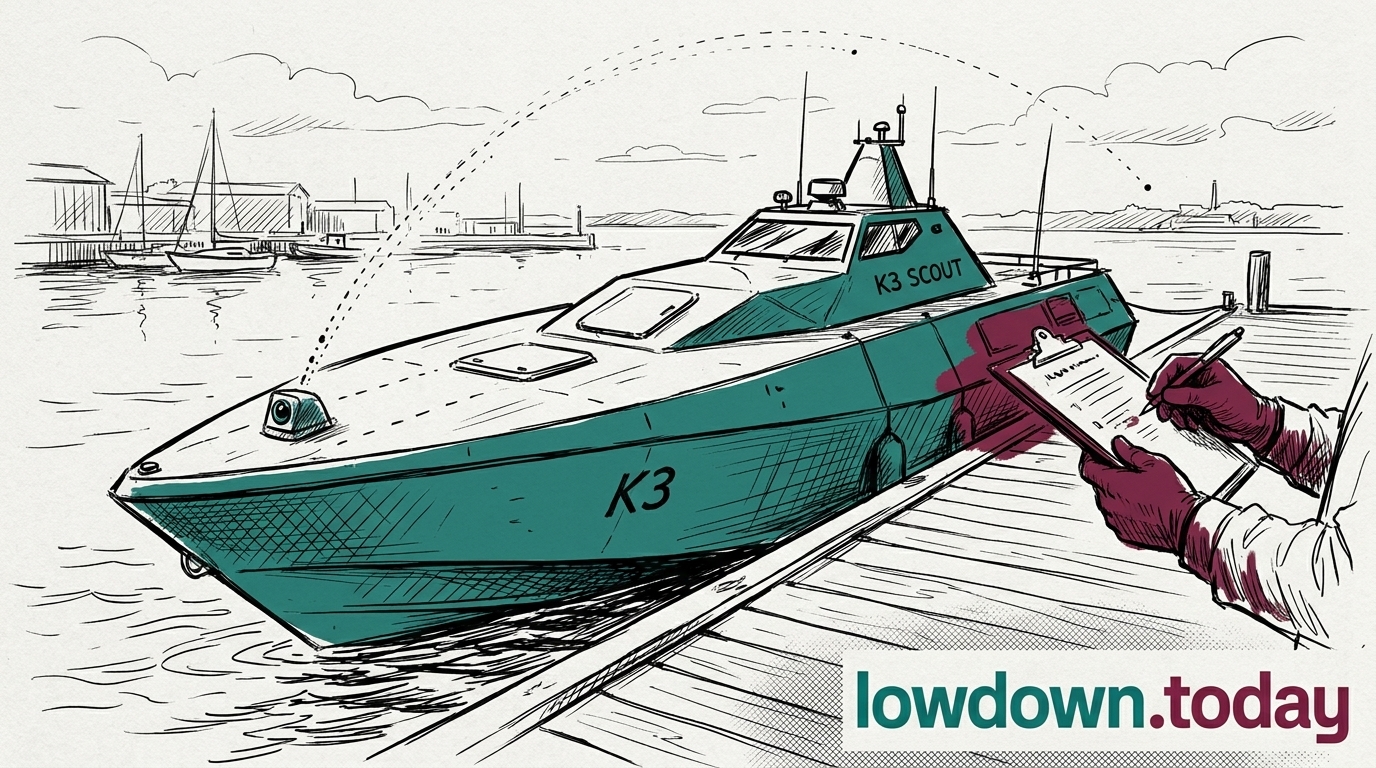
The Conservative opposition called on the Government on 9 August to 'urgently audit' equipment for hidden Chinese components, after the Telegraph's K3 SCOUT report. No named MP has been quoted on the record; the call came at party level, alongside the Ministry of Defence's own 10 August statement that no data had been compromised.
Netherlands Ministry of Defence
The Netherlands Ministry of Defence authorised Dutch Naval Design on 4 August to design 12-metre anti-submarine warfare uncrewed vessels for the Dutch-Belgian frigate programme, and to buy an adapted Compact FLASH dipping sonar from Thales Underwater Systems France. The order commits money and a named supplier while Britain's own certification body remains at the market-engagement stage.
Kraken Technology Group
Kraken Technology Group is a UK maritime-defence company based in Portsmouth that builds the K3 SCOUT, and crossed a $1bn valuation in July on a single-sourced $175m raise. The camera components reached the fleet under a third party's written security assurance, which the Platform Authority, which does not yet exist, was never positioned to check.
Navy Commercial
Navy Commercial
Navy Commercial at Whale Island published two notices on 5 August: 074032-2026, asking industry how to build a Platform Authority to certify uncrewed vessels, and 074351-2026, a GBP10m multi-role USV testbed for the Defence Chief Technology Officer. Responses on the Platform Authority close 19 August, ten days after the cameras were found transmitting to China.
Ministry of Defence
Ministry of Defence
The Ministry of Defence said on 10 August that a routine cyber vulnerability assessment found the camera fault, and a thorough investigation found no evidence that MoD data or systems had been accessed, compromised or transmitted externally. It stripped the cameras of internet connectivity but did not say whether it acted against the supplier.
Thales
Thales
Thales converted its 6 July engaging accord with Exail into a definitive combination agreement on 30-31 July, but the tender offer for Exail's remaining shares now closes by early 2028, later than July's timetable implied. Thales integrates its new undersea prime while still bidding against Kongsberg and DRASS's 2027 target for the AUKUS Pillar II contest.
