Skip to content
You can now search across every topic, entity and event.What's new
Autonomous Systems: Land & Sea
12AUG

DroneShield Q1 revenue jumps 88% with $2.3bn pipeline

4 min read
14:17UTC

Q1 2026 revenue hit AUD 62.6M, full-year secured revenue reached AUD 140M, and the pipeline expanded to three hundred potential orders across 50 countries.

TechnologyDeveloping
Key takeaway

DroneShield's $2.3bn pipeline across fifty countries is the category's clearest institutional-demand signal yet.

DroneShield posted Q1 2026 revenue of AUD 62.6 million on 13 April, up 88% year-on-year, with record cash receipts of AUD 77.4 million and secured full-year revenue of AUD 140 million. The company disclosed a sales pipeline of $2.3 billion across three hundred potential orders in 50 countries, including fifteen deals valued above $30 million each. The update landed five days after the CEO departure, and the pipeline disclosure is arguably the most useful data point the market has yet received on counter-drone demand depth.

The $2.3 billion figure is a material upgrade on the $1.2 billion EU pipeline reported when DroneShield opened its Amsterdam HQ , and it sits on top of the 276% FY2025 revenue growth . At Q1 close, secured FY2026 revenue of AUD 140 million already exceeds the base against which that growth was measured, which means the firm is guiding to another year of institutional-scale expansion rather than consolidation.

The geographic spread matters as much as the headline number. 50 countries suggests procurement is globalising past the original Anglosphere-plus-Nordic customer concentration. The fifteen individual deals above $30 million each indicate the firm is now engaging with buyers at sovereign defence-budget tier rather than unit-kit tier, which is the progression the counter-drone category as a whole has been promising investors for two years.

For counter-drone pricing power the pipeline is also a read-through to the wider attritable-systems debate. If a single vendor has three hundred orders live in 50 countries, then the argument that counter-drone demand is still concentrated in a handful of active combat theatres is outdated. The category has broadened to include airport security, critical national infrastructure, and non-combat territorial defence, and the Q1 pipeline is evidence of that breadth.

Deep Analysis

In plain English

DroneShield released its financial results for the first three months of 2026. Revenue grew 88% compared to the same period a year earlier, a very fast growth rate for any company. More striking was the sales pipeline figure: $2.3 billion worth of potential orders across 300 deals in 50 countries. A 'pipeline' means contracts under negotiation or in tender stages, not yet signed. Fifteen of those deals are each worth more than $30 million individually, which means large national governments are buying rather than small security units or local police forces. This update landed five days after the company's founding CEO left. The pipeline scale suggests the business runs on institutional momentum, which is the market's main concern after a founder departure.

Deep Analysis
Root Causes

DroneShield's Q1 conversion rate reflects two structural drivers that are specific to the April 2026 context.

First, the Iran-Gulf conflict created emergency procurement urgency in Gulf state defence ministries that collapsed normal multi-year acquisition timelines to months. The CSIS analysis of Iran's drone campaign recorded 4,446 drones launched across seven weeks; buyers at that threat level sign contracts rather than run tenders.

Second, the EU's AGILE programme and DroneShield's Amsterdam headquarters opening arrived simultaneously with a period in which European defence ministries were accelerating counter-drone procurement under NATO pressure. The $1.2 billion EU pipeline reported in February 2026 had expanded to a broader global pipeline by Q1 close, indicating that the EU acceleration did not displace other regions but compounded them.

What could happen next?
  • Opportunity

    Fifteen deals above $30 million each represent sovereign-budget procurement, which typically anchors repeat purchasing cycles: a customer who has deployed DroneShield systems at brigade level is structurally likely to return for maintenance, upgrade and expansion contracts.

    Medium term · 0.75
  • Consequence

    The $2.3 billion pipeline disclosure raises the bar for every other listed counter-drone company's investor communications; firms without comparable pipeline transparency will face increased analyst pressure to publish equivalent data.

    Short term · 0.7
  • Risk

    Pipeline conversion depends partly on European procurement timelines that may slow if the Iran-Gulf conflict de-escalates and removes the emergency-procurement urgency that has compressed decision cycles in Q1.

    Medium term · 0.65
First Reported In

Update #6 · Britain's £752M Ukraine drone package

Primary Ignition· 18 Apr 2026
Read original
Causes and effects
This Event
DroneShield Q1 revenue jumps 88% with $2.3bn pipeline
The DroneShield Q1 disclosure addresses the institutional-maturity question the board's leadership change raised, and it does so with numbers. A pipeline worth $2.3 billion across 15 deals above $30 million each looks less like founder relationships and more like enterprise procurement. For the drone-industry beat the Q1 release is the clearest counter-drone pipeline disclosure on the market, and it is the most useful comparator any publicly quoted counter-drone firm has yet published against its underlying demand signal.
Different Perspectives
Conservative opposition
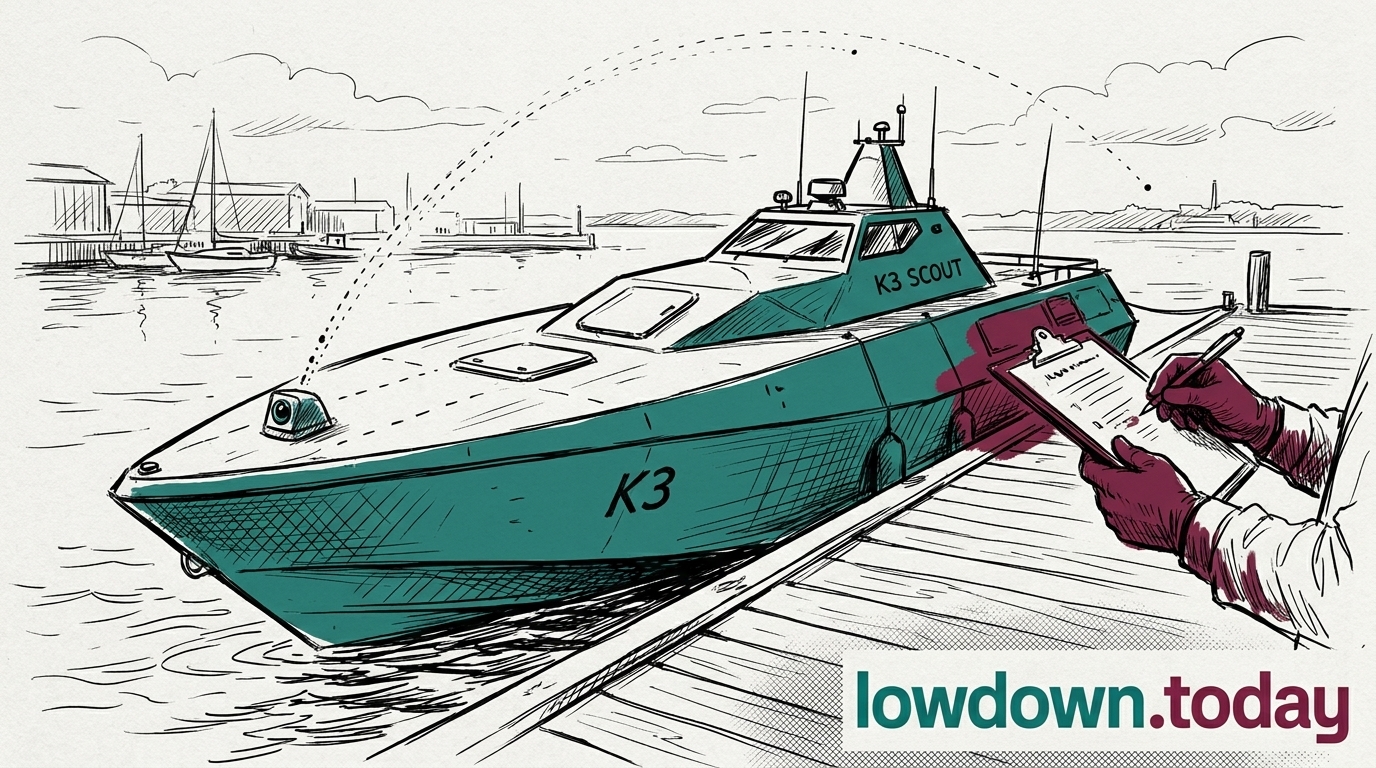
The Conservative opposition called on the Government on 9 August to 'urgently audit' equipment for hidden Chinese components, after the Telegraph's K3 SCOUT report. No named MP has been quoted on the record; the call came at party level, alongside the Ministry of Defence's own 10 August statement that no data had been compromised.
Netherlands Ministry of Defence
The Netherlands Ministry of Defence authorised Dutch Naval Design on 4 August to design 12-metre anti-submarine warfare uncrewed vessels for the Dutch-Belgian frigate programme, and to buy an adapted Compact FLASH dipping sonar from Thales Underwater Systems France. The order commits money and a named supplier while Britain's own certification body remains at the market-engagement stage.
Kraken Technology Group
Kraken Technology Group is a UK maritime-defence company based in Portsmouth that builds the K3 SCOUT, and crossed a $1bn valuation in July on a single-sourced $175m raise. The camera components reached the fleet under a third party's written security assurance, which the Platform Authority, which does not yet exist, was never positioned to check.
Navy Commercial
Navy Commercial
Navy Commercial at Whale Island published two notices on 5 August: 074032-2026, asking industry how to build a Platform Authority to certify uncrewed vessels, and 074351-2026, a GBP10m multi-role USV testbed for the Defence Chief Technology Officer. Responses on the Platform Authority close 19 August, ten days after the cameras were found transmitting to China.
Ministry of Defence
Ministry of Defence
The Ministry of Defence said on 10 August that a routine cyber vulnerability assessment found the camera fault, and a thorough investigation found no evidence that MoD data or systems had been accessed, compromised or transmitted externally. It stripped the cameras of internet connectivity but did not say whether it acted against the supplier.
Thales
Thales
Thales converted its 6 July engaging accord with Exail into a definitive combination agreement on 30-31 July, but the tender offer for Exail's remaining shares now closes by early 2028, later than July's timetable implied. Thales integrates its new undersea prime while still bidding against Kongsberg and DRASS's 2027 target for the AUKUS Pillar II contest.
