Skip to content
You can now search across every topic, entity and event.What's new
Autonomous Systems: Land & Sea
12AUG

DroneShield revenue up 276% on EU demand

1 min read
14:17UTC

The Australian counter-drone firm posted AUD $216.5 million in FY2025 revenue and is scaling EU manufacturing capacity fivefold.

TechnologyDeveloping
Key takeaway

European counter-drone demand now justifies a fivefold manufacturing capacity expansion.

DroneShield posted FY2025 revenue of AUD $216.5 million on 20 March, up 276% year-on-year, and secured an AUD $49.6 million European military contract, its second-largest single order.1 The company is scaling EU manufacturing capacity from AUD $500 million to AUD $2.4 billion annually by end-2026, a 4.8x expansion. That capacity build follows the opening of its first EU manufacturing facility .

The growth trajectory reflects a broader pattern. European defence procurement budgets have shifted from research funding to production contracts. DroneShield's bet is that European militaries will prefer locally manufactured counter-drone systems for competitive contract bidding, a calculation that makes geographic presence as important as technical performance.

Deep Analysis

In plain English

DroneShield is an Australian company that makes systems to detect and disable enemy drones. It is growing extremely fast because European governments are now buying counter-drone equipment in bulk, following years of watching drone warfare evolve in Ukraine. The 276% revenue growth means the company nearly quadrupled its revenue in a year. It is now building a factory in Europe so it can supply European military customers faster and qualify for contracts that require local manufacturing.

What could happen next?
  • Consequence

    European counter-drone manufacturing gains a significant non-US supplier with proven demand validation, reducing NATO dependence on US-only solutions.

  • Opportunity

    DroneShield's EU manufacturing position gives it an advantage in procurement competitions requiring local manufacturing offsets or favouring non-US suppliers.

First Reported In

Update #3 · Anduril wins $20 billion counter-drone deal

Fuzzy Panda Research· 30 Mar 2026
Read original
Different Perspectives
Conservative opposition
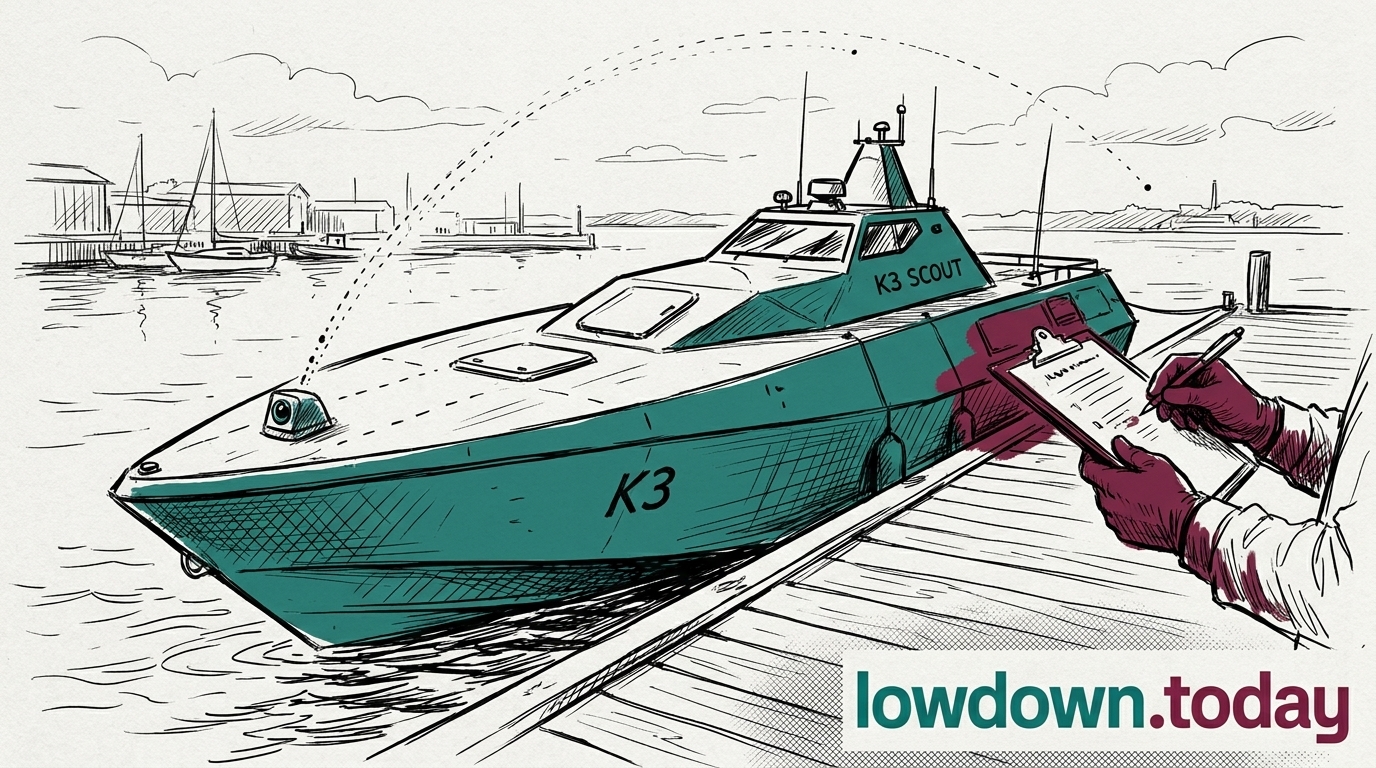
The Conservative opposition called on the Government on 9 August to 'urgently audit' equipment for hidden Chinese components, after the Telegraph's K3 SCOUT report. No named MP has been quoted on the record; the call came at party level, alongside the Ministry of Defence's own 10 August statement that no data had been compromised.
Netherlands Ministry of Defence
The Netherlands Ministry of Defence authorised Dutch Naval Design on 4 August to design 12-metre anti-submarine warfare uncrewed vessels for the Dutch-Belgian frigate programme, and to buy an adapted Compact FLASH dipping sonar from Thales Underwater Systems France. The order commits money and a named supplier while Britain's own certification body remains at the market-engagement stage.
Kraken Technology Group
Kraken Technology Group is a UK maritime-defence company based in Portsmouth that builds the K3 SCOUT, and crossed a $1bn valuation in July on a single-sourced $175m raise. The camera components reached the fleet under a third party's written security assurance, which the Platform Authority, which does not yet exist, was never positioned to check.
Navy Commercial
Navy Commercial
Navy Commercial at Whale Island published two notices on 5 August: 074032-2026, asking industry how to build a Platform Authority to certify uncrewed vessels, and 074351-2026, a GBP10m multi-role USV testbed for the Defence Chief Technology Officer. Responses on the Platform Authority close 19 August, ten days after the cameras were found transmitting to China.
Ministry of Defence
Ministry of Defence
The Ministry of Defence said on 10 August that a routine cyber vulnerability assessment found the camera fault, and a thorough investigation found no evidence that MoD data or systems had been accessed, compromised or transmitted externally. It stripped the cameras of internet connectivity but did not say whether it acted against the supplier.
Thales
Thales
Thales converted its 6 July engaging accord with Exail into a definitive combination agreement on 30-31 July, but the tender offer for Exail's remaining shares now closes by early 2028, later than July's timetable implied. Thales integrates its new undersea prime while still bidding against Kongsberg and DRASS's 2027 target for the AUKUS Pillar II contest.
