Skip to content
You can now search across every topic, entity and event.What's new
Autonomous Systems: Land & Sea
12AUG

Arsenal-1 adds three more weapons lines

3 min read
14:17UTC

Anduril's Ohio factory will produce four distinct platforms by year-end, but currently operates with 30 workers on a single shift against a target of 250.

TechnologyDeveloping
Key takeaway

Arsenal-1's four-platform ambition rests on an eightfold workforce expansion with no confirmed timeline.

Anduril Industries announced that Arsenal-1 in Columbus, Ohio will produce four weapons systems by end-2026: the YFQ-44A Fury collaborative combat aircraft, Roadrunner interceptor, Barracuda cruise-missile-class munition, and a classified platform. The factory shipped its first Fury in late March , four months ahead of schedule, but currently runs 30 workers across 22 workstations on a single shift.

The strategic logic is defensive as much as offensive. A factory producing four programmes simultaneously is structurally harder to displace than one producing a single airframe. Each additional platform deepens the infrastructure investment that competitors would need to replicate. Combined with the $20 billion Lattice enterprise vehicle and the sole-source Ghost-X contract (see Event 4), Anduril is building reinforcing moats across multiple Pentagon programme offices before rivals reach the production stage.

The workforce gap is the reality check. Growing from 30 to 250 workers requires recruiting and training defence manufacturing talent in rural Ohio, where no obvious pipeline exists. Three full shifts are needed to reach the stated 150 Fury per year capacity; at current single-shift staffing, output is a fraction of that figure. Every month at current levels widens the gap between Anduril's stated capacity and its actual production.

For the Pentagon, Arsenal-1's expansion creates a concentration risk: counter-UAS command, autonomous combat aircraft, and tactical ISR production under one roof and one contractor.

Deep Analysis

In plain English

Anduril is building a factory in Ohio that will produce four different types of military drones and weapons by the end of this year. Think of it as a car factory that is going to build four different car models at the same time, but currently has only 30 workers. To meet their targets, they need to hire and train 220 more workers by December. That is the size of a small school's entire staff, recruited and trained in eight months, for a highly technical job in a part of Ohio that has not done this kind of manufacturing before. The weapons themselves include a small autonomous combat aircraft called the Fury, a drone interceptor called Roadrunner, and a cruise-missile-class weapon called Barracuda. A fourth classified weapon is also being made there.

Deep Analysis
Root Causes

Arsenal-1's four-platform expansion reflects a procurement logic as much as an industrial one. Pentagon programme offices manage budgets by capability category; a manufacturer with products across multiple categories becomes harder to exclude from any single budget cycle. The classified fourth platform is significant precisely because it is unknown: it ensures Arsenal-1 has relationships with at least one programme office whose requirements are not publicly disclosed.

The concentration of four programmes under one roof also reflects the Pentagon's stated preference for 'arsenal ships' or 'arsenal factories' that can surge production across weapon types in response to operational demand. Arsenal-1 is being designed to match a procurement doctrine that itself is still being written.

What could happen next?
  • Risk

    Arsenal-1's stated 150 Fury per year capacity cannot be reached without three-shift operation; at current single-shift staffing, actual output is under 50 aircraft per year, creating a gap between contracted delivery timelines and operational reality.

    Short term · 0.77
  • Consequence

    A four-platform factory under one contractor gives the Pentagon a faster surge option in a wartime emergency but concentrates supply chain risk in a single facility and a single workforce pool.

    Medium term · 0.72
  • Opportunity

    Arsenal-1's classified fourth platform creates a procurement relationship with a programme office whose identity and budget are insulated from public competitive pressure, providing Anduril with revenue diversification that cannot be directly competed.

    Long term · 0.68
First Reported In

Update #5 · Gulf drone war rewrites procurement

Breaking Defense· 13 Apr 2026
Read original
Different Perspectives
Conservative opposition
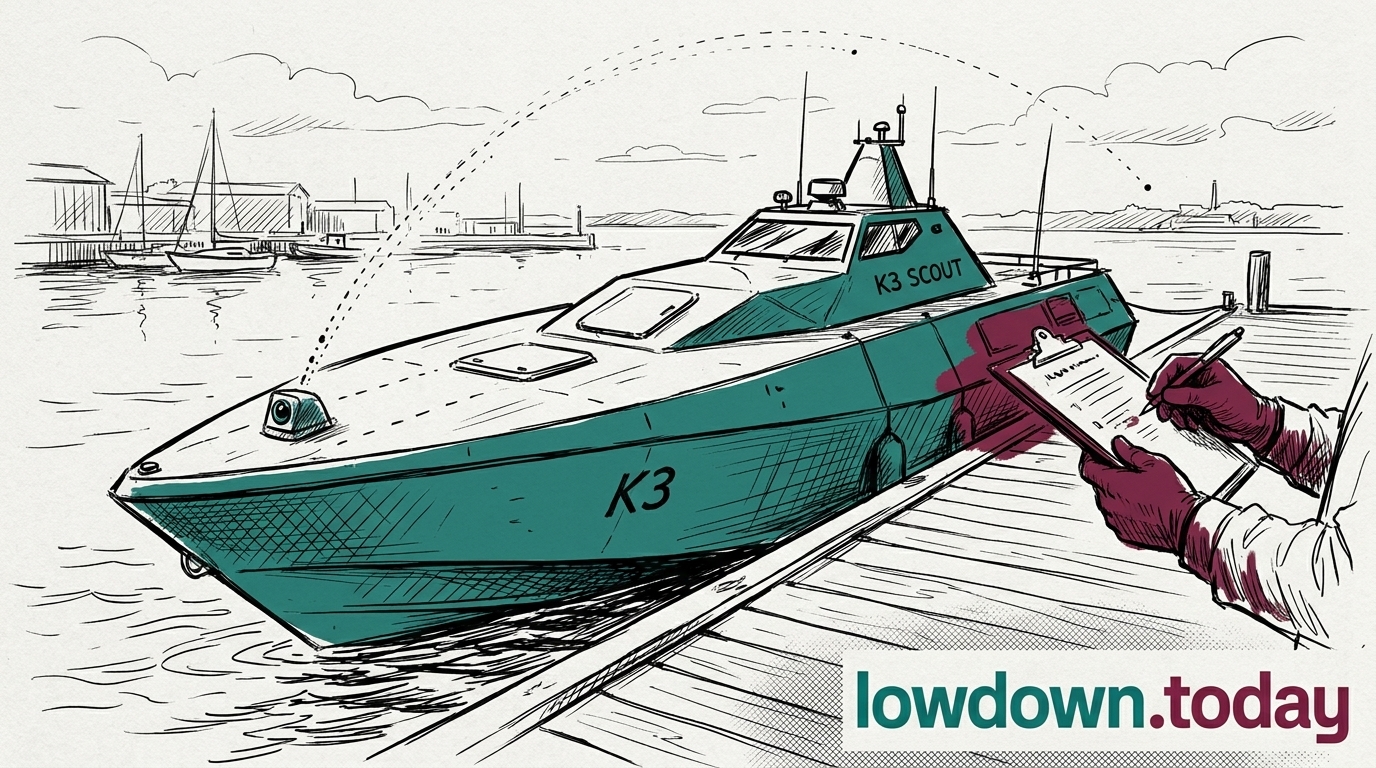
The Conservative opposition called on the Government on 9 August to 'urgently audit' equipment for hidden Chinese components, after the Telegraph's K3 SCOUT report. No named MP has been quoted on the record; the call came at party level, alongside the Ministry of Defence's own 10 August statement that no data had been compromised.
Netherlands Ministry of Defence
The Netherlands Ministry of Defence authorised Dutch Naval Design on 4 August to design 12-metre anti-submarine warfare uncrewed vessels for the Dutch-Belgian frigate programme, and to buy an adapted Compact FLASH dipping sonar from Thales Underwater Systems France. The order commits money and a named supplier while Britain's own certification body remains at the market-engagement stage.
Kraken Technology Group
Kraken Technology Group is a UK maritime-defence company based in Portsmouth that builds the K3 SCOUT, and crossed a $1bn valuation in July on a single-sourced $175m raise. The camera components reached the fleet under a third party's written security assurance, which the Platform Authority, which does not yet exist, was never positioned to check.
Navy Commercial
Navy Commercial
Navy Commercial at Whale Island published two notices on 5 August: 074032-2026, asking industry how to build a Platform Authority to certify uncrewed vessels, and 074351-2026, a GBP10m multi-role USV testbed for the Defence Chief Technology Officer. Responses on the Platform Authority close 19 August, ten days after the cameras were found transmitting to China.
Ministry of Defence
Ministry of Defence
The Ministry of Defence said on 10 August that a routine cyber vulnerability assessment found the camera fault, and a thorough investigation found no evidence that MoD data or systems had been accessed, compromised or transmitted externally. It stripped the cameras of internet connectivity but did not say whether it acted against the supplier.
Thales
Thales
Thales converted its 6 July engaging accord with Exail into a definitive combination agreement on 30-31 July, but the tender offer for Exail's remaining shares now closes by early 2028, later than July's timetable implied. Thales integrates its new undersea prime while still bidding against Kongsberg and DRASS's 2027 target for the AUKUS Pillar II contest.
