Skip to content
You can now search across every topic, entity and event.What's new
Autonomous Systems: Land & Sea
12AUG

Army hands Anduril sole-source ISR deal

2 min read
14:17UTC

The US Army awarded Anduril a $16.8 million sole-source contract for Ghost-X reconnaissance drones on 7 April; no other company bid.

TechnologyDeveloping
Key takeaway

Anduril holds sole-provider positions in three Pentagon drone programmes simultaneously.

The US Army awarded Anduril a $16.8 million firm-fixed-price contract on 7 April for Ghost-X VTOL reconnaissance drones equipped with Trillium HD45LP sensors. Only one bid was received. The contract extends Anduril's monopoly pattern: the $20 billion Lattice enterprise vehicle consolidated counter-drone procurement, and the sole-source Ghost-X award now locks tactical ISR to the same vendor. The completion date is 1 May 2026.

A sole-source award on a tactical ISR requirement that multiple firms could theoretically fill indicates that the procurement structure has been shaped around the incumbent. Ghost-X was selected for the Army's company-level small UAS directed requirement in September 2024; this contract converts that selection into a production order without competitive pressure. The pattern mirrors the Lattice task order and its parent enterprise vehicle: each award is structured to prevent parallel competition.

Anduril now holds default procurement positions in three separate Pentagon programme offices simultaneously: counter-UAS command (Lattice), autonomous combat aircraft (Fury at Arsenal-1), and tactical ISR (Ghost-X). No single defence contractor has held monopoly positions across three drone programme categories before. The commercial consequence is that non-incumbent firms face a structural narrowing of addressable market that compounds with each contract cycle.

The broader question is whether this concentration is a wartime acceleration choice or a permanent structural shift. Competitive tendering was designed to prevent single-vendor dependency; its abandonment signals that speed-to-delivery has overtaken competition as the dominant procurement value.

Deep Analysis

In plain English

The US Army paid Anduril $16.8 million for reconnaissance drones that can hover and land vertically, like a helicopter. The unusual detail is that only Anduril bid for the contract; no other company submitted a competing offer. Sole-source contracts are legal and sometimes justified when speed matters most. The question defence watchers are asking is whether this is one of those cases or whether the competition was designed in a way that discouraged other companies from bidding.

What could happen next?
  • Consequence

    Anduril's simultaneous sole-source positions in counter-UAS command, autonomous combat aircraft, and tactical ISR create a concentration of defence drone procurement in a single private company with no parallel in post-Cold War US defence history.

  • Risk

    Structural dependency on a single privately-held contractor across three drone programme categories means that any financial, operational, or leadership crisis at Anduril propagates simultaneously into three critical Pentagon programme offices.

First Reported In

Update #5 · Gulf drone war rewrites procurement

Army Recognition· 13 Apr 2026
Read original
Different Perspectives
Conservative opposition
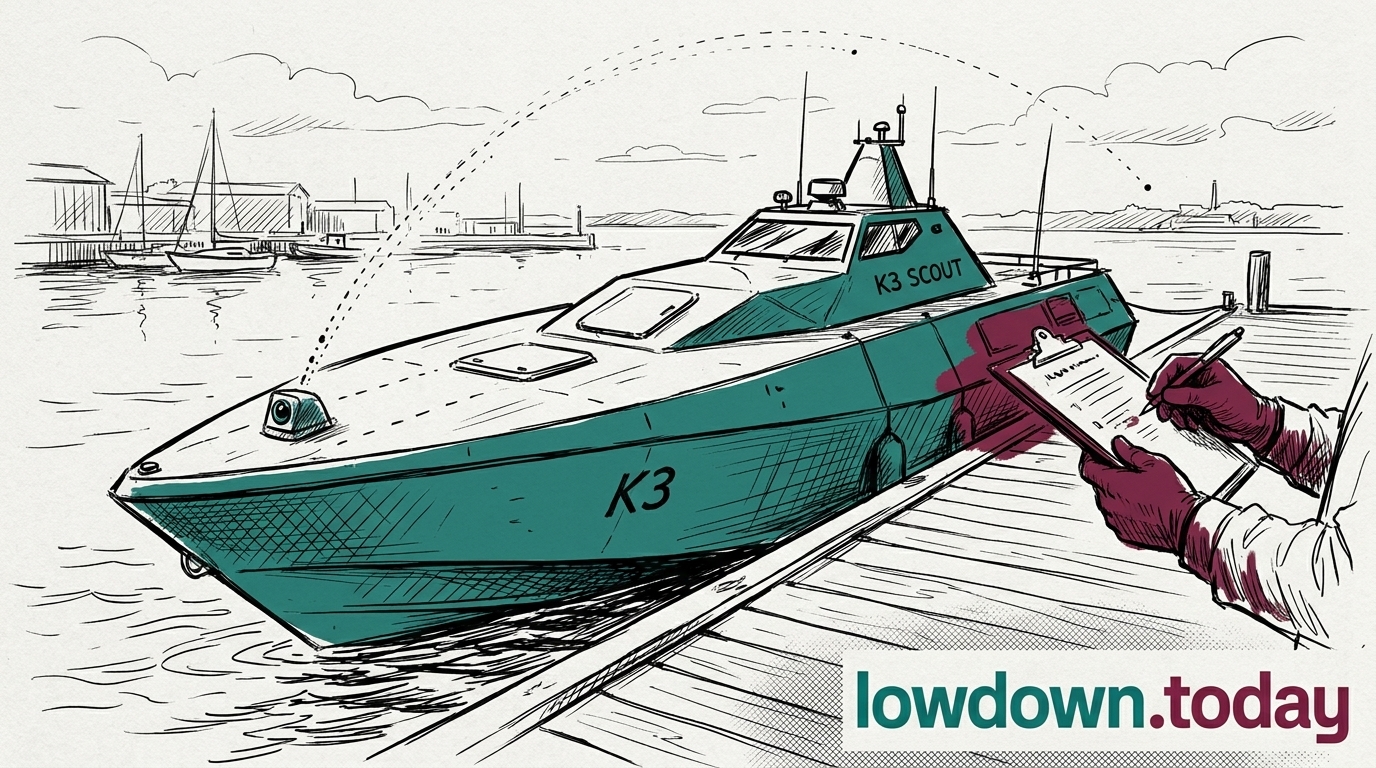
The Conservative opposition called on the Government on 9 August to 'urgently audit' equipment for hidden Chinese components, after the Telegraph's K3 SCOUT report. No named MP has been quoted on the record; the call came at party level, alongside the Ministry of Defence's own 10 August statement that no data had been compromised.
Netherlands Ministry of Defence
The Netherlands Ministry of Defence authorised Dutch Naval Design on 4 August to design 12-metre anti-submarine warfare uncrewed vessels for the Dutch-Belgian frigate programme, and to buy an adapted Compact FLASH dipping sonar from Thales Underwater Systems France. The order commits money and a named supplier while Britain's own certification body remains at the market-engagement stage.
Kraken Technology Group
Kraken Technology Group is a UK maritime-defence company based in Portsmouth that builds the K3 SCOUT, and crossed a $1bn valuation in July on a single-sourced $175m raise. The camera components reached the fleet under a third party's written security assurance, which the Platform Authority, which does not yet exist, was never positioned to check.
Navy Commercial
Navy Commercial
Navy Commercial at Whale Island published two notices on 5 August: 074032-2026, asking industry how to build a Platform Authority to certify uncrewed vessels, and 074351-2026, a GBP10m multi-role USV testbed for the Defence Chief Technology Officer. Responses on the Platform Authority close 19 August, ten days after the cameras were found transmitting to China.
Ministry of Defence
Ministry of Defence
The Ministry of Defence said on 10 August that a routine cyber vulnerability assessment found the camera fault, and a thorough investigation found no evidence that MoD data or systems had been accessed, compromised or transmitted externally. It stripped the cameras of internet connectivity but did not say whether it acted against the supplier.
Thales
Thales
Thales converted its 6 July engaging accord with Exail into a definitive combination agreement on 30-31 July, but the tender offer for Exail's remaining shares now closes by early 2028, later than July's timetable implied. Thales integrates its new undersea prime while still bidding against Kongsberg and DRASS's 2027 target for the AUKUS Pillar II contest.
