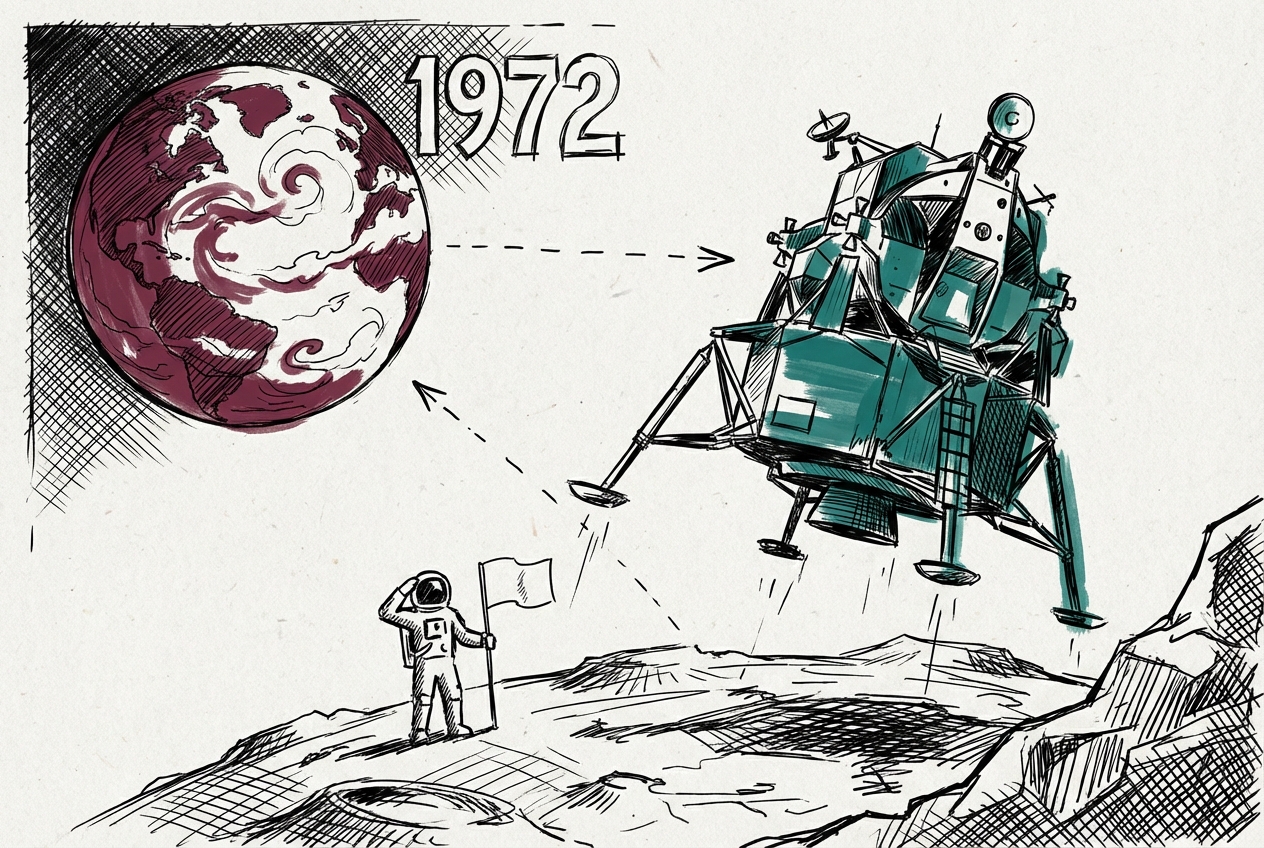
Apollo 17
Last crewed Moon landing in December 1972, 54 years before Artemis II.
On 1 April 2026, Artemis II left low Earth orbit, ending a human absence beyond it since Apollo 17 in December 1972. Apollo 17 remains the last mission to land people on the Moon.
Last refreshed: 22 September 2026 · Appears in 1 active topic
Why did 54 years pass between the last Moon landing and Artemis II?
Timeline for Apollo 17
Mentioned in: Artemis III core stage ships Monday
Artemis II Moon MissionMentioned in: Dose data dark 72 hours on
Artemis II Moon MissionMentioned in: Orion due to splash down; crew recovery planned
Artemis II Moon MissionMentioned in: Orion splashes down in Pacific, crew recovered aboard USS Murtha
Artemis II Moon MissionMentioned in: Lockheed Martin discloses 286 reusable Orion components ahead of NASA
Artemis II Moon MissionBackground
Apollo 17 is the final crewed Moon landing and the last human mission to operate on the lunar surface. Its December 1972 flight remains the direct benchmark for later crewed lunar missions, including Artemis II's April 2026 free-return flight.
Eugene Cernan, Harrison Schmitt and Ron Evans flew the mission. Cernan and Schmitt spent three days at Taurus-Littrow Valley, while Evans remained in lunar orbit. Schmitt was the only professional geologist to walk on the Moon, and the CREW returned 110 kg of lunar material.
The mission's long absence from human deep-space flight gives it continuing significance. Orion entered the lunar sphere of influence on 6 April 2026, the first crewed spacecraft to do so since Apollo 17. Artemis II returned to Earth on 10 April 2026, but did not land on the Moon.
Who was the last person on the Moon?
When was the last Moon landing before Artemis?
Did Artemis II land on the Moon?
What records did Apollo 17 set?
