Skip to content
You can now search across every topic, entity and event.What's new
AI: Jobs, Power & Money
23APR

The AI layoffs nobody is counting

4 min read
14:51UTC

A March ResumeBuilder survey found 59% of managers overstate AI in layoffs; Stanford puts the real loss at a million hires never made. Two numbers, opposite errors.

EconomicDeveloping
Key takeaway

AI's labour effect is over-attributed in press releases and under-measured in official data; the true channel is hires never made.

59% of hiring managers say they deliberately overstated artificial intelligence as the reason for their layoffs, according to a ResumeBuilder survey of 1,000 managers published in March 1. Only 9% said AI had actually replaced roles at their organisations. ResumeBuilder is a US job-search and CV platform; the survey asked managers directly why they had cut staff and whether AI was the genuine cause. The question turned live again this week, as the Office for National Statistics reported UK unemployment at 4.9% and the European Parliament stripped a worker AI-literacy right.

The 59% reads, on its own, as proof the job losses are exaggerated. Oxford Economics, a UK forecasting firm, puts genuine AI-driven cuts at around 4.5% of US layoffs in the first 11 months of 2025, roughly 55,000 positions against about 245,000 lost to ordinary cost pressure. Firms credit the machine for decisions the budget had already made. Sam Altman of OpenAI has acknowledged the practice, the same week his company moved toward a September listing above one trillion dollars .

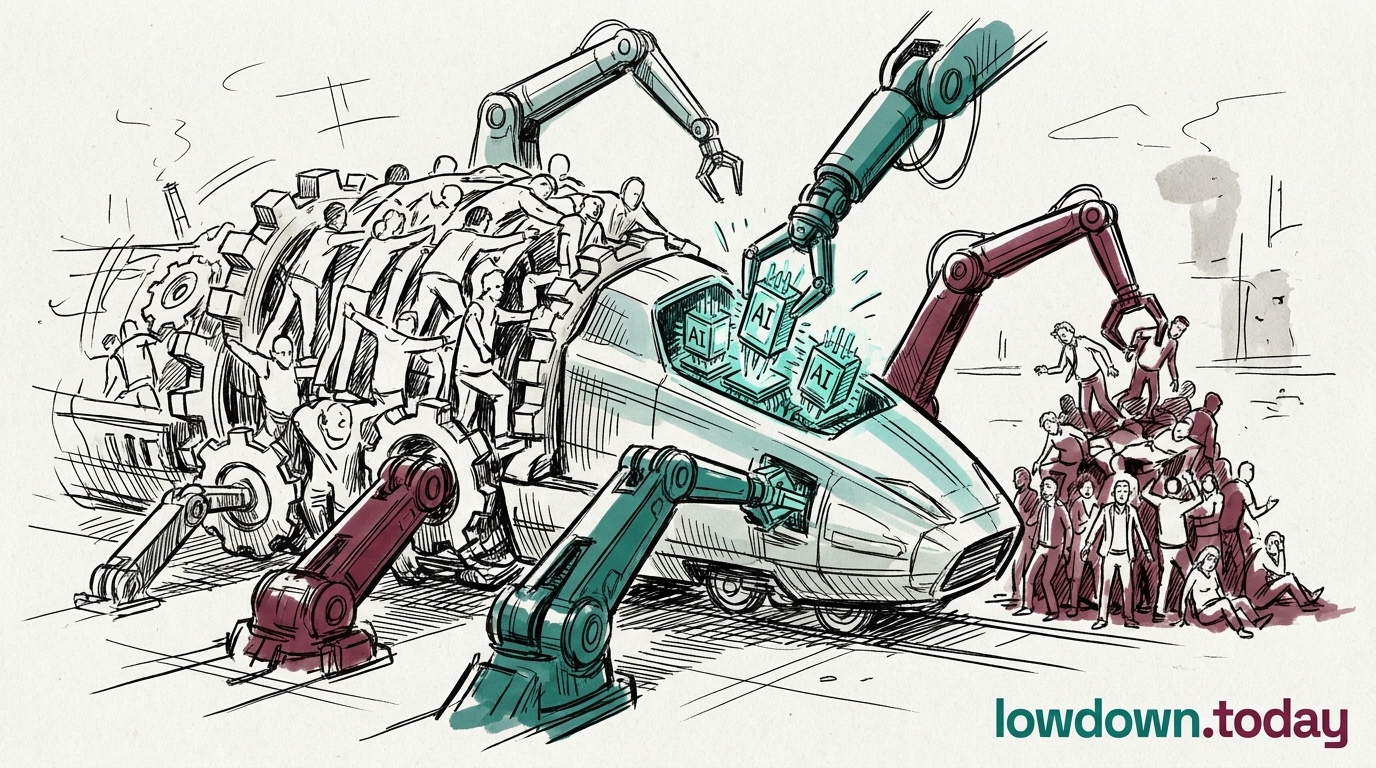
The bigger number runs the other way. The Stanford Digital Economy Lab, Stanford University's economics research unit under Erik Brynjolfsson, calculates that AI is preventing roughly 950,000 to one million US hires a year. Set that against about 145,000 declared AI layoffs since 2023, per the outplacement firm Challenger, Gray & Christmas through May. Most of the loss never reaches a redundancy notice; it shows up as the requisition never opened and the graduate never called back, so a graduate entering the workforce this year faces a far tighter market than one who arrived in 2023. MIT Sloan economist Paul Osterman told Fortune in May that AI attribution often dresses up cuts that were planned anyway , and the New York Federal Reserve has found displacement signals that predate ChatGPT entirely .

Deep Analysis

In plain English

Companies have been announcing layoffs and blaming artificial intelligence, but a new survey shows most of them are exaggerating. ResumeBuilder asked 1,000 hiring managers: 59% admitted they deliberately overstated AI's role in cutting jobs, and only 9% said AI had actually replaced anyone at their company. Oxford Economics researchers found that genuine AI-driven cuts made up about 4.5% of US layoffs in 2025; roughly 55,000 jobs out of more than a million. Stanford researchers found a separate but bigger effect: AI is causing companies to post fewer new jobs than they otherwise would; perhaps 950,000 to 1 million fewer vacancies per year in the US. That second effect does not show up in layoff counts at all, which is why the official numbers feel much smaller than the anxious headlines suggest.

Deep Analysis
Root Causes

The measurement gap has three structural causes.

First, no US or UK government agency yet publishes an AI-attribution layer in official labour statistics. The ONS, BLS, and Eurostat all collect layoff data without requiring employers to identify the automation driver. This is not an oversight; there is no agreed methodology for distinguishing AI-driven from ordinary workforce reduction.

Second, Securities and Exchange Commission disclosure rules create an incentive misalignment. Firms that attribute layoffs to AI signal innovation to equity markets; firms that attribute them to cost pressure signal management failure. The ResumeBuilder finding (59% deliberate exaggeration) is the logical consequence of this incentive structure.

Third, the Stanford JOLTS analysis measures hire suppression; roles that were never posted; which is by definition invisible to layoff trackers. The 34:1 ratio between suppressed hires and declared AI layoffs is not a paradox; it reflects two separate mechanisms operating simultaneously.

What could happen next?
  • Consequence

    Without an official AI-attribution layer in BLS or ONS data, policymakers cannot distinguish cyclical from structural unemployment, risking under-investment in targeted retraining programmes.

    Medium term · Assessed
  • Risk

    SEC disclosure practice that rewards AI attribution creates a self-reinforcing narrative: even companies not using AI to cut jobs gain investor approval by saying they are, making the measurement problem worse each quarter.

    Short term · Assessed
  • Opportunity

    The ResumeBuilder survey data, if replicated at scale by an academic institution, would give plaintiffs' employment lawyers evidence to challenge AI-attributed layoffs as pretextual, potentially triggering WARN Act liability for firms that used the excuse to avoid notice obligations.

    Medium term · Reported
First Reported In

Update #14 · The AI layoffs nobody is counting

Metaintro· 20 Jun 2026
Read original
Different Perspectives
Barclays
Barclays
Barclays economist Pooja Sriram flagged a 28,000-a-month bleed in finance and information roles the same week Microsoft disputed that AI drove its own 4,800 cuts. The bank treats Challenger's AI-attribution share as a lagging indicator against faster erosion visible in raw labour-market data.
European Commission
European Commission
Brussels deferred the Digital Omnibus's Annex III employment-compliance deadline from 2 August 2026 to December 2027, even as California advanced three binding AI-hiring bills the same week. The 17-month delay leaves EU workers without the algorithmic-hiring safeguards the regulation already promises.
OpenAI
OpenAI
OpenAI proposed a 5% US government equity stake worth $42.6bn, structured as a public wealth fund modelled on the Alaska Permanent Fund, with Sam Altman pitching it directly to Trump, Bessent and Lutnick. The offer pre-empts Sanders' rival one-time 50% AI-stock tax, which has not yet reached committee.
India's IT and outsourcing sector
BAT's transfer of 3,500 roles to Accenture on 29 June fits a delivery model Indian IT firms increasingly run: consultancies win Western contracts, then execute through offshore centres. The sector expects more Fit2Win-style transfers, not straight redundancies, as employers absorb AI without cutting outsourced headcount.
European Trade Union Confederation
ETUC says the Council's shift from 'ensure' to 'support' in the AI-literacy duty, confirmed in the Digital Omnibus's final adoption on 29 June, is a collapse of the legal threshold, not a drafting tidy-up. It expects EU workers to face AI-driven hiring and monitoring decisions with a statutory right to explanation that exists in name only.
British American Tobacco's Fit2Win workforce
BAT is cutting 9,000 roles under Fit2Win, transferring 3,500 to Accenture rather than making them redundant, to reach roughly £500m in AI-driven savings by 2027. For affected staff, that distinction decides whether they keep a job at all, just not at BAT.

