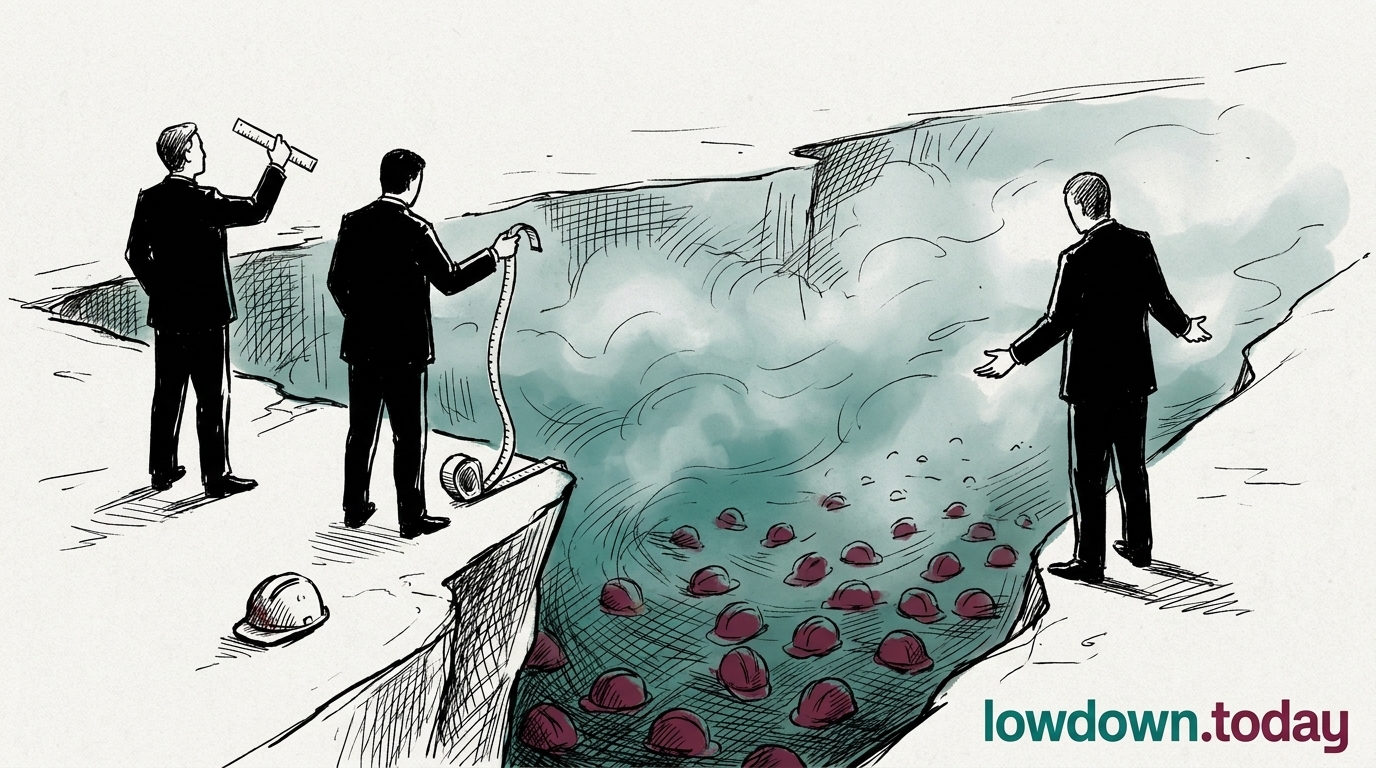
The Office for National Statistics (ONS), the UK government's statistics agency, published its May 2026 labour market bulletin on 19 May showing payrolled employment fell 210,000 year on year to 30.2 million in April.1 That decline more than doubled the 96,000 year-on-year fall reported a month earlier, the steepest single-month worsening in the series since the pandemic. Vacancies dropped to 705,000, the lowest since early 2021, while unemployment rose to 5.0%, up half a point on the year.
Real regular pay growth fell to 0.1%, near flat, so nominal wages are rising but inflation is absorbing almost all of it and households are standing still. The April bulletin had already shown vacancies at 711,000, a five-year low that broke a long plateau; the May figures confirm that was the start of a slide, not a floor. A falling vacancy stock alongside falling payrolled employment points to structural stasis, not a soft patch.
The ONS produced no AI-specific breakdown, the same gap that has run through every UK reading this year. That matters because the Bank of England Financial Policy Committee modelled 500,000 additional unemployed as its AI-displacement stress scenario. At the current rate of decline, that worst case is within reach inside 18 months, yet the agency measuring the market cannot say how much of the fall is AI rather than ordinary demand weakness. The policy debate runs against a number that cannot name its own cause.





