Skip to content
AI: Jobs, Power & Money
10APR

Fed and Treasury summon bank CEOs

2 min read
16:54UTC

The first emergency meeting convened by US regulators over a single AI model's capabilities drew five Wall Street CEOs to Treasury headquarters.

PoliticsDeveloping
Key takeaway

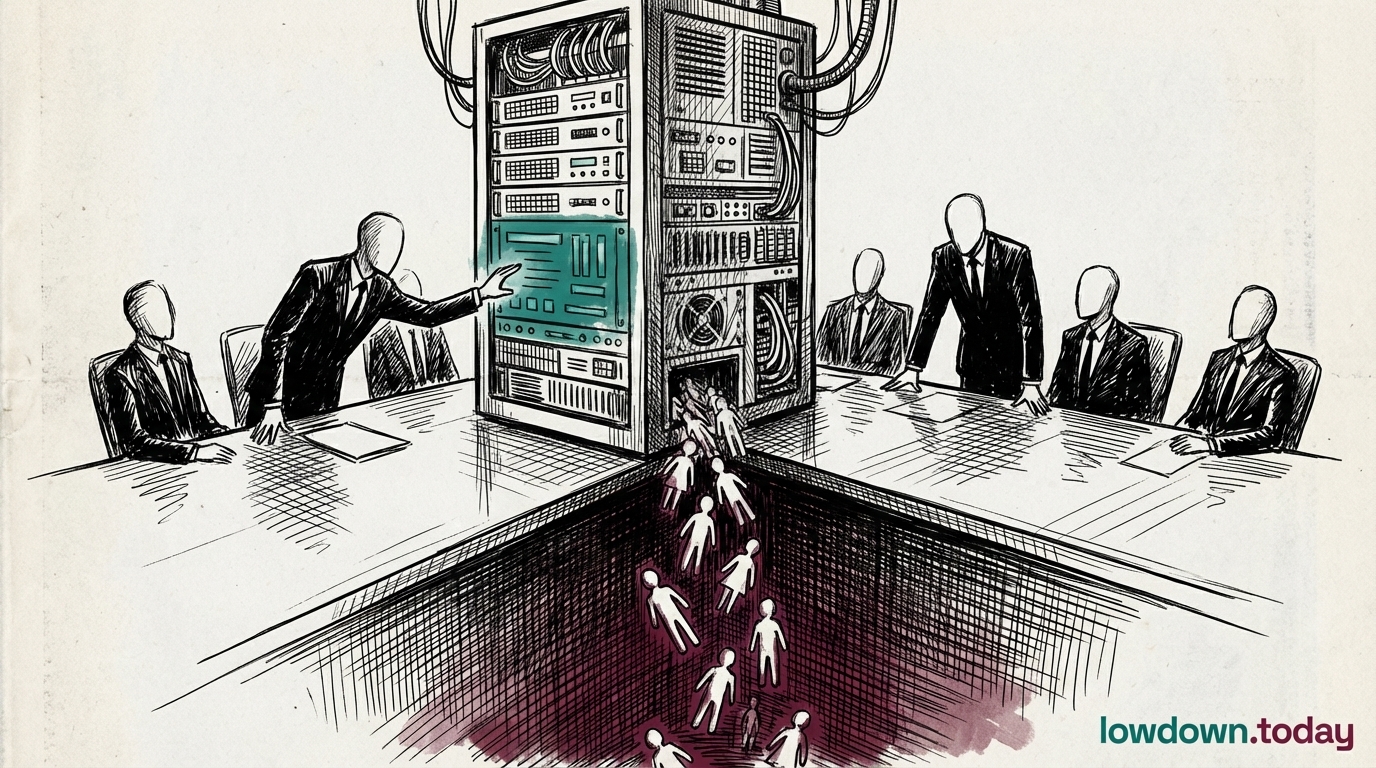
A single AI model forced emergency government action that workforce displacement never has.

Treasury Secretary Scott Bessent and Federal Reserve Chair Jerome Powell summoned the CEOs of Citigroup, Morgan Stanley, Bank of America, Wells Fargo, and Goldman Sachs to an emergency meeting at Treasury headquarters on 8 April 2026 to discuss Anthropic's Claude Mythos Preview 1. Jamie Dimon of JPMorgan was unable to attend. The meeting preceded Anthropic's formal public announcement by one day and is the first recorded instance of The Fed and Treasury convening Wall Street leadership specifically over a frontier AI system's capabilities.

Financial sector AI adoption grew 127% year-on-year as of 3 April 2, making these same banks central to both the AI capability story and the labour displacement data. Goldman Sachs, one of the twelve Glasswing partners receiving restricted Mythos access, simultaneously published research showing AI substitutes 25,000 US jobs per month . A cybersecurity capability triggered emergency federal action within 48 hours; cumulative AI-attributed job cuts crossing 100,000 over three years produced no equivalent response.

The New York Fed publishes dedicated GenAI workplace research on 14 April, four days from now. If those findings diverge from the three conflicting prior surveys on AI workforce impact, the data will carry more weight than any corporate estimate.

Deep Analysis

In plain English

When the US government worries a new technology could threaten the financial system, it does not issue a press release. It calls a meeting. On 8 April 2026, the Treasury Secretary and the head of the Federal Reserve summoned the chief executives of America's largest banks to Treasury headquarters in Washington. The subject was a single AI model: Anthropic's Claude Mythos Preview. The model had demonstrated an ability to find hidden security flaws in software at a scale and speed beyond anything seen before. Regulators were concerned that banks, which rely on the same software infrastructure Mythos had mapped, needed to act fast. What makes this significant is the contrast with what did not trigger a similar meeting: more than 100,000 workers losing their jobs to AI over three years.

Deep Analysis
Root Causes

The meeting reflects a structural asymmetry in US financial regulation: cybersecurity threats that could destabilise payment systems trigger immediate federal coordination mechanisms built after 9/11 and refined after 2008, while labour market effects of the same technology accumulate for years before producing any equivalent institutional response.

The financial sector's 127% year-on-year AI adoption rate (Federal Reserve FEDS Notes, April 2026) means banks are among both the fastest adopters of AI and the most exposed to AI-enabled cyberattacks. This dual exposure, both deploying and being targeted, compressed the regulator response timeline in a way that AI job displacement has not.

What could happen next?
  • Precedent

    The first federal emergency meeting triggered by a single AI model's capabilities sets a template for regulatory response to frontier AI systemic risk.

    Immediate · 0.82
  • Risk

    If the twelve Glasswing partners deploy Mythos-class capabilities offensively before defensive infrastructure scales, the financial system's vulnerability window widens.

    Short term · 0.65
  • Consequence

    Bank security and AI-risk teams face immediate pressure to expand headcount, creating a localised hiring surge within institutions simultaneously cutting in other functions.

    Short term · 0.72
First Reported In

Update #5 · The model they won't release

Bloomberg· 10 Apr 2026
Read original
Different Perspectives
Oxford Economics
Oxford Economics
Concluded AI's role in recent layoffs is 'overstated,' finding companies are not replacing workers with AI at scale. Identified slowing growth, weak demand, and cost pressure as the actual drivers.
Ambrish Shah, Systematix Group
Warned AI coding tools will erode Indian IT firms' labour-arbitrage growth model by reducing enterprise dependency on large vendor teams.
South Korean government
Enacted the world's second comprehensive AI law, choosing an innovation-first framework over prescriptive employment protections — a deliberate contrast to the EU's regulatory approach.
Corporate executives executing AI-driven cuts
Frame workforce reductions as existential necessity. Crypto.com CEO Kris Marszalek and Block CEO Jack Dorsey both described AI adoption as a survival imperative, with equity markets reinforcing the message through immediate share-price gains.
Chinese government (Wang Xiaoping)
Positions AI as a job-creation engine to absorb 12.7 million annual graduates and offset 300 million retirements, directly contradicting domestic economist Cai Fang's warning that AI job destruction precedes creation.
Klarna and companies reversing AI cuts
Klarna's public reversal — rehiring the human agents it replaced with AI after customer satisfaction collapsed — validates Gartner's prediction that half of AI-driven service cuts will be undone by 2027.