Skip to content
You can now search across every topic, entity and event.What's new
2026 FIFA World Cup
15APR

Rubio: Iran can play, IRGC staff cannot

3 min read
09:43UTC

US Secretary of State Marco Rubio told reporters on 24 April that 'nothing from the US has told them they can't come', then drew a line at IRGC-linked support staff posing as journalists or trainers.

SportDeveloping
Key takeaway

Rubio left the door open to athletes and shut it on IRGC-linked staff; Pearson then closed it on a president.

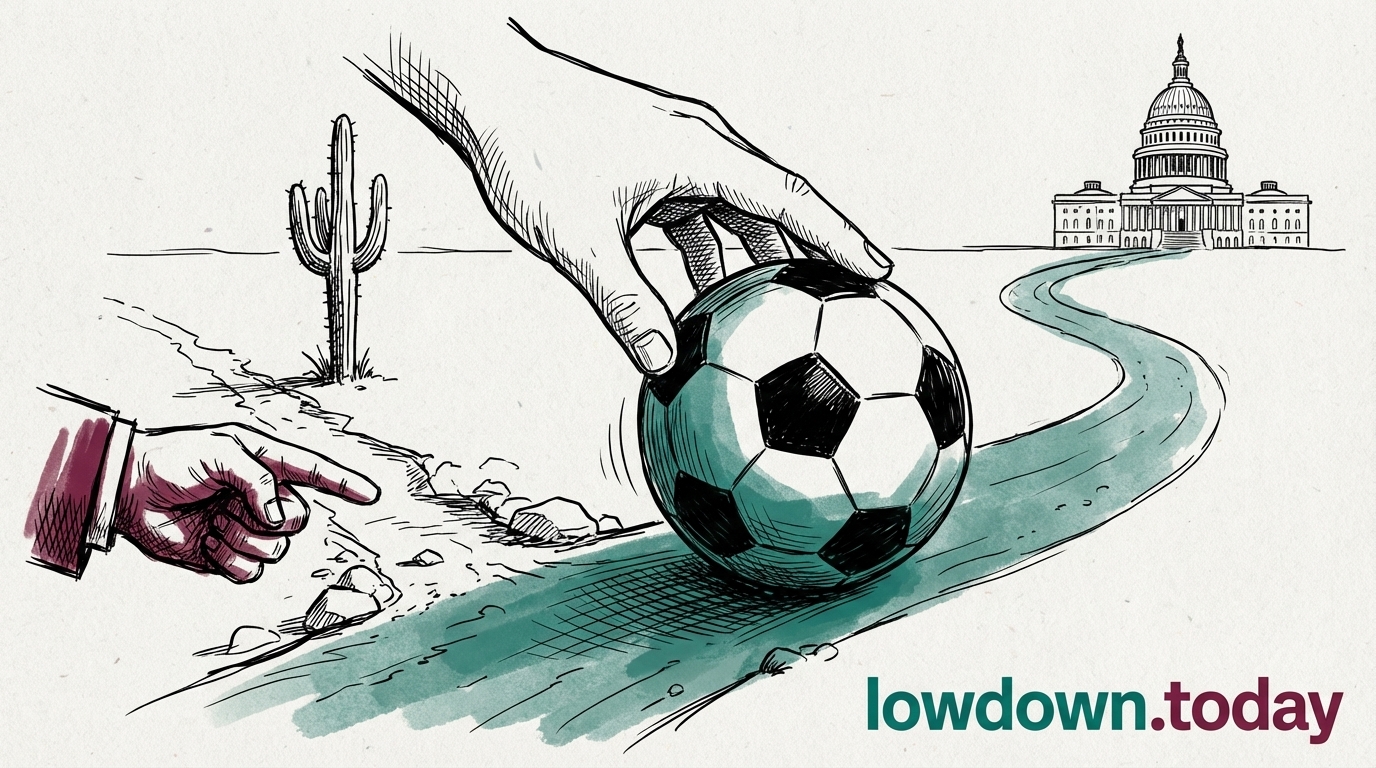
Marco Rubio, US Secretary of State, told reporters in Washington on Friday 24 April 2026 that the United States had not barred Iranian athletes from competing at the World Cup. 'Nothing from the US has told them they can't come,' he said, before adding the condition that has shaped every subsequent border event: 'They can't bring a bunch of IRGC terrorists into our country and pretend that they are journalists and athletic trainers' 1.

Rubio's wording aimed the carve-out at squad support staff. Pearson on Wednesday applied the same logic to a federation president. Mehdi Taj had cleared Canada's formal visa process; an airport-stage vetting decision then overrode the consular clearance. The carve-out was not new: senior FIFA executives had already pressed Infantino in mid-April to ask Trump for a 39-day ICE moratorium on host cities , an ask that went nowhere. Rubio's 24 April statement was the policy reply, narrower than the moratorium FIFA wanted and narrower than the visa-bond expansion to 50 countries that frames foreign-visitor entry more broadly.

Three border events in five weeks have now produced two clean crossings, Antalya on 1 April and the Vancouver delegates on 30 April, and one denial at Pearson on 29 April. Canada and the United States both designate the IRGC; Turkey, where the FFIRI delegation met Infantino without friction in early April , does not. The Iran squad is scheduled to open its Kino Sports Complex camp at Tucson on Sunday 10 May, the next dated US port-of-entry event for Iranian football personnel and the test the Rubio carve-out was written for.


Deep Analysis

In plain English

US Secretary of State Rubio said in late April that Iranian footballers can come to the World Cup. But he added a condition: Iran cannot bring people who work for the IRGC, Iran's military, by disguising them as journalists or coaches. The problem is that the person turned back at the Canadian border was not a journalist or a coach. He was the head of Iran's football federation, the equivalent of the FA's chief executive. Rubio's condition does not quite cover the situation Canada just demonstrated, leaving open exactly who else might be stopped at the US border.

Deep Analysis
Root Causes

The IRGC carve-out exists because Iran's sports and military bureaucracies are structurally intertwined in a way with no direct equivalent among other participating nations. The IRGC operates commercial enterprises, sports clubs, and stadium infrastructure; FFIRI officials at multiple levels have held concurrent IRGC roles.

The US designation of the IRGC as a Foreign Terrorist Organisation in 2019 created a downstream entry bar that federal law requires officers to enforce, regardless of any sporting exception.

Rubio's carve-out attempts to draw a line inside that structural overlap. The line he drew, journalists and trainers posing as support staff, is a category that does not map onto the roles of a FIFA delegation, which includes federation presidents, legal officers, and accreditation coordinators who are not nominally athletic but who have no other route to accompany the squad.

What could happen next?
  • Risk

    Because Rubio's verbal carve-out is narrower than CBP's statutory authority under 8 U.S.C. 1182(a)(3)(B), the Tucson port of entry may apply a broader vetting test than Rubio's public framing implies, blocking officials he did not name as a target.

  • Precedent

    If the Tucson entry proceeds cleanly, it establishes that a presidential endorsement (Trump, 30 April) and a Secretary of State clarification (Rubio, 24 April) together constitute sufficient political direction to CBP to pass a FIFA delegation, setting a precedent with value for future tournaments hosted by nations with active geopolitical disputes.

First Reported In

Update #9 · Iran's Pearson test

Al Jazeera· 1 May 2026
Read original
Different Perspectives
Spain
Spain
Spain face France on Tuesday for the second semi-final place, the last unresolved tie in the bracket.
France
France
France already through to the other semi-final, await Tuesday's result against Spain to know who plays the England-Argentina winner in the final.
Switzerland
Switzerland
Switzerland reached their first World Cup quarter-final since 1954 and led Argentina before Breel Embolo's second yellow card left them a man down for the last half-hour. They expect the run to raise expectations for the next cycle rather than close a chapter.
Norway
Norway
Norway leaned on Erling Haaland to reach a first modern-era quarter-final, and he nearly took them further before a disallowed goal and England's late double ended the run. Their tournament closes as the best World Cup performance in the country's history.
Argentina national team
Argentina broke down a 10-man Switzerland late, extending Scaloni's run of reaching every semi-final he has managed since 2019. Messi will make his first World Cup appearance against England, a fixture Argentine coverage framed around that unbroken run rather than the personal narrative.
England
England
England needed a 93rd-minute Bellingham winner to see off Norway, the third straight knockout tie settled in its closing stages rather than controlled. They travel to Atlanta as favourites but with Declan Rice a fitness doubt and Jarell Quansah suspended.


