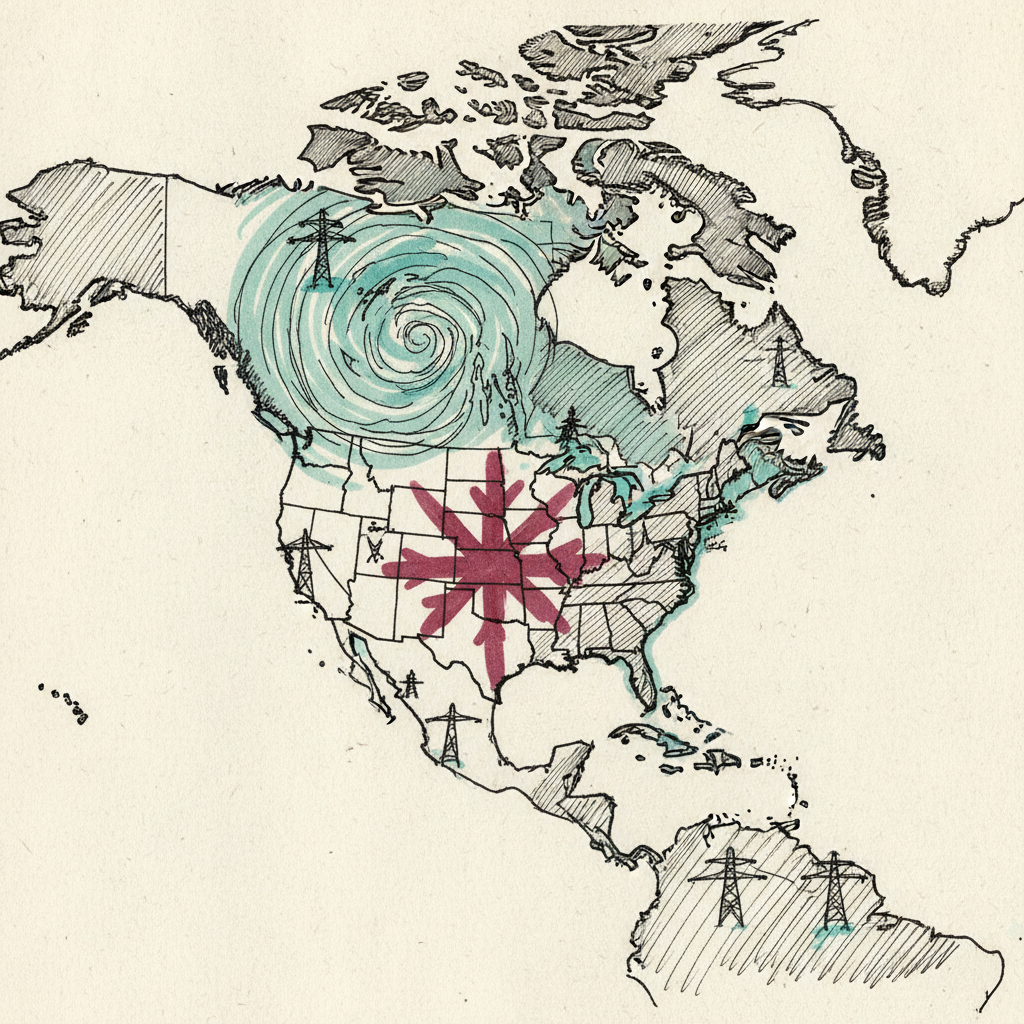
Winter Storm Elliott
Winter Storm Elliott was a December 2022 North American blizzard that caused widespread grid failures; the DOE used Section 202(c) to keep generation running during the event, establishing the statutory precedent applied in 2026 to data-centre load.
Last refreshed: 26 May 2026 · Appears in 1 active topic
How did a 2022 blizzard give the US government the power to switch off data centres in 2026?
Timeline for Winter Storm Elliott
DOE lets PJM switch off data centres
Data Centres: Boom and BacklashBackground
Winter Storm Elliott was a powerful extratropical cyclone that struck North America from 21-26 December 2022, causing widespread grid failures across the eastern United States. Temperatures dropped to record lows across the South and Midwest; at least 60 people died. The storm forced the US Department of Energy to invoke Section 202(c) of the Federal Power Act, ordering electricity generators to stay online despite maintenance or commercial reasons to shut down, to prevent grid collapse. It was one of the most significant invocations of 202(c) in recent history and became the defining precedent for emergency grid authority.
Section 202(c) grants the DOE authority to order electricity generators and, by interpretation, electricity loads to take actions necessary to maintain grid reliability during an emergency. The Elliott invocation targeted generation — keeping plants running. In May 2026, the DOE issued a second 202(c) order, this time targeting load — specifically granting PJM Interconnection authority to curtail data centres equipped with behind-the-meter backup generation. Elliott established that 202(c) could be used aggressively; the 2026 order extended that logic from supply to demand.
The significance for the data-centre sector is structural. Before 2026, operators building behind-the-meter gas generation assumed they could operate independently of grid conditions. The DOE's 202(c) order — citing Elliott as the statutory model — demonstrated that the federal government can compel large loads to curtail regardless of their own generation capacity. The precedent now hangs over every BTM gas fleet in the PJM footprint.