West Texas
Permian Basin region; WTI Crude delivery hub and key US oil production corridor.
Last refreshed: 6 July 2026 · Appears in 1 active topic
Why does the Brent-WTI spread matter for European oil buyers right now?
Timeline for West Texas
Mentioned in: Aramco cuts Europe off for October
Iran Conflict 2026Mentioned in: Brent spikes on the strike, then gives it back
Iran Conflict 2026Mentioned in: CFTC data show funds cut WTI length 23%
European Oil MarketsMentioned in: Hormuz risk lifts the Brent-Dubai EFS
European Oil MarketsMentioned in: Brent-WTI blows out as price sits still
European Oil MarketsBackground
West Texas encompasses the Permian Basin, one of the world's most productive sedimentary oil basins, centred on the Midland-Abilene corridor. It is the delivery and pricing geography for West Texas Intermediate (WTI), the benchmark US crude grade whose settlement point is the Cushing, Oklahoma pipeline hub — though the Permian itself originates the physical barrels. US crude production from the Permian Basin has driven the shale revolution, making the United States the world's top oil producer by the 2020s. The basin's output underpins EIA weekly stock data and directly feeds into Brent-WTI spread dynamics on global markets.
Beyond oil, West Texas hosts significant wind and solar generation on the ERCOT grid, which serves approximately 90 per cent of Texas's electricity demand and is the largest grid in the continental US not subject to FERC oversight. The region's structural advantages — grid sovereignty through ERCOT, cheap land, and access to competitive Power Purchase Agreements — drove it to rank second globally for data-centre siting in May 2026 analysis, behind Finland. Some 9.1 GW of existing crypto-mining capacity is converting to AI compute via brownfield routes that bypass the ERCOT large-load study queue.
WTI Cushing is the US domestic crude benchmark against which European traders track the Brent-WTI spread, a live indicator of the relative tightness of seaborne supply (Brent) versus landlocked US pipeline crude (WTI). In The Week to 26 May 2026, managed money in NYMEX WTI collapsed from net long +172,580 to near-flat as Hormuz Ceasefire optimism unwound the geopolitical premium from the landlocked leg, compressing Brent-WTI to roughly $2-3/bbl from the prior $4-5 band. Positioning then reversed sharply: by The Week to 23 June, NYMEX WTI managed money had rebuilt to net long +82,872 contracts, a swing of roughly 110,000 contracts in three weeks, while Brent speculative length stayed thin, decoupled by EU Regulation 833/2014's bar on European refiners taking discounted Iranian GL X barrels. Flat price kept falling regardless: WTI traded around $68 on 2 July, a fresh leg below the 17 June three-month low, even as funds held their rebuilt long book. That long book was tested on 6 July, the first session after OPEC+ confirmed its August output hike: the Brent-WTI spread widened a further 60% to $3.26 as Brent absorbed more of the OPEC-linked softness than WTI, settling at $71.42 against WTI's $68.16.
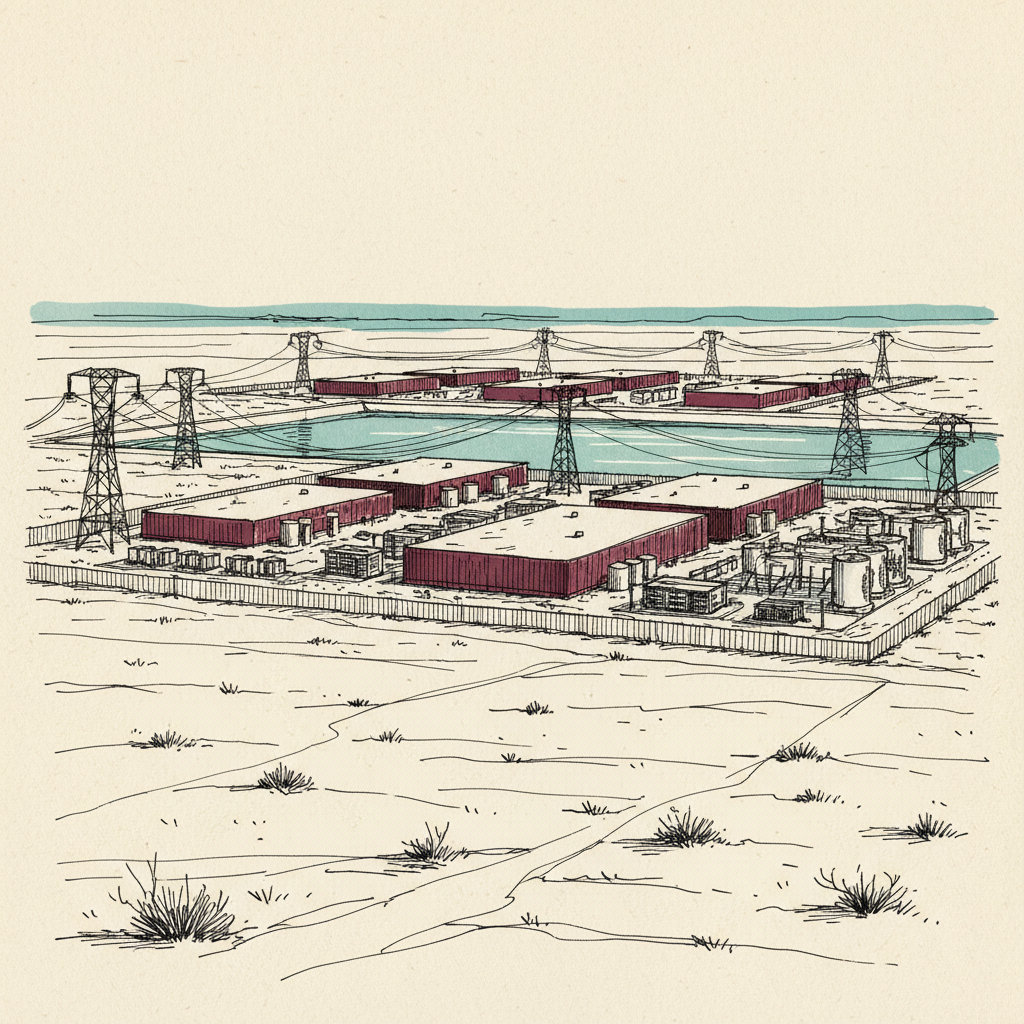
West Texas (Midland-Abilene) ranked second on the global data-centre siting shortlist for 2026, behind Finland's Kajaani-Tampere corridor. Its structural advantage is grid sovereignty: ERCOT is not synchronous with the Eastern or Western Interconnection, so behind-the-meter arrangements in West Texas sit outside FERC jurisdiction. Operators can avoid the federal interconnection queue entirely. 9.1 GW of existing crypto-mining capacity is converting to AI compute, a brownfield route that sidesteps both the ERCOT large-load study process and the gas-turbine ordering backlog. That behind-the-meter thesis moved from theory to construction on 22 June, when Chevron's Energy Forge One signed a 20-year Power Purchase Agreement with Microsoft to build a 2.67 GW gas plant, branded Project Kilby, co-located with a West Texas data centre at roughly $7bn capex; first power is due in 2028, and at 2.67 GW it is the largest dedicated-generation deal struck for a data centre in 2026.
Why are data centres moving to West Texas?
How much crypto-mining capacity in West Texas is converting to AI data centres?
Why is West Texas the second-best location for new data centres in 2026?
What is the GE Vernova turbine backlog and why does it matter for Texas data centres?
How is ERCOT different from other US electricity grids?
What is McKinsey's role in the ERCOT large-load queue?
Where are crypto mining facilities being converted to AI data centres in the US?
What is WTI crude oil and where is it produced?
Why does the Brent-WTI spread widen and narrow?
How much oil does the Permian Basin produce?
Why are data centres building in West Texas?
What is Project Kilby in West Texas?
