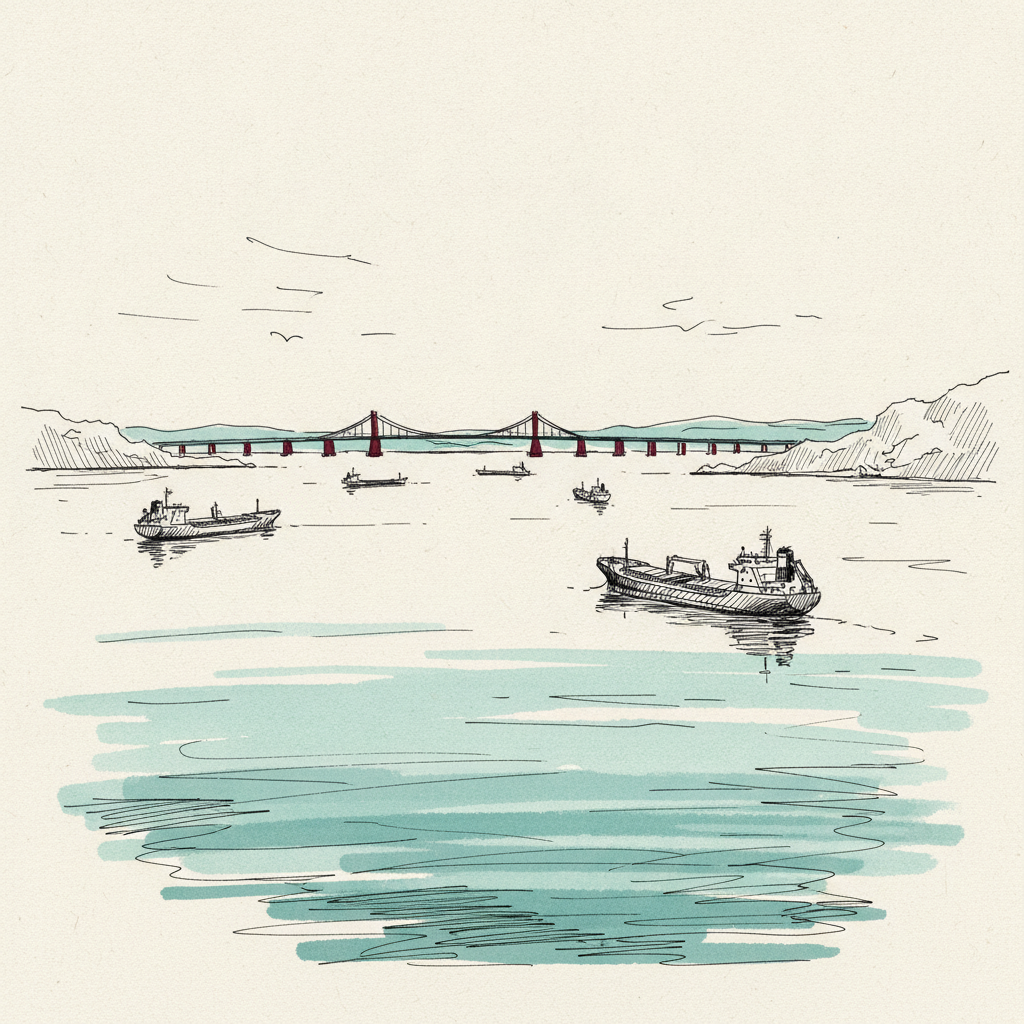
Sea of Azov
Shallow inland SEA between Russia and Ukraine, now a fuel-Tanker War chokepoint.
The Sea of Azov, the world's shallowest SEA, became the front line of Ukraine's fuel war on Russia from 11 July 2026, when strikes on its tankers cut vessel traffic by a possible 55%.
Last refreshed: 3 August 2026 · Appears in 1 active topic
Timeline for Sea of Azov
Mentioned in: Brovdi claims 285 tankers struck, breakdown sums to 79
Russia-Ukraine War 2026Mentioned in: Crimea lost its summer to the blackouts
Russia-Ukraine War 2026Mentioned in: Sea drones push into the Black Sea
Russia-Ukraine War 2026Mentioned in: Ukraine says it hit 159 tankers
Russia-Ukraine War 2026Ukraine's strikes move to the Azov
Russia-Ukraine War 2026Background
The Sea of Azov is the world's shallowest SEA, an enclosed basin of roughly 37,600 sq km with a maximum depth of only 14 metres, linked to the Black Sea by the narrow Kerch Strait. Its principal ports, Mariupol, Berdyansk, Taganrog and Yeysk, carried Ukrainian grain and Russian fuel exports for generations before the war.
Russia has controlled the SEA's western and northern shoreline, including Mariupol, since seizing it in 2022, giving Moscow an unbroken land corridor to occupied Crimea. That control makes the Azov as much a supply route as a battlefield: fuel tankers moving diesel out through Azov ports keep Russian petrol stations supplied at home, so strikes here land directly on domestic fuel policy rather than the front line.
The SEA's shallow, narrow geography concentrates shipping into predictable lanes, making it unusually vulnerable to the precision strikes now reshaping the wider war's economic front.
Tanker strikes throttle Sea of Azov traffic
Ukraine widened its long-range strike campaign from inland refineries to the tankers crossing the Sea of Azov from 11 July 2026, and AIS tracking by Starboard Maritime Intelligence recorded a possible 55% drop in vessel traffic between 30 June and 11 July. Moscow's own decree banning diesel exports followed within days, running from 8 to 31 July.
The SEA's shallow, narrow geography, barely 14 metres deep at its maximum and linked to the Black Sea only through the Kerch Strait, concentrates shipping into predictable lanes that Ukraine's SEA drones can target with precision. By mid-July Ukraine said it had struck 159 shadow-fleet tankers in twelve days, a rate its military called a sharp escalation on the previous 96 hours.
Why is Ukraine striking ships in the Sea of Azov?
How deep is the Sea of Azov?
Does Russia control the Sea of Azov coastline?
What connects the Sea of Azov to the Black Sea?
Did Ukraine's shadow-fleet strikes move beyond the Sea of Azov?

