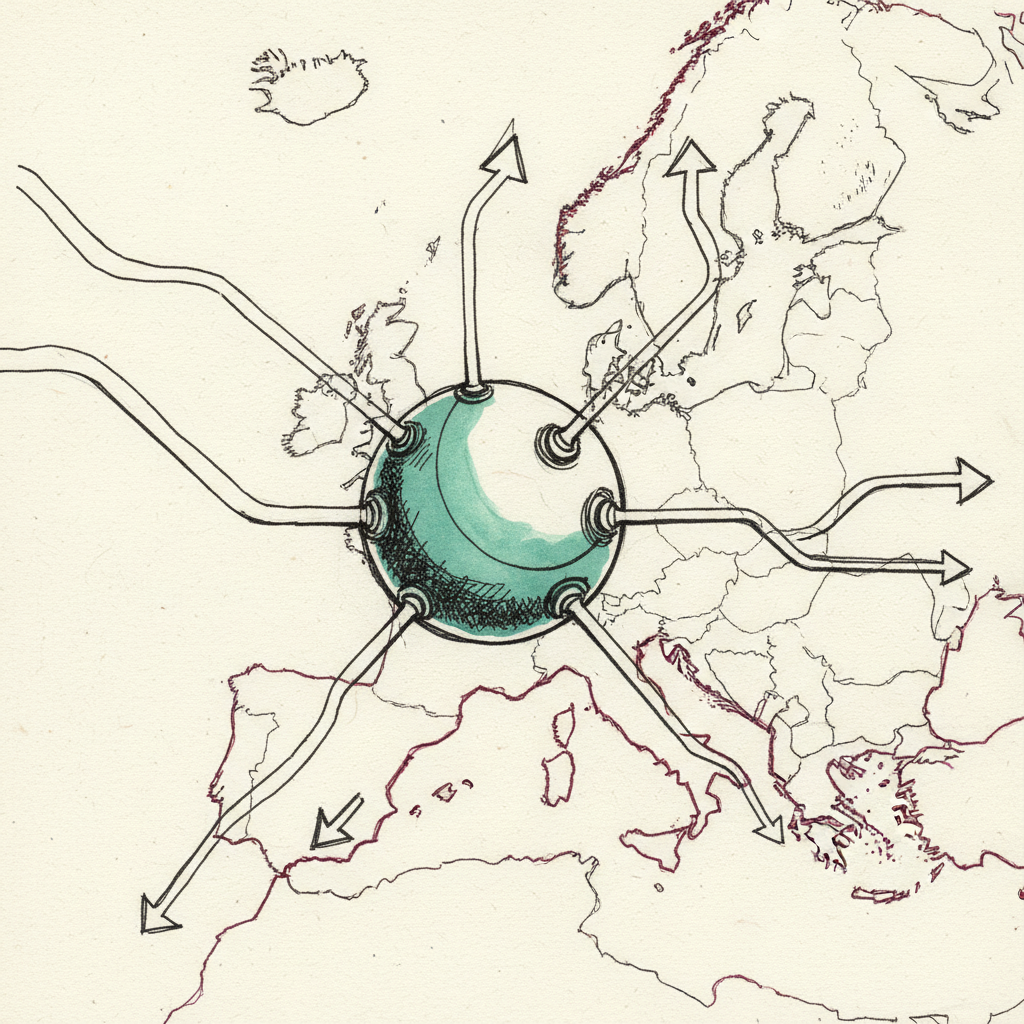
Why does Italy's virtual gas hub price matter when LNG cargoes arrive at Adriatic LNG?
Timeline for PSV
Mentioned in: Central European gas basis nearly vanishes before ban
European Energy MarketsMentioned in: Russian pipeline ban binds in nine days
European Energy MarketsGolden Pass routes Qatari LNG via Texas
European Energy MarketsBackground
PSV is directly downstream of the Adriatic LNG terminal off the Italian coast, which receives Atlantic-routed cargoes from QatarEnergy's Golden Pass US equity position, the 15,000 km Texas-to-Adriatic detour that has been QatarEnergy's primary European route since Force majeure on Ras Laffan Hormuz exports in March 2026. The PSV-TTF spread is therefore a live signal for whether QatarEnergy's rerouted volumes are fully clearing into the Italian market or creating surplus pressure that pushes the basis down. On 11 June 2026, the CEGH-TTF spread, the closest daily-published proxy for the Central European basis including PSV, compressed to €0.41/MWh from a €2-plus premium through May, confirming that markets are pricing the 17 June EU short-term Russian gas import ban as a legal event only, not a structural supply disruption, given that long-term TurkStream contracts exempted until 30 September 2027 carry the bulk of Hungarian and Slovak supply.
The Punto di Scambio Virtuale (PSV) is Italy's national virtual gas trading hub, operated by Snam Rete Gas, Italy's gas transmission system operator. As a virtual title-transfer point, it is where gas ownership changes hands on the Italian high-pressure network without requiring physical delivery at a specific location. PSV is the primary price reference for Italian gas consumers and the entry point through which Adriatic LNG and Livorno regasification terminals inject Atlantic-origin LNG into the domestic network.
PSV prices are assessed daily by ICIS and S&P Global Platts. The PSV-TTF spread is the key routing signal for Atlantic LNG cargo operators choosing between the Adriatic LNG terminal (connecting to PSV) and northwest European terminals connecting to TTF or NBP. A wide PSV premium attracts cargoes to Italian regasification; compression toward TTF makes northwest European terminals the preferred destination. Key supply inputs to PSV include Algerian pipeline gas (Trans-Mediterranean), Libyan pipeline gas (Greenstream), and regasified LNG from the Adriatic LNG and Livorno FSRU terminals.
For European energy market monitoring, PSV sits within the Central European hub basis complex alongside CEGH (Austria), NCG and Gaspool (Germany), and ZTP (Belgium). These hubs typically trade at premiums to TTF that reflect locational tightness as Russian pipeline supply shifted from east-entry (via Ukraine and TurkStream) to west-entry (via Atlantic LNG). ACER's winter 2026 wholesale gas report logged Central European hub premiums above €2/MWh through May 2026, narrowing sharply to €0.41/MWh by 11 June as markets priced the EU's 17 June short-term Russian gas import ban as a legal marker rather than a supply event.