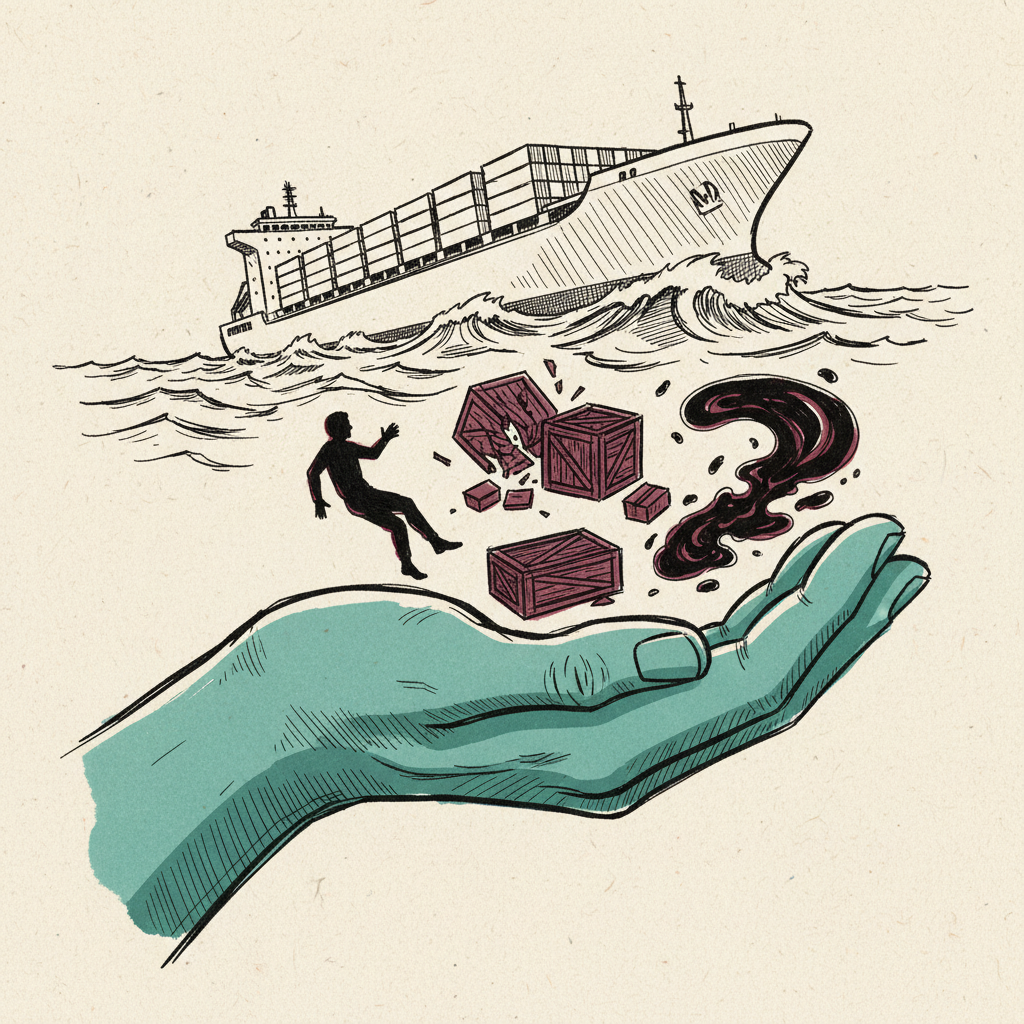
Protection and Indemnity (P&I)
Maritime liability cover whose withdrawal can halt ships even when waterways remain physically open.
On 18 August 2026, twelve leading P&I clubs withdrew ancillary war-risk cover for Gulf shipping after reinsurers pulled their backing, then arranged replacement buyback cover within three days, Lloyd's List reported.
Last refreshed: 19 August 2026 · Appears in 2 active topics
Can ships still obtain Gulf war-risk cover after repeated vessel strikes?
Timeline for Protection and Indemnity (P&I)
P&I clubs rebuy war-risk cover in three days
Iran Conflict 2026Mentioned in: First sailors die in the tanker war
Iran Conflict 2026Mentioned in: Seventh licence keeps ISAB Priolo open
European Oil MarketsDeclined to reinstate war-risk cover until navigable channels are swept and the PGSA-OFAC conflict is resolved
Iran Conflict 2026: Insurers cut the price, not the riskMentioned in: Freight rate holds as Brent caves
European Oil MarketsBackground
Protection and Indemnity (P&I) insurance is the primary liability cover for the global Shipping Industry, provided through 13 non-profit mutual clubs organised under the International Group of P&I Clubs, a London-based umbrella body. Collectively its members cover roughly 90 per cent of global ocean-going tonnage, more than 2 billion gross tonnes, against claims for crew injury, cargo damage, collision liability, wreck removal and environmental pollution.
Clubs operate on a mutual principle: members pay calls (premiums) and share pooled losses, with the International Group placing excess-of-loss reinsurance through Lloyd's of London and specialist Marine underwriters for the largest claims. P&I cover is a condition of port entry in virtually every jurisdiction and is required under conventions including the Civil Liability Convention, the Bunkers Convention and the Nairobi Wreck Removal Convention.
A lapse in cover effectively grounds a vessel: ports refuse entry and charterers cancel regardless of the military situation on the water. That mechanism is why the withdrawal or reinstatement of war-risk cover, rather than the physical state of a strait, has repeatedly determined whether Gulf shipping can move.
Reinsurers force a cover withdrawal
On 18 August 2026, twelve leading Protection and Indemnity clubs withdrew ancillary war-risk cover for Gulf transits after reinsurers pulled their backing, Lloyd's List reported. Ordinary P&I cover continued throughout; only the specialist war-risk layer was affected.
Within three days the clubs arranged replacement buyback cover at prevailing market prices, restoring the war-risk layer. The episode shows how quickly the concept's structural role, a condition of port entry, can be tested and repriced even without visible escalation on the water.
Sanctions silence strands tanker cargoes
OFAC's General Licence U, which had let P&I clubs service Iranian-origin cargoes loaded on or before 20 March, expired at 00:01 EDT on 19 April after 25 days without renewal. That pushed roughly 325 tanker cargoes into a legal grey zone and exposed clubs to secondary sanctions.
By 23 April, all five vessels crossing the strait of Hormuz were running AIS-suppressed, the first day of zero AIS-visible crossings since the blockade began, a direct consequence of the cover gap.
War-risk pricing outlasts the ceasefire
Western war-risk insurance returned to The Gulf corridor at 3 to 4 per cent of hull value in June 2026, against 0.25 per cent before the conflict, embedding roughly $1 to $1.50 a barrel in extra cost on a very large crude carrier cargo.
On 18 June, Brent fell 6.9 per cent as markets priced the Islamabad Accord as a completed Hormuz reopening, but no P&I club lifted its war-risk exclusion and no commercial tanker transited the strait.
Reference
What is the difference between hull insurance and P&I insurance?
What is Protection and Indemnity insurance in shipping?
Is Hormuz P&I insurance restored after the Iran ceasefire?
What happened to the CMA CGM San Antonio in the Strait of Hormuz?
Can ships get insurance to pass through the Strait of Hormuz in 2026?
What is OFAC General Licence U and why did its expiry matter?
Can a shipping company lose P&I cover because of Iran sanctions?
What happens to Iranian tankers when General Licence U expires?
Why did P&I clubs close Hormuz to shipping?
What is P&I insurance and why does it matter for the Hormuz blockade?
Why do ships need P&I insurance to enter ports?
Who are the main P&I clubs for shipping?
What does P&I insurance cover for ships?


Written with AI from Lowdown's published reporting. Not individually reviewed by an editor. Updated 19 August 2026. Editorial standards.