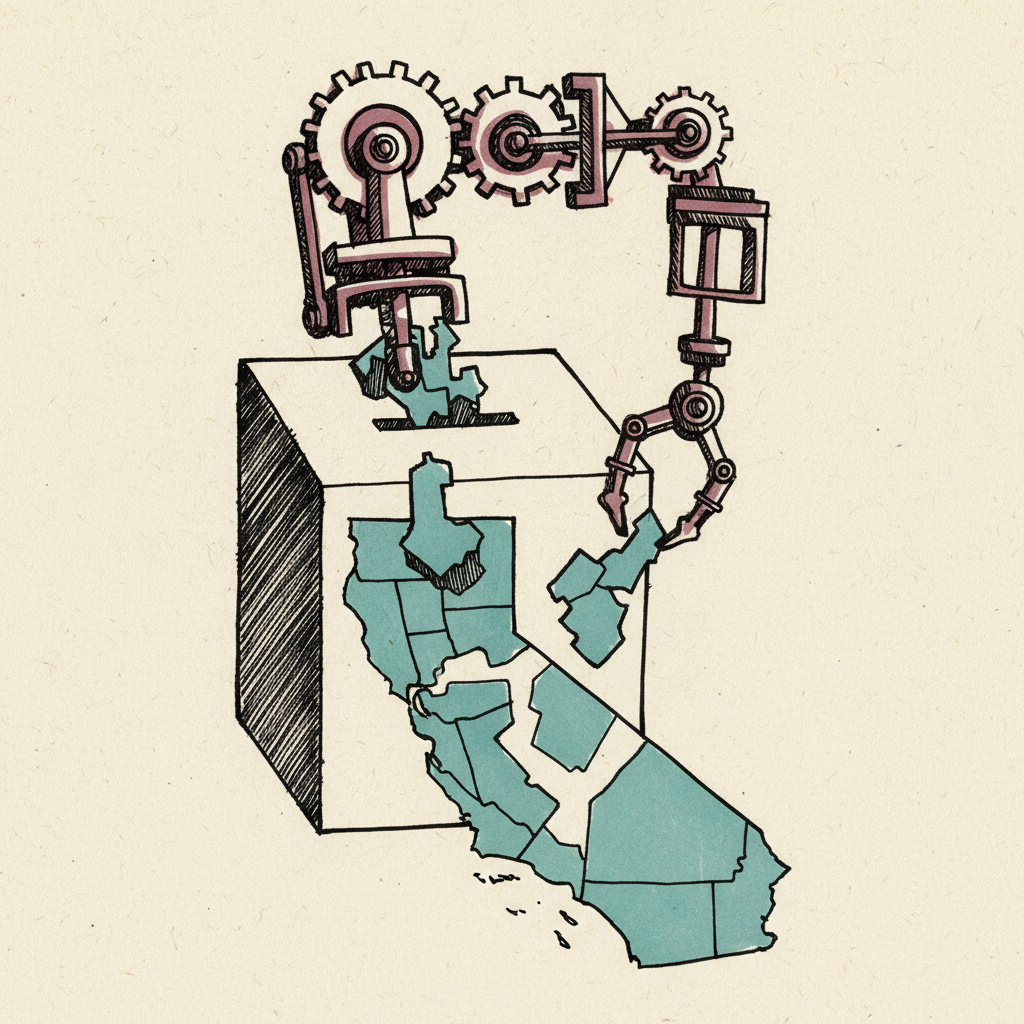
Proposition 50
California's 2025 constitutional amendment requiring legislature-drawn congressional maps through 2030, answering Texas.
Proposition 50's map faces its first House election on 3 November 2026 as Democrats' only surviving redistricting gain of the cycle; on 24 September California's Supreme Court ordered a sheriff to return 650,000 ballots seized from the vote that adopted it.
Last refreshed: 1 October 2026 · Appears in 1 active topic
Did California Democrats gerrymander their own maps into a Supreme Court racial gerrymandering trap?
Timeline for Proposition 50
Supplied the seized ballots
US Midterms 2026: Bianco must hand back 650,000 ballotsEvery Democratic redistricting track but California's is closed
US Midterms 2026Background
Proposition 50 is a California constitutional amendment, placed on the ballot by the Legislature and approved by voters in a special election on 4 November 2025 with about 64% of the vote. It requires the congressional maps the Legislature passed in August 2025 to be used through 2030, presented as a response to Texas's mid-decade partisan redistricting. The Citizens Redistricting Commission, which voters created to draw the maps, resumes the job after the 2030 census.
The measure has survived two kinds of challenge. In Tangipa v. Newsom, Republicans argued the map is a racial gerrymander; a three-judge federal court refused an injunction in January 2026 and the US Supreme Court declined to intervene in February.
The vote itself also came under attack. Riverside County Sheriff Chad Bianco seized about 650,000 ballots from the special election under a February 2026 warrant. On 24 September California's Supreme Court ruled 7-0 that the seizure was unlawful and ordered the ballots returned.
California's map is the Democrats' lone gain
When Texas redrew its congressional map mid-decade, Democrats tried several routes to answer it. By 19 May 2026 every one of those tracks had closed except Proposition 50. Courts, state legislatures and referendum rules stopped efforts elsewhere, from Virginia to Colorado, while California's measure had already passed and survived its first federal challenge.
That makes the measure the whole of the Democratic counter-move for 2026. Its maps, drawn by the Legislature in August 2025, govern California's House races in November, and the seats they shift are the only redistricting offset Democrats carry into an election where Republican redraws elsewhere moved a larger number of seats.
What did California Proposition 50 do to redistricting?
What happened to the California redistricting commission under Proposition 50?
Is Proposition 50's California redistricting map being challenged in court?
Did Proposition 50 pass?
Why did the California Supreme Court order the Riverside sheriff to return Proposition 50 ballots?





Written with AI from Lowdown's published reporting. Not individually reviewed by an editor. Updated 1 October 2026. Editorial standards.