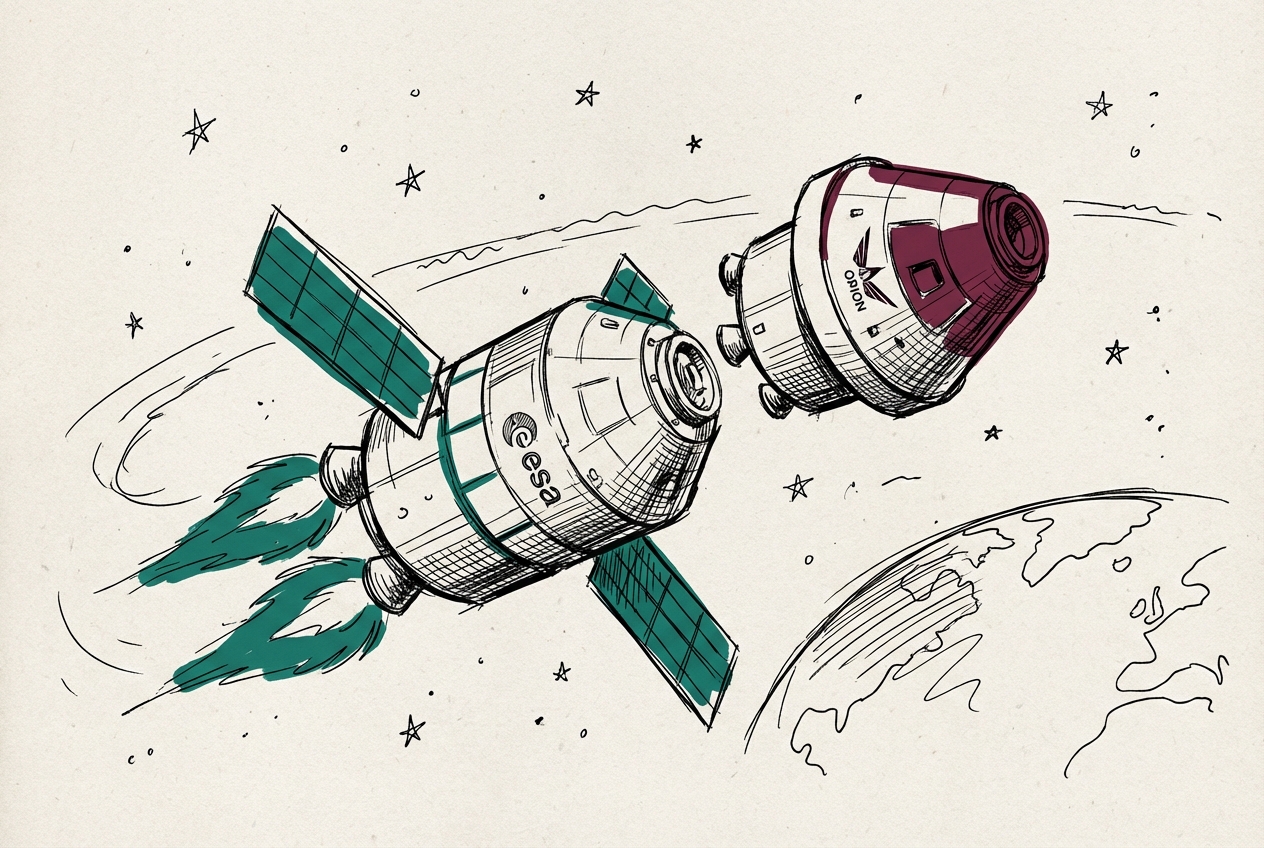
European Service Module
ESA-built propulsion module for Orion; valve leak ran 10x ground predictions on Artemis II.
On 16 April, the European Service Module's pressurisation valves remained among five unresolved Orion items, while ESM-3 awaited public confirmation of its hardware baseline.
Last refreshed: 22 September 2026 · Appears in 1 active topic
Does ESM-3 fix the valve that leaked ten times worse than expected on Artemis II?
Timeline for European Service Module
Mentioned in: Artemis III capsule powered up at KSC
Artemis II Moon MissionMentioned in: Five open Orion items, no fix dates
Artemis II Moon MissionMentioned in: ESA press release skips valve anomaly
Artemis II Moon MissionDestroyed on re-entry with no public performance statement from manufacturer or programme
Artemis II Moon Mission: ESA routes ESM review to June CouncilCompleted initial power-up and joined crew module adapter at KSC
Artemis II Moon Mission: Camarda 5% estimate still hangs over NASABackground
The European Service Module is ESA's propulsion, power, thermal-control and life-support unit for NASA's Orion spacecraft. It is the service element that enables Orion to undertake crewed lunar missions, rather than a detachable auxiliary payload. ESA identified ESM-2 as an Airbus-built module assembled in Bremen with components from 13 member states.
Its propulsion system combines a 24-kilonewton main engine derived from the Space Shuttle Orbital Manoeuvring System with auxiliary and attitude-control thrusters. The design gives Europe a direct industrial and operational role in Orion missions. The module's ability to supply propulsion, electrical power and life-support support makes it a core dependency for the wider Artemis programme.
The valve baseline remains unresolved
On 10 April, POST-mission analysis found a valve on the module's oxygen manifold leaking at ten times the ground-test prediction. Artemis II remained SAFE because its propulsion system could operate in blowdown mode, but that workaround cannot support a full lunar-orbit mission.
By 16 April, the pressurisation valves were one of five open Orion items without public fix dates. ESM-3 had already reached Kennedy Space Center before the anomaly became public, leaving its valve configuration and any needed rework unconfirmed. For the European Service Module, the issue is now whether its next flight unit can clear a hardware question exposed by its predecessor.