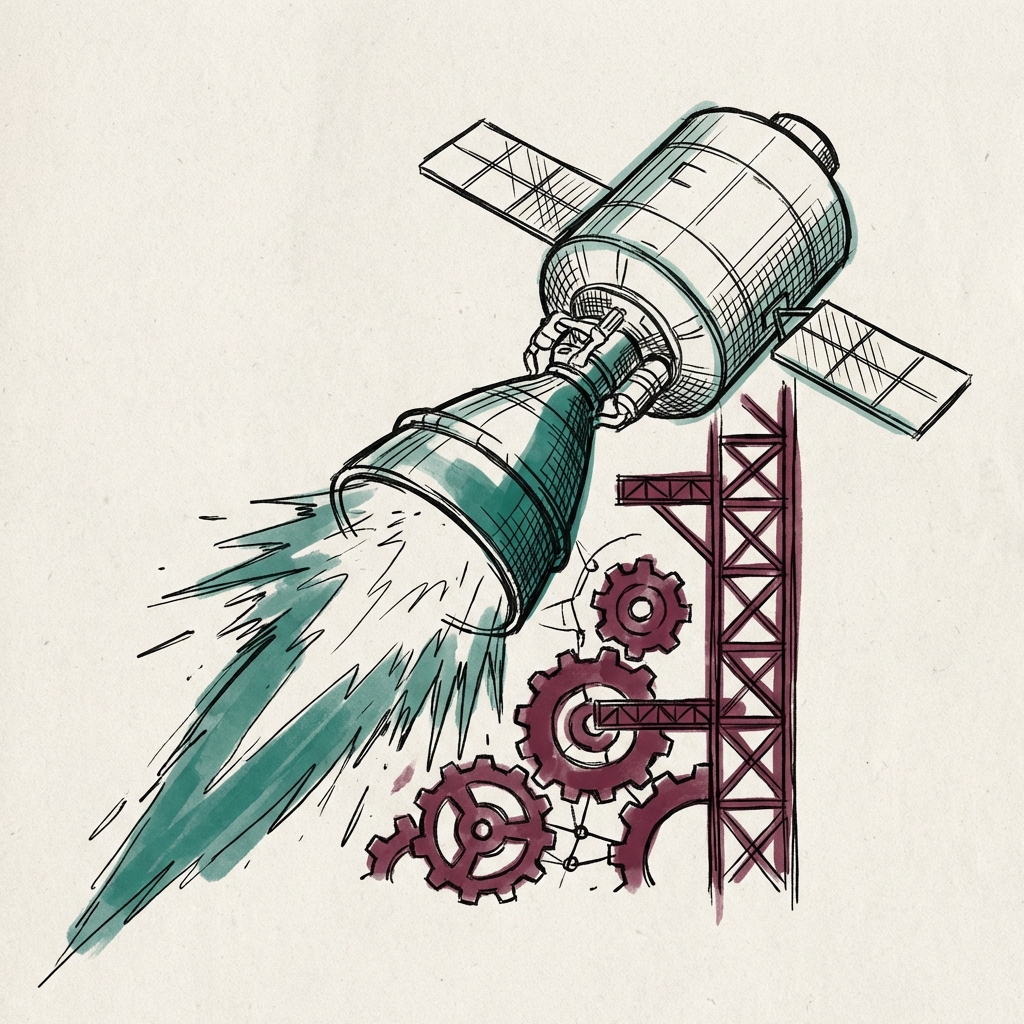
OMS-E
Shuttle-Heritage hypergolic engine powering Orion's European Service Module.
Last refreshed: 4 April 2026 · Appears in 1 active topic
Why is a 1970s Shuttle engine powering NASA's Moon missions today?
Timeline for OMS-E
First crew home from Moon since 1972
Artemis II Moon MissionThird Burn Breaks Orion's Navigation Streak
Artemis II Moon MissionSecond Correction Burn Scrubbed; Navigation Precision Holds
Artemis II Moon MissionOrion skips burn; trajectory is precise
Artemis II Moon MissionMentioned in: Shuttle Engine Fires Four Astronauts Toward the Moon
Artemis II Moon MissionBackground
The Orbital Manoeuvring System Engine (OMS-E) is a hypergolic rocket engine inherited from the Space Shuttle programme, now integrated into the European Service Module (ESM) that propels the Orion spacecraft on Artemis missions. It burns a mixture of monomethyl hydrazine and nitrogen tetroxide, producing approximately 26.7 kN of thrust, and is used for major orbital manoeuvres including translunar injection and lunar orbit insertion and departure.
The OMS-E was carried over into Artemis because of its proven reliability across 135 Shuttle missions. The engine was refurbished and integrated by ESA and Airbus for the ESM, bridging Shuttle-era hardware with a new generation of deep-space exploration architecture. On Artemis II, the OMS-E is responsible for the burns that shape the free-return trajectory, though Orion's precise navigation allowed the first scheduled correction burn to be skipped.
Relying on heritage Shuttle hardware for a crewed lunar mission represents both a pragmatic cost decision and a dependency on ageing infrastructure. The OMS-E supply chain is finite: only a limited number of flightworthy units remain, and the engine will eventually need a successor for sustained Artemis operations beyond the first few missions.