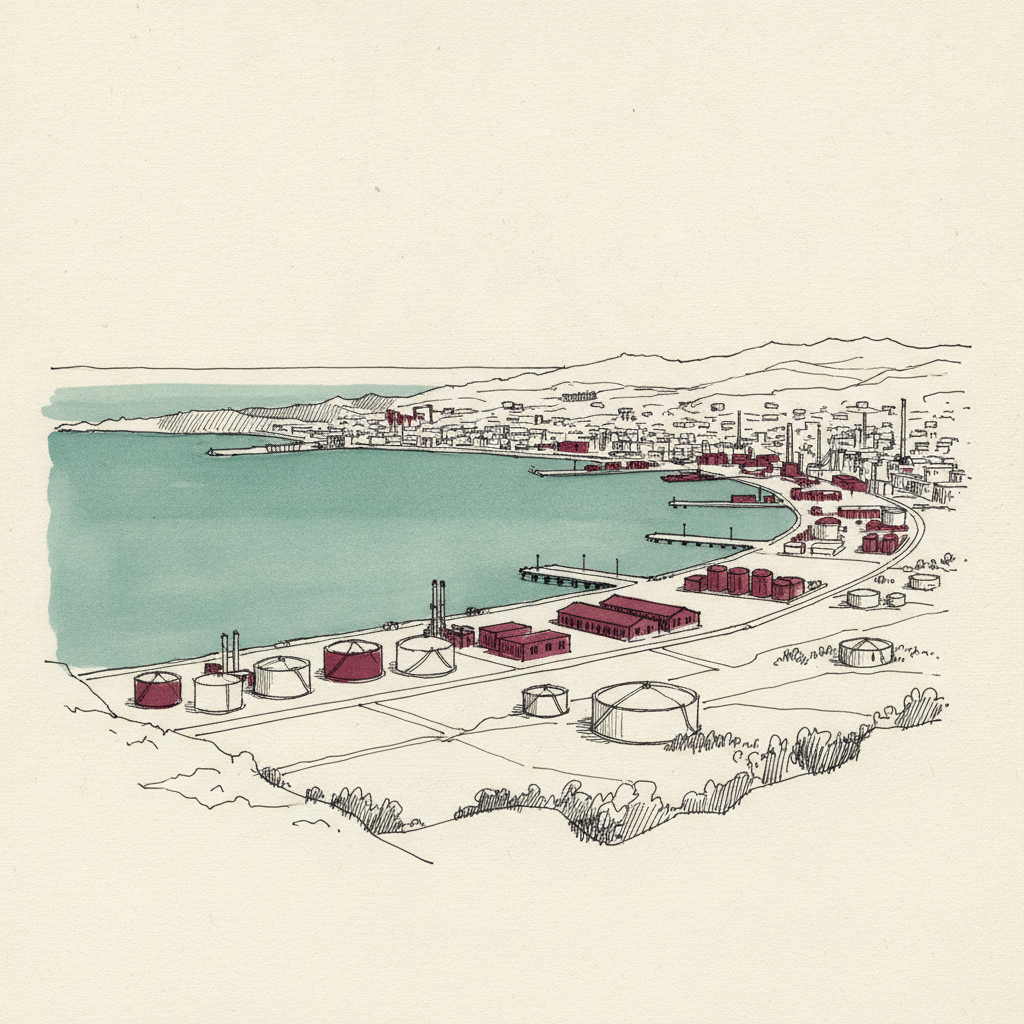
Augusta
Sicilian refining and port hub, one of the Mediterranean backfill points squeezed by tightening Fujairah stocks and Suez-route freight costs.
Augusta, the Sicilian refining port that backfills light distillates via Suez, faces tighter supply after Fujairah's light-ends stocks collapsed 37% to a record 1.121 million barrels in The Week to 20 July.
Last refreshed: 3 August 2026 · Appears in 1 active topic
Why is a Sicilian refining town feeling the effects of a Gulf storage-tank shortage?
Timeline for Augusta
Mentioned in: Med diesel crack assessed at $91.67
European Oil MarketsMentioned in: Fujairah light ends hit record low
European Oil MarketsBackground
Augusta is a refining and port hub on Sicily's eastern coast, handling crude imports and product exports for the wider Mediterranean refining chain. Unlike the Amsterdam-Rotterdam-Antwerp cluster that anchors north-west European pricing, Augusta and its Mediterranean peers such as Sines and Trieste depend on Suez-routed cargoes to backfill light-distillate shortfalls rather than on a comparable regional storage buffer of their own.
That dependency makes Augusta structurally more exposed than northern hubs whenever Gulf re-export points such as Fujairah run short of spare product or Suez-linked freight rates rise, because there is no quick local alternative to draw on. The hub's throughput and export flows are consequently read by traders as a barometer of Mediterranean, rather than north-west European, product tightness.
Augusta's significance lies in that structural exposure: it is one of a small group of Mediterranean hubs whose backfill dependency turns Gulf storage disruption into a European price signal, even when no disruption originates at Augusta itself.
Augusta's backfill route is tightening
Augusta relies on Suez-routed cargoes to backfill Mediterranean light-distillate shortfalls, a route that grew harder to lean on in The Week to 20 July, when Fujairah's light-ends stocks collapsed 37% to a record 1.121 million barrels and total product stocks fell 16% to an eight-week low of 8.492 million barrels.
For a Sicilian hub with no equivalent of the ARA cluster's northern storage buffer, that drawdown at The Gulf's main re-export point narrows the margin for error on every cargo Augusta still needs from further east, a different exposure to the squeeze playing out at Rotterdam and Antwerp.
Augusta trades at a wider premium
Argus assessed the West Mediterranean diesel crack at $91.67 a barrel on 30 July, having peaked near $95 the day before, against an $85.86 reading for the Amsterdam-Rotterdam-Antwerp hub the same day, a $33.50-a-tonne premium.
For Augusta, sitting on the Mediterranean side of that gap, the premium reflects the extra cost of the Suez-routed backfill cargoes the hub depends on rather than any shortfall in its own refining runs; the wider that premium grows, the more Augusta's economics turn on freight cost rather than crude cost.
Reference
Why does Suez freight cost matter to Augusta?
What is Augusta's role in Mediterranean oil markets?
Where is the Augusta refinery located?
How is Augusta connected to Fujairah stock levels?
Why is Augusta affected by the Fujairah stock drawdown?
Written with AI from Lowdown's published reporting. Not individually reviewed by an editor. Updated 3 August 2026. Editorial standards.