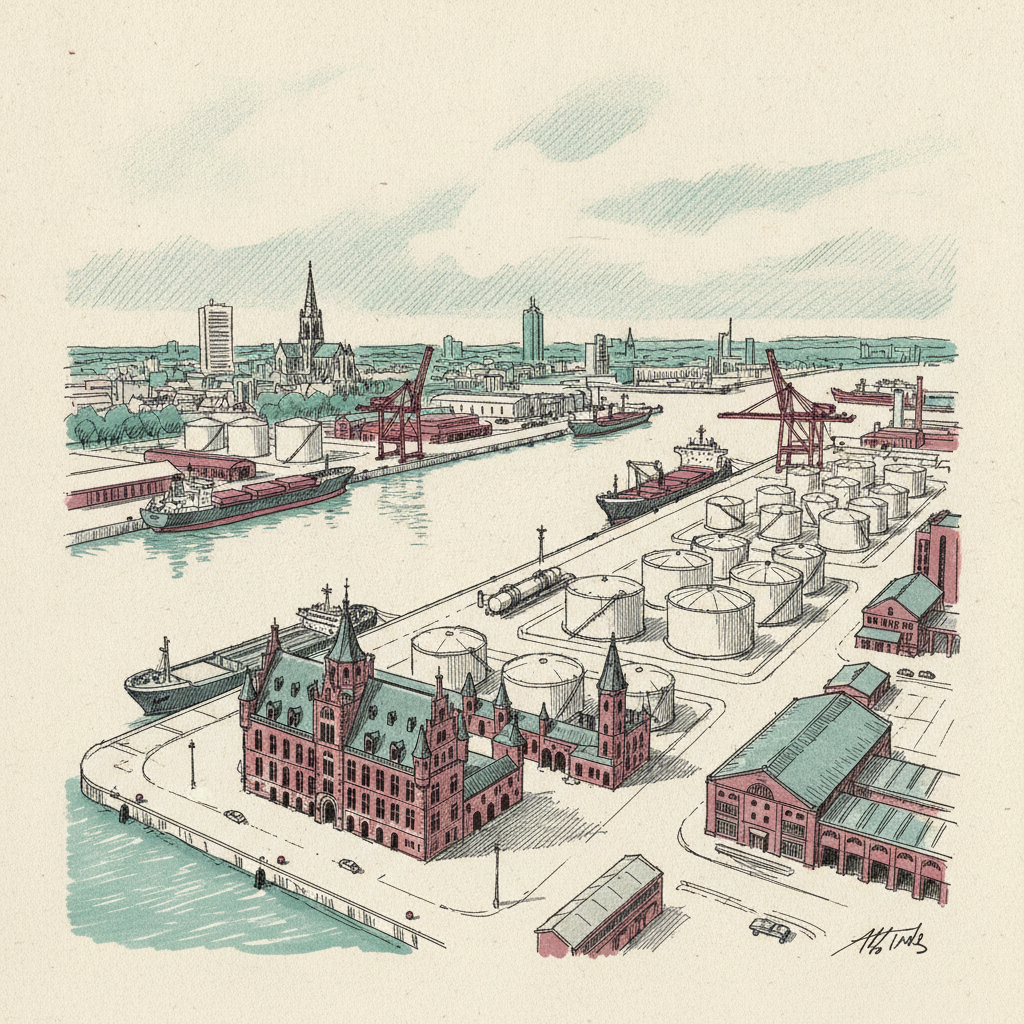
Antwerp
Major Belgian port and the 'A' in the ARA oil-products benchmark cluster.
Antwerp anchors the ARA hub whose gasoil imports halved to 84,000 barrels a day in the fortnight to 15 July, from June's 188,000, leaving hub stocks at a 2.5-year low of 13.48 million barrels.
Last refreshed: 3 August 2026 · Appears in 1 active topic
How exposed is European refining to further labour disputes across the ARA hub after Antwerp?
Timeline for Antwerp
Mentioned in: $4.17m to test Zaire vaccine antibodies
Pandemics and BiosecurityMentioned in: Med diesel crack assessed at $91.67
European Oil MarketsMentioned in: ARA gasoil imports halve as stocks hit a fresh low
European Oil MarketsMentioned in: Russia's diesel ban sets a record crack
European Oil MarketsMentioned in: Diesel cracks hold as crude sells off
European Oil MarketsBackground
Antwerp is Belgium's largest port and one of Europe's largest by total cargo volume, forming the 'A' in the Amsterdam-Rotterdam-Antwerp (ARA) cluster that serves as the benchmark pricing zone for European gasoline, diesel and fuel oil. The city hosts major refining capacity operated by ExxonMobil, among the largest single processing sites in North-West Europe, feeding both the domestic Belgian market and wider regional export flows.
As a primary delivery point for crude oil and refined products, Antwerp's throughput and storage levels are watched closely by traders assessing north-west European margin benchmarks; disruption at its refineries or terminals tends to Ripple through fuel prices across Belgium, the Netherlands, Germany and beyond. The port's Labour relations, particularly at its largest refinery, have periodically become a flashpoint that traders track as a source of supply risk.
Antwerp's significance rests less on any single event than on its structural role: it is one of only three ports whose combined activity sets the reference price for refined products across the whole of North-West Europe, giving even localised industrial action at Antwerp outsized market visibility.
Antwerp's hub stocks keep draining
Antwerp's throughput sits inside the wider Amsterdam-Rotterdam-Antwerp storage complex, so a fortnight in which the hub's gasoil imports halved to 84,000 barrels a day, down from June's 188,000, registers directly against Antwerp's own tank capacity. Independent stocks across the complex fell to a 2.5-year low of 13.48 million barrels by mid-July, the tightest cushion the port has carried in years.
Europe has been replacing lost Russian volumes with cargoes shipped the long way from Saudi Arabia via Suez; when that route slows, Antwerp has no quick local backup to refill its own tanks, a different exposure to the pricing-benchmark role Rotterdam and Amsterdam play in the same cluster.
Antwerp sets Europe's diesel floor
On 30 July, Argus assessed the combined Amsterdam-Rotterdam-Antwerp diesel crack at $85.86 a barrel, more than $5 below the West Mediterranean assessment of $91.67 the same day. Antwerp's ExxonMobil refinery is the largest single processing point inside that ARA figure, so its own margin tracks the north-west European side of a widening Mediterranean premium rather than the Mediterranean number itself.
The $33.50-a-tonne gap between the two basins matters for Antwerp specifically because it measures how much cheaper the port's refined products are running against southern Europe, a spread that widens the incentive to move product south rather than process more of it locally.
What is the ARA hub in oil markets?
Why does Antwerp matter for European oil prices?
Is there a refinery in Antwerp?
What happened at the Antwerp refinery in June 2026?
