Skip to content
Briefings are running a touch slower this week while we rebuild the foundations.See roadmap
US Midterms 2026
28APR

SAVE Act Stalls as Thune Refuses Nuclear Option

2 min read
16:18UTC

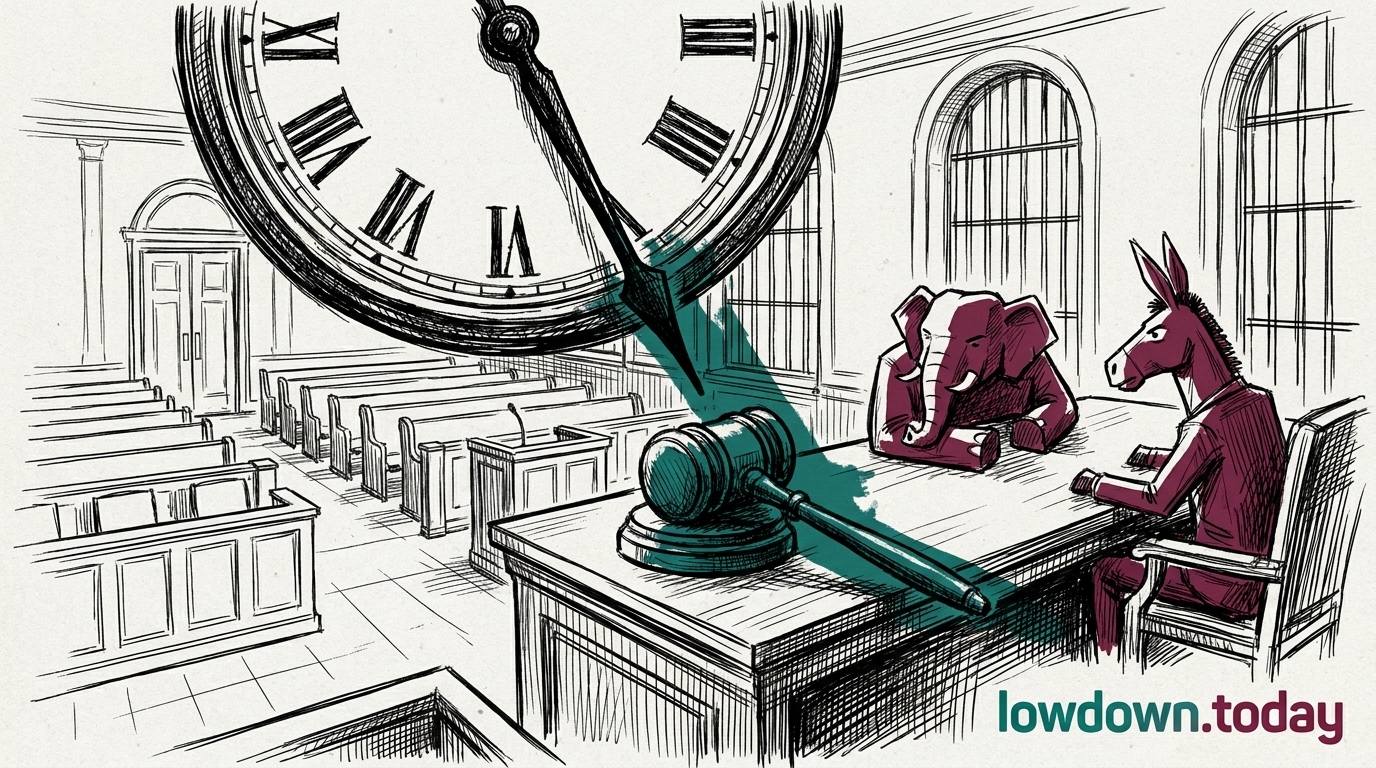
Senate Republicans have abandoned any genuine attempt to pass the SAVE Act. The strategy has shifted to a performative marathon floor debate designed to display Democratic opposition rather than achieve cloture.

PoliticsDeveloping
Key takeaway

The SAVE Act cannot pass the Senate, leaving the blocked executive order as the only remaining vehicle.

Senate Majority Leader John Thune has explicitly refused the nuclear option to pass the SAVE Act (Safeguard American Voter Eligibility Act), citing insufficient votes within his own conference 1. The strategy has shifted to a "marathon floor debate": a performative takeover designed to display Democratic opposition rather than achieve cloture .

The filibuster holds. Republicans have 53 seats; they need 60. Senator Lisa Murkowski (Republican, Alaska) has already voted against proceeding. The Federalist reports other GOP senators calling for filibuster elimination, but Thune's refusal makes that a dead letter for this bill.

The pivot confirms what The earlier briefing flagged as likely: the EO is now the sole vehicle for citizenship verification requirements. With most of the EO enjoined and the legislative route dead, the administration's electoral infrastructure agenda rests on federal litigation demanding voter rolls from nearly every state and a voter screening system that flags one in six records incorrectly. The constitutional stakes are elevated precisely because the normal legislative path has failed; executive action is substituting for legislation that could not command a majority even among Republican senators.

Deep Analysis

In plain English

The United States Senate requires 60 votes to end debate and move to a final vote on most legislation. This is called cloture. Republicans control only 53 seats, meaning they need at least 7 Democrats to join them , and Democrats are unanimously opposed to the SAVE Act, which would require documentary proof of citizenship to register to vote in federal elections. Senate Majority Leader John Thune could have tried to change the rules to allow the SAVE Act to pass with only 51 votes (eliminating the filibuster for this legislation), but he publicly refused. He cited insufficient support within his own Republican conference , including Senator Lisa Murkowski of Alaska, who voted against even beginning debate on the bill. Instead, Republicans plan a long floor debate to demonstrate that Democrats are blocking the bill. The bill will not become law, but the public opposition can be used in campaign advertising.

Deep Analysis
Root Causes

The SAVE Act's legislative failure rests on the 60-vote cloture threshold and the Republican caucus's internal disagreement on filibuster elimination.

Murkowski's opposition is structural: she represents a state with significant indigenous Alaskan communities for whom documentary proof of citizenship creates disproportionate registration barriers (birth certificates are often unavailable for older Alaska Native individuals). She has consistently opposed legislation that creates registration barriers, making her vote predictable regardless of the broader political context.

Thune's refusal of the nuclear option reflects a calculation about caucus management: if he attempts filibuster elimination and fails (because even one additional Republican beyond Murkowski defects), he exposes the limits of Republican Senate discipline and creates a template for future defections on other priorities. The cost of failure exceeds the cost of not trying.

What could happen next?
  • Consequence

    With the SAVE Act dead legislatively and seven EO provisions blocked by courts, the administration's entire citizenship verification agenda now rests on the DOJ voter data litigation and the SAVE system's 17% error rate , both operating without statutory authority or legislative mandate.

  • Opportunity

    The performative floor debate creates extended opposition party contrast footage for Republican campaign advertising , particularly in districts where Democratic senators are in competitive races in 2026.

First Reported In

Update #2 · First votes exceed every forecast

The Hill· 12 Apr 2026
Read original
Different Perspectives
EU trade and sanctions policy analysts
EU observers are tracking whether a larger Republican House majority after November 2026 reduces domestic pressure on the White House to negotiate tariff relief. Redistricting-locked Republican committee majorities have historically resisted rollbacks framed as concessions; a Democratic House flip, if the wave overcomes the maps, would restore committee leverage on Financial Services and Ways and Means.
Canadian USMCA trade watchers
Canadian trade observers track House committee composition because the Ways and Means Committee processes USMCA tariff schedules. A net Republican redistricting gain of 12-15 seats would consolidate Republican committee chairs through 2028, reducing bipartisan leverage on the 2026 USMCA review window Canada's government has flagged as a priority.
V-Dem Institute and Chatham House
V-Dem's Anna Grzymala-Busse assessed Callais as completing a 13-year constitutional rollback: Shelby County removed preclearance, Brnovich narrowed vote-denial claims, Callais retires the affirmative duty, leaving the VRA practically inoperative in states where all three mechanisms operated together. Chatham House analysts are logging the judgment-forthwith mechanism as a qualitative escalation in procedural acceleration.
Democratic opposition and civil rights plaintiffs
House Minority Leader Hakeem Jeffries named New York, Illinois, and Maryland as retaliation targets; the structural problem is that New York requires court action or a constitutional referendum, neither compatible with November 2026. Brennan Center plaintiffs whose Callais forthwith application was rejected around 6-7 May now face a Court that has already declined to stay its own order.
WSJ editorial board: conservative backfire warning
The WSJ editorial board warned that aggressive Republican redistricting in a D+5.9 generic-ballot environment risks backfiring: maps that eliminate competitive districts can energise the opposing base beyond what the drawn-in margins absorb. The warning is the cross-ideological dissent the broader conservative consensus on Callais is not publicly engaging.
Trump administration and Republican state executives
The White House signed zero election-related executive orders between 28 April and 7 May; presidential influence ran through the Supreme Court majority, the DOJ voter-data litigation, and Article III confirmations. DeSantis, Lee, and Reeves called redistricting sessions within 24 hours of Callais, each acting on executive timetables requiring no referendum or bipartisan agreement.
