Skip to content
Welcome, thoughtbot's Giant Robots listeners!Start here
US Midterms 2026
27OCT

DSCC borrows $15m from Amalgamated Bank

2 min read
13:20UTC

The Democratic Senatorial Campaign Committee drew $15m on 5 October from a $25m Amalgamated Bank credit line opened in July, its pre-general report to the FEC shows.

PoliticsAssessed
Key takeaway

Both Senate party committees now carry bank debt; net of it, Lowdown's arithmetic puts Democrats narrowly ahead.

The Democratic Senatorial Campaign Committee (DSCC) drew $15m on 5 October from a $25m line of credit with Amalgamated Bank of New York, its pre-general report to the FEC (Federal Election Commission) shows⁠1. The DSCC is the party committee that works to elect Democrats to the Senate. Its report, filed on 22 October, covers 1 to 14 October and is the last scheduled one before polling day on 3 November.

The line, opened on 24 July, runs to June 2028 and is secured on the committee's current and future assets. The DSCC's September report showed no debt; it ended 14 October with $20.67m in cash and $15m owed, leaving $10m of the line undrawn. Party committees often borrow late against pledges they expect to collect. The Democratic National Committee carried $15m from a 2025 loan at its last report.

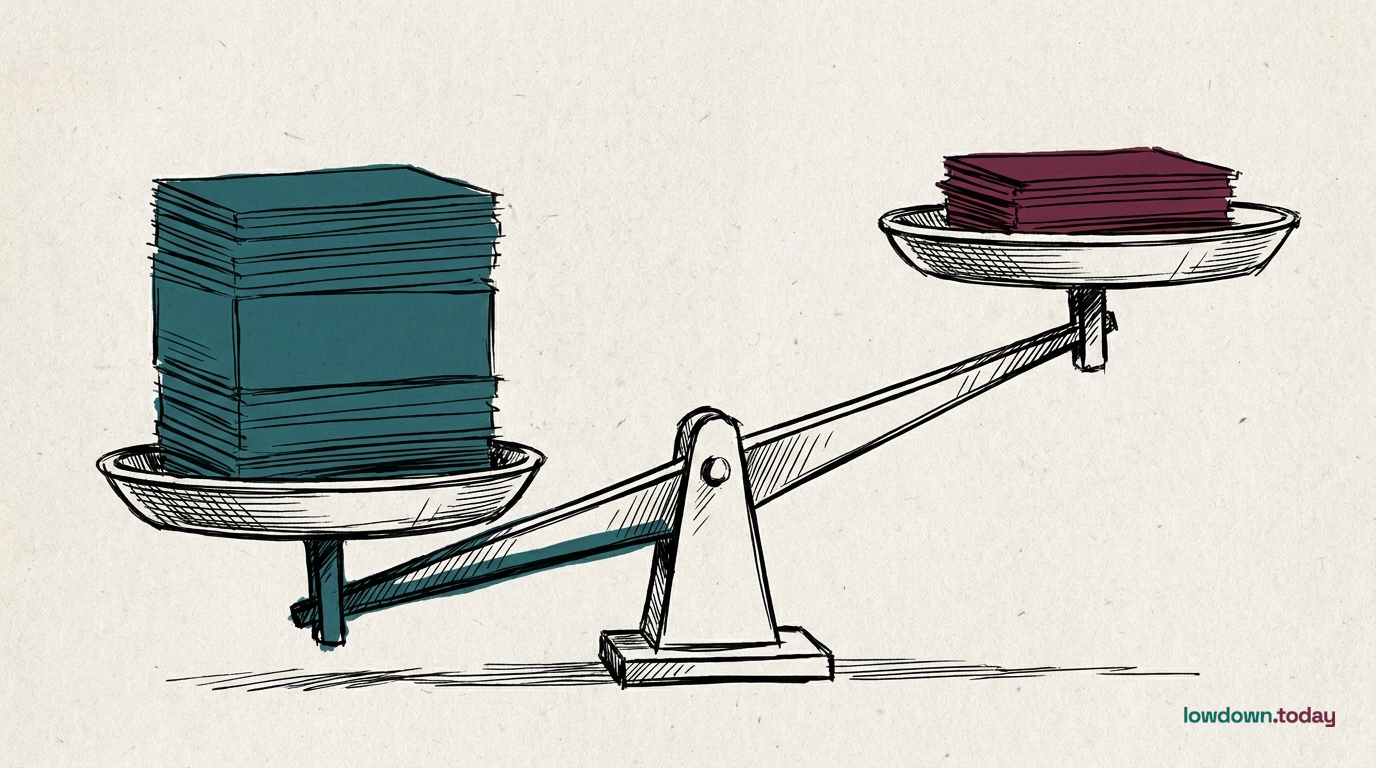
Both Senate party committees now carry bank debt. The National Republican Senatorial Committee (NRSC), the DSCC's Republican rival, took $20m from Chain Bridge Bank in September and still owes all of it⁠2. Set each committee's cash against its debt, on Lowdown's arithmetic, and the Democrats lead by a whisker: $5.67m to $5.20m. Neither committee has much left that it does not already owe, so the money still to be spent in the last week sits mostly with the super PACs.


Deep Analysis

In plain English

Each party has a committee whose job is to win Senate seats. The Democrats' is the Democratic Senatorial Campaign Committee (DSCC); the Republicans' is the National Republican Senatorial Committee (NRSC). Both must report their money to the Federal Election Commission (FEC), the US regulator for campaign funding. The DSCC's latest report shows it borrowed $15m from a New York bank in early October. Borrowing lets a committee spend money now that it expects to raise later. The Republican committee borrowed $20m in September, so both sides are now running partly on loans in the last weeks before the 3 November vote.

Deep Analysis
Root Causes

Party committees face contribution limits that super PACs do not, so their cash arrives in many small and medium cheques spread across the cycle. A credit line lets a committee spend that expected money in October, when airtime matters most, rather than in the months it actually arrives.

the Supreme Court's June ruling freed party spending alongside candidates from its old limits. That raised the value of a party dollar in the final weeks, and with it the case for borrowing to have more of them on hand.

What could happen next?
  • Risk

    The DSCC still has $10m of its $25m line undrawn, which it could draw before 3 November without any report showing it until December.

  • Consequence

    Whichever Senate committee loses on 3 November will begin the 2028 cycle repaying a bank loan from post-election donations.

First Reported In

Update #22 · Senate Democrats borrow $15m, outspend GOP

Federal Election Commission· 27 Oct 2026
Read original →
Different Perspectives
Department of Justice (DOJ)
DOJ appealed to the 9th Circuit after Judge David O. Carter did not rule by a noon deadline on 22 October that DOJ itself had set, seeking to have California set aside mail ballots from more than 20,000 listed voters. Its case is that ineligible votes cancel lawful ones; the panel dismissed the appeal 2-1 on 26 October.
Lower Costs Now
Lower Costs Now
Lower Costs Now reported $7.37m in Kansas on 24 and 25 October, part of $65.65m in Senate races since its first independent expenditure on 1 October, including $17.21m for Josh Turek in Iowa. Its FEC filings show $50.18m raised by 14 October.
MAGA Inc
MAGA Inc
MAGA Inc, the super PAC aligned with Donald Trump, filed $7.20m against James Talarico on 22 October, taking its Texas spending to $37.65m. Of that, $30.12m is against Talarico and $7.53m is for Ken Paxton, the Republican nominee.
Senate Majority PAC (SMP)
SMP's pre-general report shows it spent $108.70m from 1 to 14 October, including $65.0m to WinSenate and $10.0m to Texas Forever, and ended with $32.72m. Texas Forever has reported $19.40m against Ken Paxton since 1 October.
Senate Leadership Fund (SLF)
SLF's pre-general report shows $88.42m in cash on 14 October and $18.98m raised in the fortnight, none of it from Elon Musk. It has since reported $12.07m against Sherrod Brown in Ohio, and its $2.7m to Plains PAC preceded that committee's first Kansas buy on 25 October.
National Republican Senatorial Committee (NRSC)
The NRSC's pre-general report shows nothing spent with Ashley Hinson in Iowa, or with its nominees in six other states, from 1 to 14 October, after $5.54m with Hinson in September. It took no new loan and ended the fortnight with $25.20m in cash and $20m of debt.

Written with AI from Lowdown's published reporting. Not individually reviewed by an editor. Editorial standards.