Skip to content
You can now search across every topic, entity and event.What's new
US Midterms 2026
7SEP

SC sets special primary for 11 August

2 min read
13:32UTC

South Carolina's election commission set filing for 21-28 July and a special primary for 11 August. Lowdown's own arithmetic puts the federal overseas-ballot deadline for that primary two weeks before Graham died.

PoliticsDeveloping
Key takeaway

Filing opens 21 July for an 11 August primary whose federal ballot deadline, by our count, passed on 27 June.

The South Carolina State Election Commission set the calendar to fill the Republican nomination on Monday 13 July: candidate filing from 21 July to 28 July, a special primary on 11 August, a runoff on 25 August if needed, and the general election on 3 November 1. State law counts each of those dates forward from the date of death, under S.C. Code Section 7-11-55.

Work the federal deadline backwards and the calendar meets itself coming the other way. UOCAVA, the Uniformed and Overseas Citizens Absentee Voting Act, requires ballots to reach military and overseas voters 45 days before a federal election. Forty-five days before 11 August falls on 27 June, a fortnight before Graham died. For the 25 August runoff it falls on 11 July, the day he died. This calculation is Lowdown's own; no official or outlet has published it, and we attribute it to nobody else.

What that produces reads as a defect in the statutes' design rather than an act of bad faith. Justice Department guidance confirms the 45-day rule reaches special and runoff federal elections with no blanket carve-out. But 52 U.S.C. Section 20302(g) lets a state ask the Secretary of Defense for an undue-hardship waiver, and we do not know whether South Carolina has sought or received one. Lowdown makes no claim that the state has broken federal law. No court or agency has answered the question.

Vacancy statutes and ballot-transmission statutes were written by different legislatures decades apart, one starting its count at a death and the other at an election. UOCAVA's interval came from the 2009 MOVE Act, whose drafters wrote a fixed 45 days and a hardship waiver but no procedure for an election whose triggering event lands inside the window. Any state whose replacement calendar runs forward from a death inherits the same trap the moment a member dies close enough to a primary.

One further wrinkle sits in who would enforce any of this. The Justice Department has spent the year suing states over their voter rolls and losing, most recently when its Michigan case was dismissed and the dismissal affirmed on appeal . It now holds a live compliance question against a state its own party governs.

Deep Analysis

In plain English

When Senator Graham died, South Carolina law set an automatic schedule to replace him: candidates file 21-28 July, a special primary follows on 11 August, a runoff on 25 August if nobody wins outright, and the general election lands on 3 November alongside everything else on the ballot. A separate federal rule normally requires overseas and military ballots to be mailed out 45 days before any election. Because Graham died so close to the primary date the state calendar produces, there was never enough time to hit that 45-day mark for either the primary or a possible runoff. Whether that becomes a real legal problem depends on whether the state asks for, and gets, a hardship exception from the Pentagon.

Deep Analysis
Root Causes

South Carolina's Sec. 7-11-55 sets a fixed sequence: filing opens the second Tuesday after a nominee's death, the primary follows two weeks after filing closes, and any runoff follows two weeks after that.

Working backward from Graham's 11 July death, this is Lowdown's own calculation, not an official finding: the federal UOCAVA rule requiring overseas and military ballots to go out 45 days before an election would have needed a transmission date of 27 June for the 11 August primary, two weeks before the vacancy even existed, and 11 July, the day Graham died, for a possible 25 August runoff.

The compliance problem is therefore built into the statute's own timetable, not a product of any official decision to rush the process. Whether it amounts to an actual violation of federal law depends on a hardship waiver under 52 U.S.C. Sec. 20302(g), which the Secretary of Defense can grant; no source reviewed confirms whether South Carolina has sought one.

What could happen next?
  • Risk

    A hardship waiver request to the Secretary of Defense under 52 U.S.C. Sec. 20302(g) has not been confirmed as filed or granted; without one, the special primary and any runoff proceed on a calendar that cannot structurally meet the 45-day overseas-ballot rule.

First Reported In

Update #13 · Graham's death strands the SAVE Act route

South Carolina State Election Commission· 17 Jul 2026
Read original
Different Perspectives
New Hampshire student voters
Students who hold no accepted photo ID under HB 323 cannot vote in the 8 September primary after Judge Laplante declined to block the law on timing grounds. Whether the same rule applies on 3 November is still open.
Alaska Democratic Party
The Alaska Democratic Party moved $884,835 in coordinated spending to Mary Peltola between 17 and 30 July, more than the DCCC spent nationally in the same fortnight.
National Republican Senatorial Committee
The NRSC, which sued to remove coordinated-spending caps in NRSC v. FEC, put $2,230,472 behind candidates in the first complete month after winning that case, more than double the total for the prior six months combined.
Supreme Court of Missouri
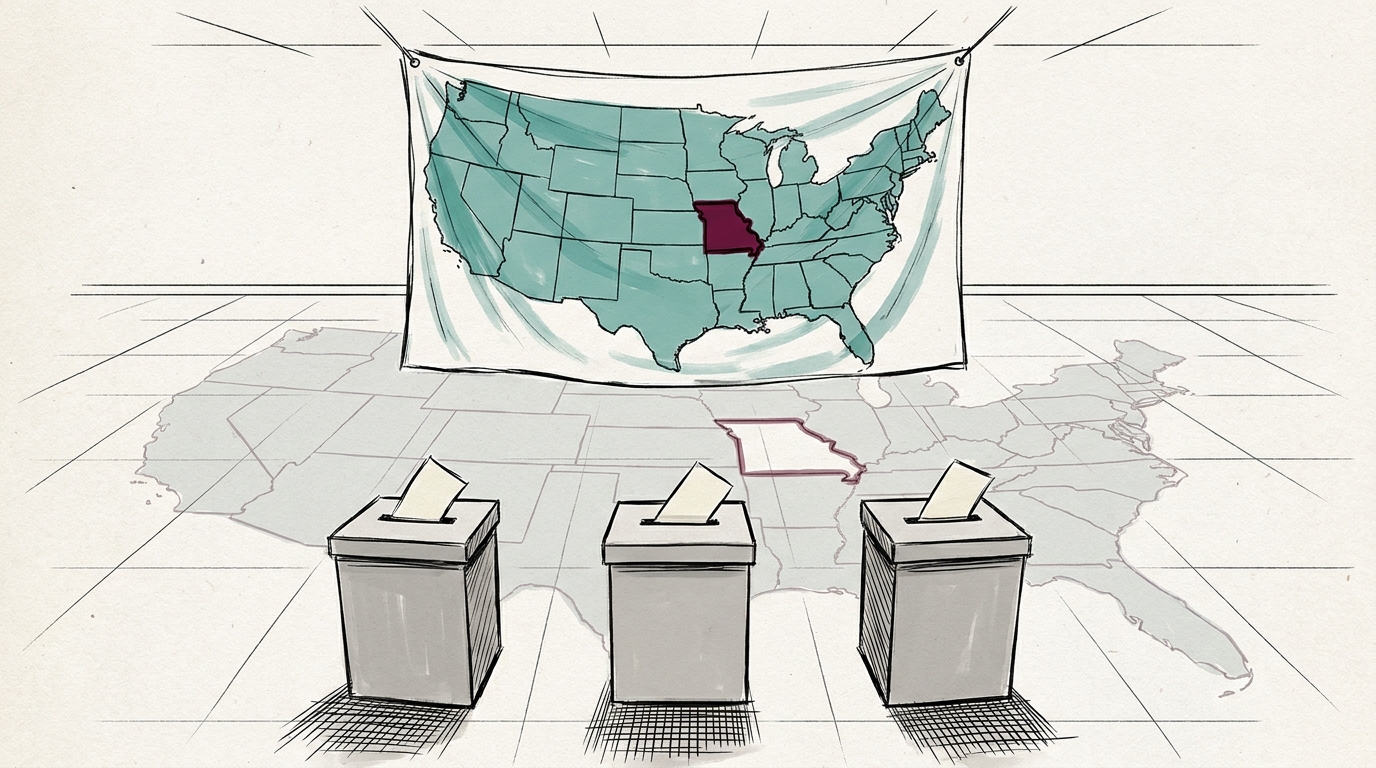
The unanimous court held that Article III, section 49 carries no redistricting exception, so a referendum petition against a congressional map is as valid as against any other law. It ordered the 2022 map to govern unless voters approve HB 1 on 3 November.
Denny Hoskins, Missouri Secretary of State
Hoskins told the Supreme Court that changing the congressional map after 1.2 million primary votes and ahead of the 19 September overseas-ballot deadline violates Purcell and the Elections Clause. He wants HB 1 reinstated before ballots print for November.
Senate Republican leadership
Floor time is finite at 51-47 with a bipartisan funding negotiation running, and a contested procedural fight over grant conditions is not the best use of it this month. Nothing has been abandoned; the resolution keeps its place on the calendar.
